AMD Radeon Vega 8 (Ryzen 2000/3000)

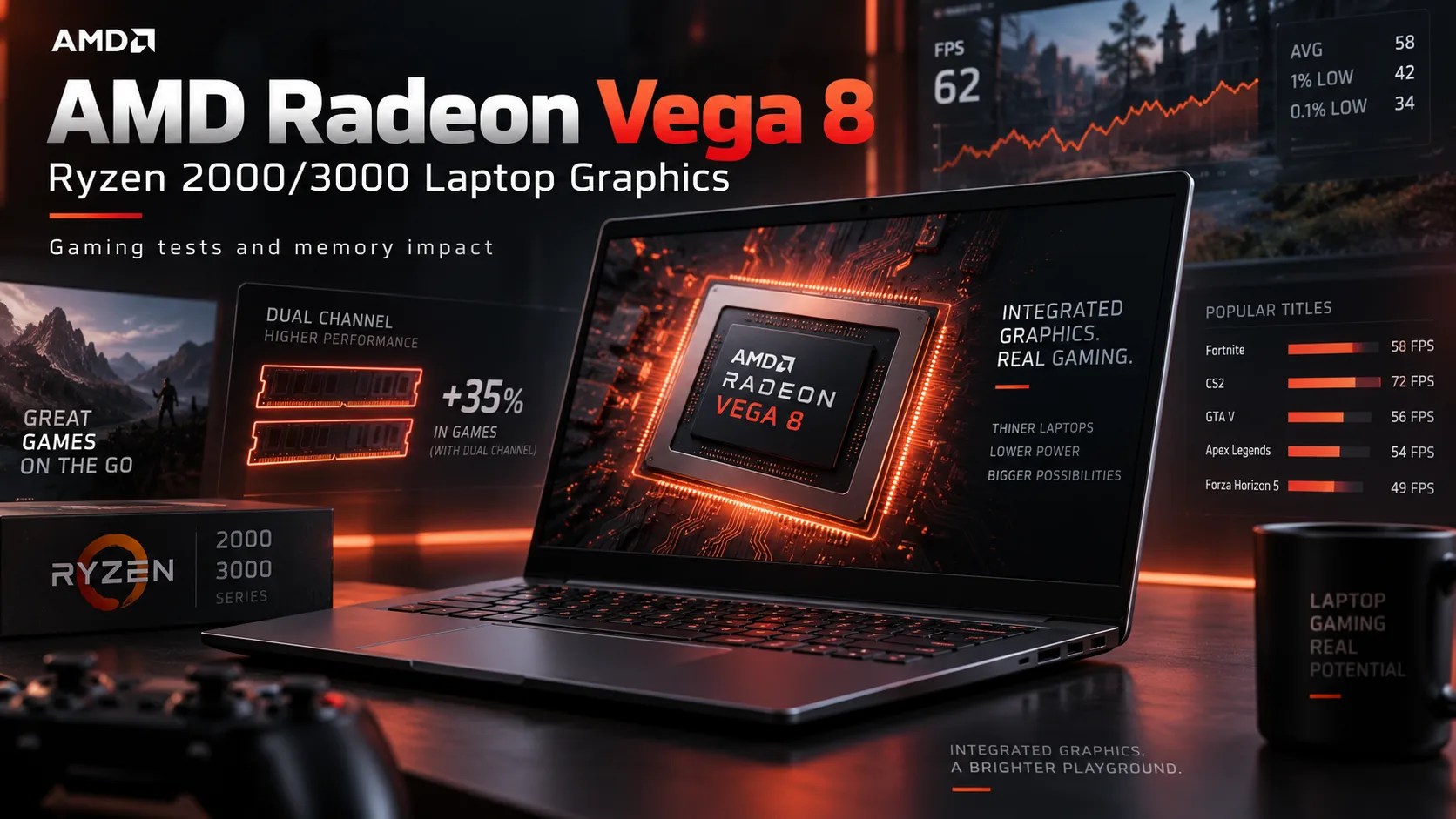
AMD Radeon Vega 8 (Ryzen 2000/3000): Gaming Tests and Differences Between Laptops
Radeon Vega 8 was featured in laptops with the Ryzen 5 2500U, Ryzen 5 3500U, and other mobile Ryzen 2000/3000 processors. Its performance varies widely: two laptops with Vega 8 can differ in performance by dozens of percent. The main reasons are memory, power limits, and cooling.
The graphics in the Ryzen 5 2500U runs at up to 1100 MHz, while the Ryzen 5 3500U reaches up to 1200 MHz. Vega 8 has no dedicated video memory-it uses system DDR4, so RAM bandwidth directly affects FPS.
Vega 8 Performance in Laptops
Radeon Vega 8 in laptops with Ryzen 2000/3000 processors typically scores around 670-700 points in 3DMark Time Spy Graphics.
| Laptop | Processor | RAM | 3DMark Time Spy Graphics |
|---|---|---|---|
| Lenovo ThinkPad A285 | Ryzen 5 PRO 2500U | 8 GB | 523 |
| HP ProBook 445 G6 | Ryzen 5 2500U | 8 GB | 556 |
| Lenovo ThinkPad T495 | Ryzen 5 PRO 3500U | 16 GB | 693 |
| HP ProBook 445 G6 Dual-Channel | Ryzen 5 2500U | 16 GB | 735 |
| Acer Swift 3 SF314-41 | Ryzen 5 3500U | 8 GB | 742 |
| Honor MagicBook 14 | Ryzen 5 3500U | 8 GB | 788 |
| Huawei MateBook 13 2020 AMD | Ryzen 5 3500U | 8 GB | 790 |
The difference between the lowest and highest results exceeds 50%.
The HP ProBook 445 G6 demonstrates how heavily Vega 8 depends on memory. The configuration with a Ryzen 5 2500U and 8 GB of RAM scored 556 points, while the 16 GB dual-channel version scored 735 points. The difference is about 32%.
For Vega 8, the memory configuration matters more than the difference between GPU clocks of 1100 and 1200 MHz.
Gaming Performance
Vega 8 can no longer handle modern demanding games at 1080p.
| Game | Resolution | FPS |
|---|---|---|
| Shadow of the Tomb Raider | 1080p | 10 |
| Cyberpunk 2077 | 1080p | 9.25 |
| Battlefield V | 1080p | 24.1 |
| GTA V | 1080p | 18 |
Cyberpunk 2077, at around 9 FPS in 1080p, is not playable at that performance level. Shadow of the Tomb Raider also requires lowering the resolution and graphics quality.
Less demanding games run significantly faster.
Dota 2 Reborn delivers around 70 FPS at low settings, 60 FPS at medium settings, and 38 FPS at high settings.
GTA V delivers around 55-60 FPS at low and medium settings, but FPS drops sharply as graphics quality increases.
The Witcher 3 delivers around 30-35 FPS at low settings. For higher FPS, it is worth switching to 900p or 720p.
Dota 2, League of Legends, Minecraft, and GTA V can still be played on Vega 8 at acceptable FPS. More demanding games require switching to 720p or 900p and lowering the graphics settings.
Vega 8 Compared with Other GPUs
| GPU | 3DMark Time Spy Graphics |
|---|---|
| Radeon RX Vega 7 | 1017 |
| Radeon RX Vega 6 (Ryzen 4000/5000) | 852 |
| Radeon Vega 8 (Ryzen 2000/3000) | 693 |
| Intel UHD Xe 32EU | 658 |
| GeForce MX130 | 645 |
Vega 8 trails the newer Vega 6 by around 23% and the Vega 7 by 47%, despite having a larger number of compute units.
The number of CUs cannot be used directly to compare different generations: architecture, clock speeds, memory, and power limits all affect the result.
Why Vega 8 Needs Dual-Channel Memory
Vega 8 has no dedicated video memory. It uses system DDR4 at the same time as the processor cores.
With a single RAM module, memory bandwidth is lower, and Vega 8 is particularly sensitive to this limitation.
When buying a laptop with Vega 8, it is worth checking not only the amount of RAM but also its operating mode. The most important thing is for the memory to operate in dual-channel mode.
Dual-channel operation is important for Vega 8 itself, while 16 GB is needed primarily by the operating system and modern applications.
Is It Worth Buying a Laptop with Vega 8 in 2026?
Vega 8 should only be considered in inexpensive used laptops.
Laptops with the Ryzen 5 3500U can be found on the used market for around $100-150, although the price depends on the model, condition, battery, memory, and SSD.
For $100-150, a laptop with a Ryzen 5 3500U, an SSD, and dual-channel memory is suitable for browsing, office work, programming, video, and undemanding games.
At around $200 or more, it is better to look for a newer Ryzen model with Vega 6/Vega 7 or a laptop with faster integrated graphics.
Before buying, check the battery, cooling, display, and whether the memory can operate in dual-channel mode. For such an old laptop, the device’s condition matters more than the small difference between the Ryzen 5 2500U and Ryzen 5 3500U.
Conclusion
In 2026, Radeon Vega 8 is only interesting in inexpensive used laptops and for undemanding games.
Dota 2, GTA V, and Minecraft still run well on it, but it no longer has enough performance for modern AAA games. In the tested laptops, the Time Spy Graphics score ranges from 523 to 790 points, while dual-channel memory increased the score by 32% in the HP ProBook example.
A laptop with a Ryzen 5 3500U, an SSD, and 16 GB of dual-channel memory for $150 is a decent inexpensive work machine. Paying significantly more for a system with Vega 8 is no longer worthwhile.
GPU Comparison
Compare Radeon Vega 8 (Ryzen 2000/3000) with other GPUs
Basic
Memory Specifications
Display and Media
Theoretical Performance
Miscellaneous
Benchmarks
Compared to Other GPU
Related GPU Comparisons

Share in social media
Or Link To Us
<a href="https://cputronic.com/gpu/amd-radeon-vega-8-ryzen-2000-3000" target="_blank">AMD Radeon Vega 8 (Ryzen 2000/3000)</a>