AMD Ryzen 5 3501U
AMD Ryzen 5 3501U: New Processor from 2019
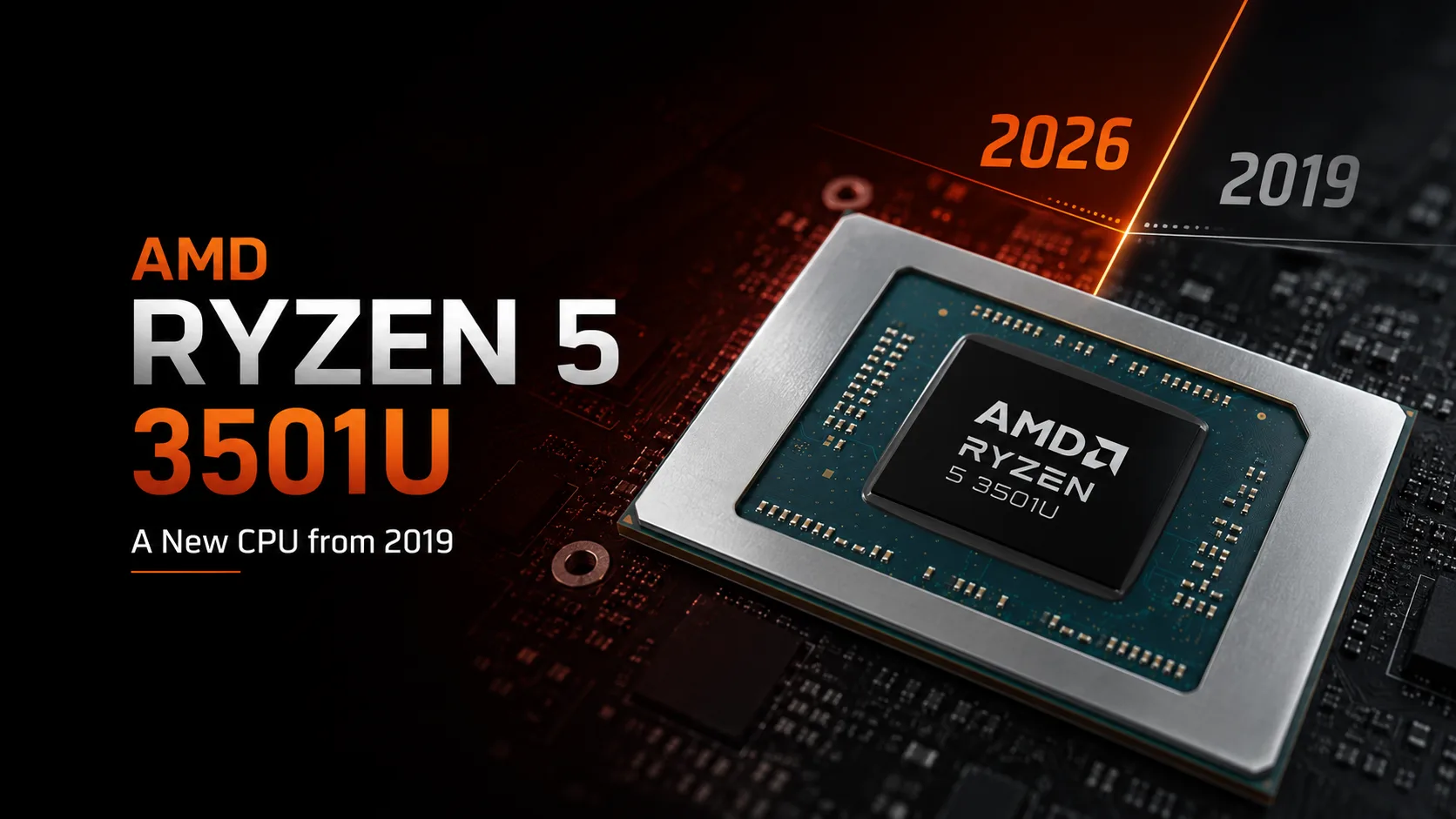
The AMD Ryzen 5 3501U appeared in the company's catalog in the second quarter of 2026 but technically almost completely replicates the Ryzen 5 3500U from 2019. It features the same four cores and eight threads, Zen+ architecture, a 12nm manufacturing process, and integrated Radeon Vega 8 graphics.
In fact, AMD has returned the old platform under a new index for budget laptops, mini-PCs, and office systems. Therefore, the Ryzen 5 3501U should not be evaluated as a modern mid-range processor, but rather as a foundation for the cheapest possible computer.
Differences Between Ryzen 5 3501U and Ryzen 5 3500U
There are no significant differences.
The Ryzen 5 3501U has:
- 4 cores and 8 threads;
- frequencies ranging from 2.1 to 3.7 GHz;
- 4 MB of L3 cache;
- Radeon Vega 8 with a frequency of up to 1200 MHz;
- support for dual-channel DDR4-2400;
- a nominal TDP of 15W.
All these parameters match the Ryzen 5 3500U. The changes are in the index, release date, and factory model designation.
The performance of the two processors should also be almost identical. The difference between specific laptops will primarily depend on cooling, power limits, and memory configuration.
How Well Does It Handle Everyday Tasks?
The four cores with support for eight threads still handle web browsing, office applications, video calls, watching videos, and light photo editing. With an SSD and 16 GB of RAM, such a computer will remain quite responsive in everyday work.
However, four cores quickly become a limitation in video editing, rendering, compiling, and heavy multitasking. The Zen+ architecture also significantly lags behind newer Ryzen processors in single-core speed, so delays will be noticeable not only in professional programs but also when multitasking with a large number of demanding applications.
Initial benchmarks of the Ryzen 5 3501U in Geekbench 6 are around 1100 points in single-threaded and 3100 points in multi-threaded tests. These are nearly the same figures as the Ryzen 5 3500U.
Radeon Vega 8 is Still Useful
The main advantage of the Ryzen 5 3501U over much weaker budget processors is the integrated Radeon Vega 8. It is suitable for video playback, simple graphic applications, older games, and less demanding online projects at low settings.
However, Vega 8's performance heavily depends on system memory. The GPU uses system DDR4, so having a single memory module significantly reduces bandwidth. For a laptop or mini-PC with the Ryzen 5 3501U, it is advisable to use two modules or soldered memory operating in dual-channel mode.
Even in this configuration, Vega 8 is not meant for modern demanding games. Its performance is limited by the old architecture, slow by modern standards DDR4-2400, and the low performance of the CPU cores.
Why Did AMD Bring Back the Old Platform?
The Ryzen 5 3501U is not intended to compete with modern Ryzen AI or Core Ultra processors. Its goal is to provide manufacturers with a cheap foundation for entry-level devices.
This can be achieved by using a well-established platform, inexpensive DDR4 memory, and ready-made power and cooling circuits. Such an approach reduces the costs of developing and manufacturing laptops, all-in-ones, and mini-PCs.
For the consumer, the takeaway is simple: the device should be significantly cheaper than models with newer Ryzen processors. The Ryzen 5 3501U can still handle basic tasks, but its new index does not make the platform modern.
What to Look for When Buying
When considering the Ryzen 5 3501U, the rest of the configuration is more important than the processor's name.
Before purchasing, check:
- whether at least 16 GB of RAM is installed;
- if the memory operates in dual-channel mode;
- if there is a possibility to add or replace modules;
- whether an NVMe SSD is used;
- how much cheaper the device is compared to models with Ryzen 5 5625U or 7530U;
- if the cooling system can handle prolonged loads.
It is especially important to compare not just the processors but the entire laptop. A newer model may perform worse in terms of screen, storage, or cooling system. However, with a comparable configuration, the Ryzen 5 5625U and 7530U are significantly stronger: they have six cores, twelve threads, Zen 3 architecture, and a noticeably larger performance headroom.
Conclusion
The AMD Ryzen 5 3501U is a re-released Ryzen 5 3500U, not a new entry-level processor. It is still sufficient for office work, studying, and simple home tasks, especially when equipped with an SSD and dual-channel memory.
The main limitation remains the old four-core architecture. It is worth purchasing a device with the Ryzen 5 3501U only if there is considerable cost savings. If the price difference is small, the Ryzen 5 5625U or 7530U would be much more reasonable choices.
CPU Comparison
Compare Ryzen 5 3501U with other CPUs
Basic
CPU Specifications
Memory Specifications
GPU Specifications
Miscellaneous
Benchmarks
Compared to Other CPU
Related CPU Comparisons


Share in social media
Or Link To Us
<a href="https://cputronic.com/cpu/amd-ryzen-5-3501u" target="_blank">AMD Ryzen 5 3501U</a>