AMD Radeon 840M

AMD Radeon 840M
AMD Radeon 840M graphics card review

AMD Radeon 840M: Modern Integrated Graphics Without Gaming Headroom

June 2026

The AMD Radeon 840M looks modern by name and architecture, but in terms of performance, it remains the entry-level integrated graphics from AMD. This iGPU is designed for mobile Ryzen AI processors and is installed in laptops that do not have a discrete graphics card. It suffices for the interface, video playback, external displays, and light gaming, but it is not a replacement for a dedicated GPU.

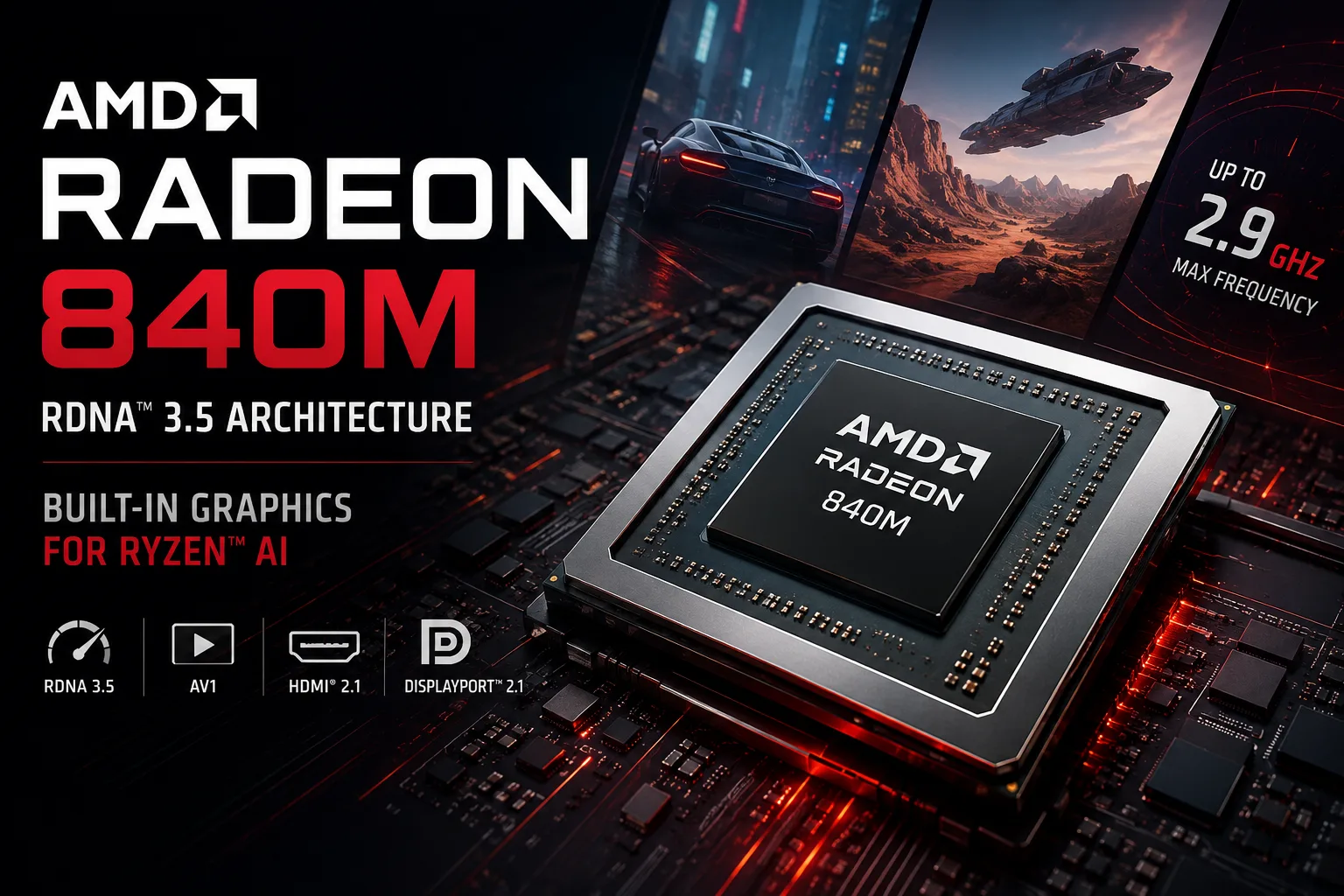
The main limitation of the Radeon 840M is its 4 CU (Compute Units), or 256 shaders. The frequency can reach up to 2900 MHz, but in games, the number of CUs and memory speed are more important. Therefore, high frequencies do not make the 840M a gaming graphics solution.

Where the Radeon 840M Stands in AMD's Lineup

In AMD's integrated graphics lineup for Ryzen AI, the Radeon 840M is positioned closer to the lower-end models. It is faster than the minimum Radeon 820M but lags behind the Radeon 860M, 880M, and 890M in terms of CU count.

Integrated Graphics Graphics Units Shaders Class
Radeon 820M 2 CU 128 Minimal iGPU
Radeon 840M 4 CU 256 Basic RDNA 3.5 Graphics
Radeon 860M 8 CU 512 Basic gaming level among iGPUs
Radeon 880M 12 CU 768 Performance iGPU
Radeon 890M 16 CU 1024 High-end integrated graphics from AMD

The main takeaway from the table is that the Radeon 840M is closer to basic integrated graphics than to the upper-end 880M and 890M. The difference lies not in the names or frequencies but in the number of CUs. The Radeon 860M has double the CUs, while the Radeon 890M has four times as many.

What is Important in Specifications

The Radeon 840M is built on the RDNA 3.5 architecture and utilizes the laptop's shared RAM. It has no dedicated video memory, so its performance depends on the laptop's configuration: the type of memory, its bandwidth, power limits of the processor, and cooling.

This is especially noticeable in thin chassis. In one laptop, the 840M may maintain high frequencies longer, while in another, it may drop them quickly due to temperature or power limits. Thus, having the same graphics name does not guarantee the same performance.

In terms of features, the 840M meets the basic requirements for a modern iGPU. It supports DirectX 12, AV1, HDMI 2.1, DisplayPort 2.1, and multiple displays. This is sufficient for office laptops, home workstations, and multimedia purposes.

Performance in Games

In gaming, the Radeon 840M remains the entry-level modern iGPU. It can handle older titles, indie games, and undemanding online games. GTA V and games of a similar level run noticeably easier than modern AAA titles.

In 3DMark Time Spy Graphics tests, the Radeon 840M typically scores around 1,500 points. This is a normal result for basic integrated graphics but not for the higher-end Radeon 860M, 880M, and 890M. In Cyberpunk 2077, Baldur’s Gate 3, and other demanding games, you will need to lower settings and resolution, with frame rates likely approaching the lower comfort threshold.

In practice, the Radeon 840M is suitable for scenarios such as:

  • Browsing, video playback, office applications, and the Windows interface - without issues;
  • Older games and light online projects - acceptable;
  • Esports - depends on the game, settings, memory, and cooling;
  • Modern AAA titles - only at low settings, often without stable comfort;
  • If a laptop is being purchased specifically for gaming - better to choose the Radeon 860M, 880M, or 890M.

In essence, the 840M is suitable for rare gaming but not for a laptop specifically designed for gaming. The hardware limitation of 4 CUs quickly becomes a bottleneck.

Radeon 840M vs. Radeon 740M and 860M

The Radeon 840M can be viewed as a development of the Radeon 740M. It has received a new architecture and platform, but it remains entry-level integrated graphics. This is an update to the basic level, not a shift to the gaming class.

The comparison with the Radeon 860M is more significant. The 860M has double the number of graphics units, making it noticeably faster and more stable in games. If the laptop is needed not only for work but also for regular gaming, it is better to choose a model with the 860M or higher.

The Radeon 840M is selected not for gaming performance but for a compact laptop with a modern processor, contemporary media capabilities, and moderate power consumption. For work, video, and occasional gaming, it is sufficient.

Who is Radeon 840M Suitable For

The Radeon 840M is appropriate for a laptop intended for work, study, browsing, video, light photo processing, and rare gaming. It is best suited for compact models without discrete graphics, where battery life, silence, and price are important.

For light gaming, it should suffice. For new demanding games - only with caveats. Expecting stable 60 fps in modern AAA games from the 840M is unrealistic, even at lowered settings.

Conclusion

The Radeon 840M is integrated graphics designed for a daily-use laptop rather than regular gaming. It supports RDNA 3.5, AV1, and modern video outputs, and it should not be a weak point in everyday tasks.

However, 4 CUs severely limit gaming performance. Therefore, the Radeon 840M is best considered as graphics for work, video, and light gaming. If gaming is a significant scenario, it is better to look for laptops with Radeon 860M, 880M, or 890M.

Basic

Label Name
Intel
Platform
Integrated
Launch Date
February 2025
Former Codename
Krackan Point / Gorgon Point
GPU Lithography
4 nm
Model Name
AMD Radeon 840M
Generation
Radeon 800M Series
Boost Clock
2800-2900 MHz
Bus Interface
Integrated
RT Cores
4
Compute Units
4
Tensor Cores
?
Tensor Cores are specialized processing units designed specifically for deep learning, providing higher training and inference performance compared to FP32 training. They enable rapid computations in areas such as computer vision, natural language processing, speech recognition, text-to-speech conversion, and personalized recommendations. The two most notable applications of Tensor Cores are DLSS (Deep Learning Super Sampling) and AI Denoiser for noise reduction.
No
TMUs
?
Texture Mapping Units (TMUs) serve as components of the GPU, which are capable of rotating, scaling, and distorting binary images, and then placing them as textures onto any plane of a given 3D model. This process is called texture mapping.
16
Foundry
TSMC
Process Size
4 nm
Architecture
RDNA 3.5

Memory Specifications

Memory Size
Shared system memory
Memory Type
System shared
Memory Bus
?
The memory bus width refers to the number of bits of data that the video memory can transfer within a single clock cycle. The larger the bus width, the greater the amount of data that can be transmitted instantaneously, making it one of the crucial parameters of video memory. The memory bandwidth is calculated as: Memory Bandwidth = Memory Frequency x Memory Bus Width / 8. Therefore, when the memory frequencies are similar, the memory bus width will determine the size of the memory bandwidth.
Dual-channel system memory, platform dependent
Memory Clock
System memory dependent
Bandwidth
?
Memory bandwidth refers to the data transfer rate between the graphics chip and the video memory. It is measured in bytes per second, and the formula to calculate it is: memory bandwidth = working frequency × memory bus width / 8 bits.
System memory dependent

Display and Media

AMD FreeSync
Yes
AV1 Encode/Decode
Encode/Decode
DisplayPort Extensions
Adaptive-Sync, HBR3, UHBR10
H.264 Hardware Encode/Decode
Encode/Decode
H.265 HEVC Hardware Encode/Decode
Encode/Decode
H.266 VVC Hardware Encode/Decode
No hardware support
HDCP Version
2.3
HDMI Version
2.1
Intel Quick Sync Video
No
Max Resolution DP
7680x4320 @ 60Hz
Max Resolution HDMI
7680x4320 @ 60Hz
Max Video Decode Bandwidth
1080p60 8bpc MPEG2, 1080p60 8bpc VC1, 1080p786 8/10bpc VP9, 2160p196 8/10bpc VP9, 4320p49 8/10bpc VP9, 1080p1200 8bpc H.264, 2160p300 8bpc H.264, 4320p75 8bpc H.264, 1080p786 8/10bpc H.265, 2160p196 8/10bpc H.265, 4320p49 8/10bpc H.265, 1080p960 8/10bpc AV1, 2160p240 8/10bpc AV1, 4320p60 8/10bpc AV1
Max Video Encode Bandwidth
1080p630 8bpc H.264, 1440p373 8bpc H.264, 2160p175 8bpc H.264, 1080p630 8bpc H.265, 1440p373 8bpc H.265, 2160p175 8bpc H.265, 4320p43 8bpc H.265, 1080p864 8/10bpc AV1, 1440p513 8/10bpc AV1, 2160p240 8/10bpc AV1, 4320p60 8/10bpc AV1
Number of Displays Supported
4
Outputs
HDMI 2.1, DisplayPort 2.1, USB-C DisplayPort Alt Mode; device dependent
USB Type-C DisplayPort Alternate Mode
Yes
Wireless Display
Miracast

Theoretical Performance

Pixel Rate
?
Pixel fill rate refers to the number of pixels a graphics processing unit (GPU) can render per second, measured in MPixels/s (million pixels per second) or GPixels/s (billion pixels per second). It is the most commonly used metric to evaluate the pixel processing performance of a graphics card.
22.4-23.2 GPixel/s
Texture Rate
?
Texture fill rate refers to the number of texture map elements (texels) that a GPU can map to pixels in a single second.
44.8-46.4 GTexel/s
FP16 (half)
?
An important metric for measuring GPU performance is floating-point computing capability. Half-precision floating-point numbers (16-bit) are used for applications like machine learning, where lower precision is acceptable. Single-precision floating-point numbers (32-bit) are used for common multimedia and graphics processing tasks, while double-precision floating-point numbers (64-bit) are required for scientific computing that demands a wide numeric range and high accuracy.
2.87-2.97 TFLOPS
FP64 (double)
?
An important metric for measuring GPU performance is floating-point computing capability. Double-precision floating-point numbers (64-bit) are required for scientific computing that demands a wide numeric range and high accuracy, while single-precision floating-point numbers (32-bit) are used for common multimedia and graphics processing tasks. Half-precision floating-point numbers (16-bit) are used for applications like machine learning, where lower precision is acceptable.
89.6-92.8 GFLOPS
FP32 (float)
?
An important metric for measuring GPU performance is floating-point computing capability. Single-precision floating-point numbers (32-bit) are used for common multimedia and graphics processing tasks, while double-precision floating-point numbers (64-bit) are required for scientific computing that demands a wide numeric range and high accuracy. Half-precision floating-point numbers (16-bit) are used for applications like machine learning, where lower precision is acceptable.
1.48 TFLOPS

AI Features

Intel Deep Learning Boost on GPU
No
NPU TOPS
Up to 50 TOPS
Processor Overall TOPS
Up to 59 TOPS

Miscellaneous

AMD SmartAccess Memory
Available
Native PCIe Lanes
16 total / 16 usable
PCI Express Version
PCIe 4.0
Shading Units
?
The most fundamental processing unit is the Streaming Processor (SP), where specific instructions and tasks are executed. GPUs perform parallel computing, which means multiple SPs work simultaneously to process tasks.
256
TDP
Shared with processor; platform dependent
Vulkan Version
?
Vulkan is a cross-platform graphics and compute API by Khronos Group, offering high performance and low CPU overhead. It lets developers control the GPU directly, reduces rendering overhead, and supports multi-threading and multi-core processors.
1.4
OpenCL Version
2.1
OpenGL
4.6
CUDA
No
DirectX
12 Ultimate (12_2)
Power Connectors
None
ROPs
?
The Raster Operations Pipeline (ROPs) is primarily responsible for handling lighting and reflection calculations in games, as well as managing effects like anti-aliasing (AA), high resolution, smoke, and fire. The more demanding the anti-aliasing and lighting effects in a game, the higher the performance requirements for the ROPs; otherwise, it may result in a sharp drop in frame rate.
8
Shader Model
6.7

Benchmarks

FP32 (float)
Score
1.48 TFLOPS
3DMark Time Spy
Score
1493
Vulkan
Score
19063
OpenCL
Score
12393

Compared to Other GPU

FP32 (float) / TFLOPS
1.535 +3.7%
1.417 -4.3%
1.387 -6.3%
3DMark Time Spy
4844 +224.4%
2399 +60.7%
1705 +14.2%
Vulkan
84816 +344.9%
60350 +216.6%
37148 +94.9%
19063
5522 -71%
OpenCL
57474 +363.8%
35443 +186%
20338 +64.1%
12393
884 -92.9%