Intel Graphics 64EU (Arrow Lake)

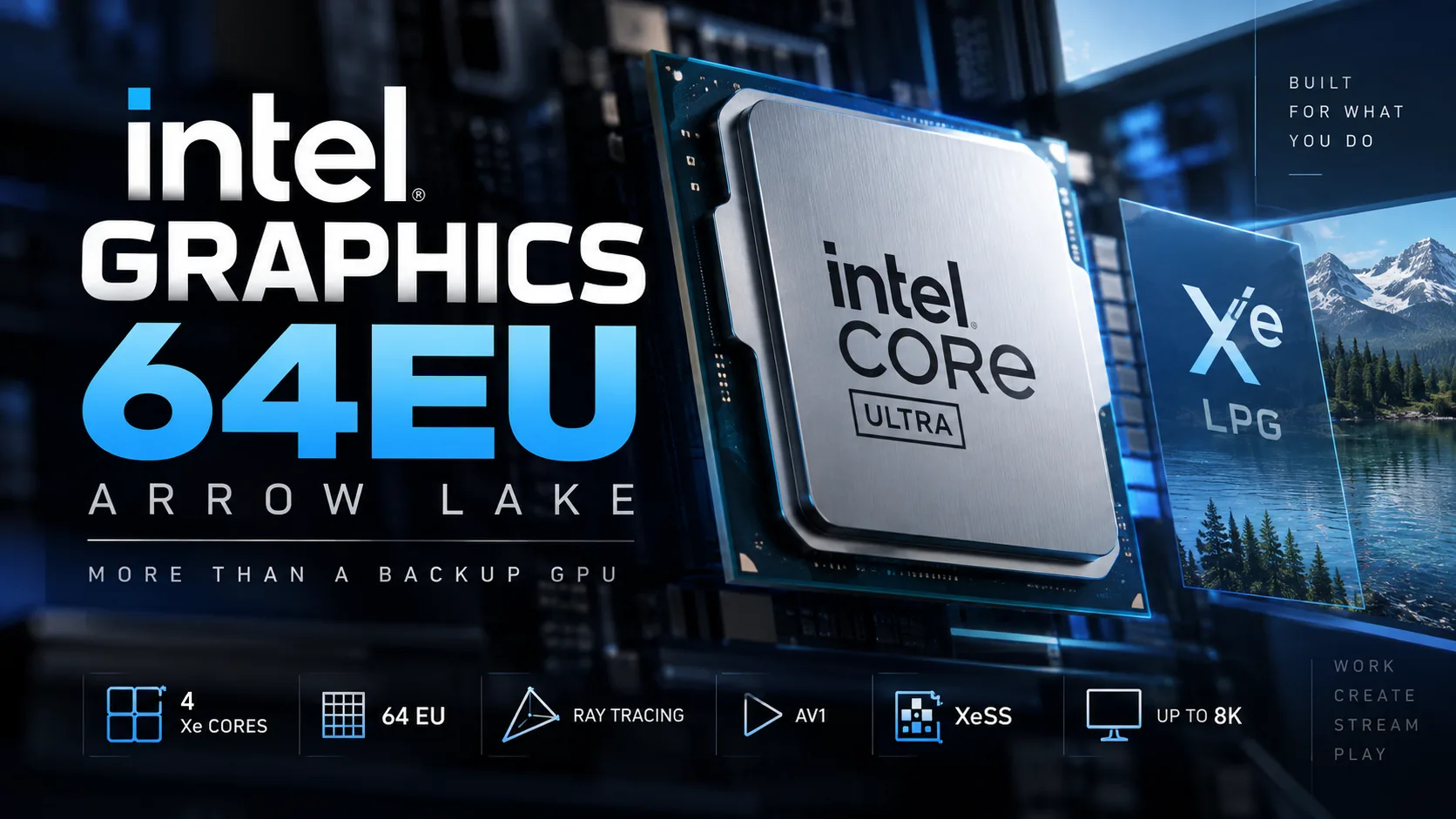
Intel Graphics 64EU in Arrow Lake: What Four Xe Cores Deliver
Intel Graphics 64EU arrived in Arrow Lake as a replacement for the significantly weaker integrated graphics in previous generations of desktop Core processors. In its full configuration, the GPU includes four Xe cores and 64 EU, while its frequency in desktop Core Ultra 200 processors reaches 2.0 GHz. In terms of performance, it is no longer in the same class as the previous UHD Graphics, but 64 EU is still not designed for modern demanding games at 1080p.
What Changed After UHD Graphics
The GPU is based on the Xe-LPG architecture. The full configuration contains four Xe cores, 64 EU, 32 TMUs, 16 ROPs, and four ray-tracing units. FP32 performance reaches 2.048 TFLOPS.
DirectX 12 Ultimate, Vulkan 1.3, and OpenCL 3.0 are supported. The media engine provides hardware encoding and decoding for AV1, H.264, and H.265, Intel Quick Sync Video, and resolutions up to 8K.
There is no dedicated video memory-the GPU uses system DDR5. It also has no XMX units. XeSS works through DP4a here, without the XMX acceleration available on discrete Arc GPUs.
Which Processors Use It
64 EU is used in desktop Arrow Lake-S processors and higher-end mobile Arrow Lake-HX processors.
| Processor | Class | Maximum GPU Frequency |
|---|---|---|
| Core Ultra 5 245K | Desktop | 1.9 GHz |
| Core Ultra 7 265K | Desktop | 2.0 GHz |
| Core Ultra 9 285K | Desktop | 2.0 GHz |
| Core Ultra 7 265HX | Laptop | up to 2.0 GHz |
| Core Ultra 9 275HX | Laptop | up to 2.0 GHz |
| Core Ultra 9 285HX | Laptop | up to 2.0 GHz |
The same configuration is used in the Core Ultra 5 250K Plus and Core Ultra 7 270K Plus. Arrow Lake also has Intel Graphics versions with 48 and 32 EU, so GPU performance cannot be determined from the GPU name alone.
Benchmarks in Real Systems
Memory, drivers, and platform settings affect the results, so the specific test configurations are listed below.
| Configuration | Test | Result |
|---|---|---|
| Core Ultra 9 285K + MSI MPG Z890 Edge Ti WiFi | 3DMark Time Spy Graphics | 2192 |
| Core Ultra 7 265K + ASUS TUF Gaming Z890-Pro WiFi | 3DMark Night Raid Graphics | 26,139 |
| Core Ultra 9 285HX + 32 GB DDR5 | 3DMark Night Raid Graphics | 24,281 |
The Core Ultra 9 285K scored 2192 points in Time Spy Graphics-the same result listed in the Cputronic database. The graphics also achieved 438 points in Steel Nomad, 20,497 points in OpenCL, and 22,384 in Vulkan.
Night Raid and Time Spy use different workloads, so their scores cannot be compared directly.
Gaming Performance
In Cyberpunk 2077 at 1920x1080, the result is around 20 FPS. To achieve an acceptable frame rate, you will have to lower the resolution or graphics quality, or enable upscaling.
GTA V is considerably less demanding-the result reaches approximately 34.9 FPS at 1080p. Older games and undemanding online titles can be played without a discrete graphics card as long as the settings are not turned up too high.
| Game | Resolution | Result |
|---|---|---|
| Cyberpunk 2077 | 1920x1080 | 20 FPS |
| GTA V | 1920x1080 | 34.9 FPS |
In demanding games, four Xe cores quickly run into a lack of compute performance. This configuration is already insufficient for 1080p gaming in modern AAA titles.
The Difference Between Core Ultra 5 and Core Ultra 9 Is Small
The Core Ultra 5 245K runs its GPU at up to 1.9 GHz, while the Core Ultra 7 265K and Core Ultra 9 285K reach up to 2.0 GHz. The difference is around 5%.
In practice, the frequency and operating mode of the DDR5 memory can have a greater impact on performance than this difference in GPU frequency. Since there is no dedicated VRAM, the result depends on memory bandwidth and dual-channel operation.
There is no point in paying extra for the Core Ultra 9 for its integrated graphics-both chips use the same four Xe cores and 64 EU.
Where 64 EU Is Enough
A discrete graphics card is not essential for an office or home PC: 64 EU is enough for the desktop, video playback, multiple displays, and light gaming.
In modern AAA games, performance is no longer sufficient for comfortable 1080p gaming without lowering the quality or using upscaling. A discrete graphics card remains necessary here.
Conclusion
With the move to 64 EU, Intel’s integrated desktop graphics is no longer merely a backup display adapter. This GPU can already run undemanding games and provide hardware video acceleration without a separate graphics card.
However, four Xe cores remain entry-level. Demanding games quickly push the GPU beyond a comfortable level of performance. 64 EU eliminates the need for a graphics card in a typical work PC, but it is not a sensible foundation for a gaming system.
GPU Comparison
Compare Graphics 64EU (Arrow Lake) with other GPUs
Basic
- Intel Core Ultra 5 245K
- Intel Core Ultra 5 245T
- Intel Core Ultra 5 250K Plus
- Intel Core Ultra 7 255HX
- Intel Core Ultra 7 265
- Intel Core Ultra 7 265HX
- Intel Core Ultra 7 265K
- Intel Core Ultra 7 265T
- Intel Core Ultra 7 270HX Plus
- Intel Core Ultra 7 270K Plus
- Intel Core Ultra 9 275HX
- Intel Core Ultra 9 285
- Intel Core Ultra 9 285HX
- Intel Core Ultra 9 285K
- Intel Core Ultra 9 285T
- Intel Core Ultra 9 290HX Plus
Memory Specifications
Display and Media
Theoretical Performance
AI Features
Miscellaneous
Benchmarks
Compared to Other GPU
Related GPU Comparisons


Share in social media
Or Link To Us
<a href="https://cputronic.com/gpu/intel-graphics-64eu-arrow-lake" target="_blank">Intel Graphics 64EU (Arrow Lake)</a>