AMD Radeon 860M
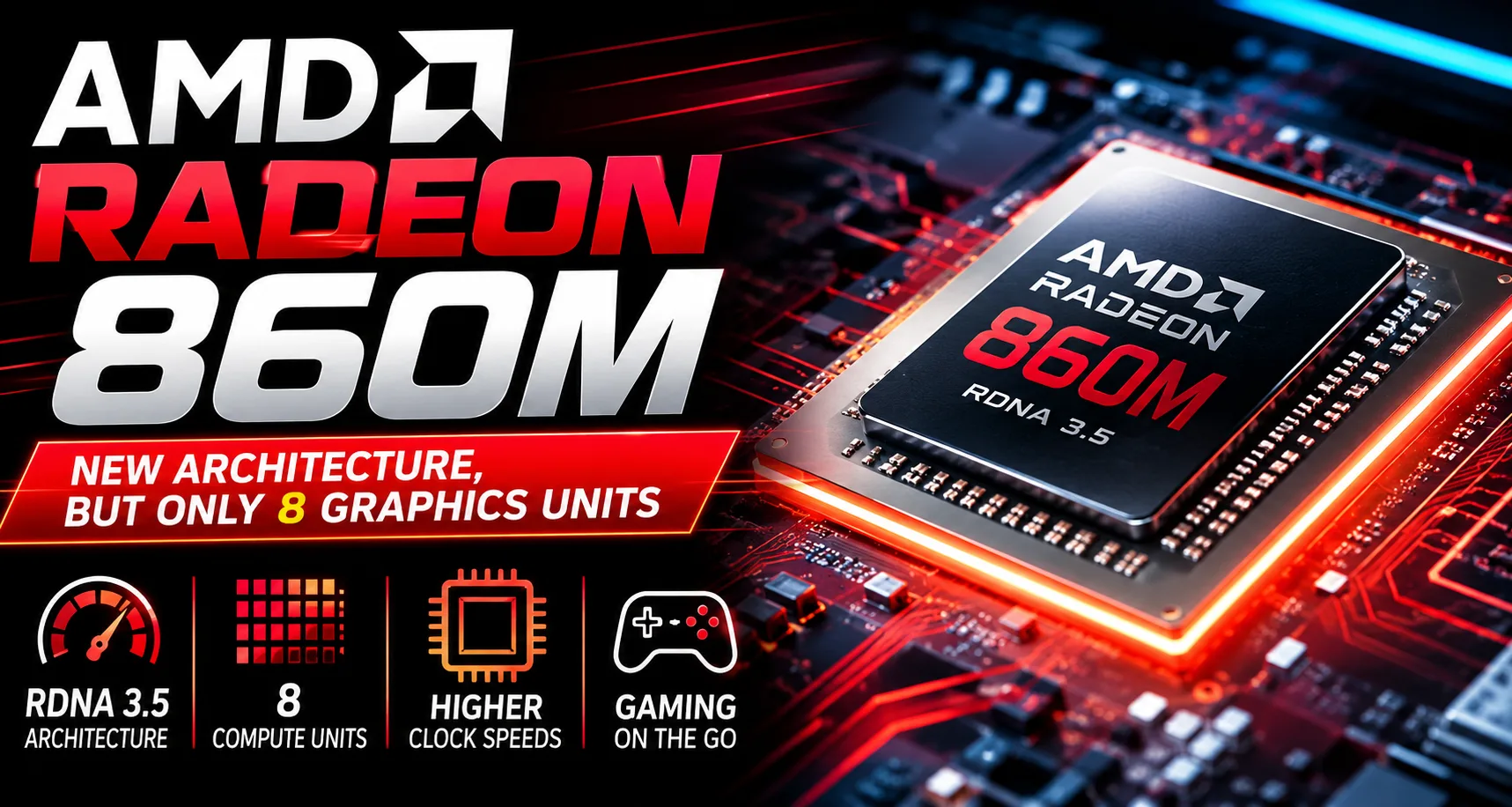
AMD Radeon 860M: New Architecture vs. 8 Graphics Units
The AMD Radeon 860M appears to be a significant update to AMD's integrated graphics: a fresh architecture, higher clock speeds, and the new Ryzen AI platform. However, in terms of configuration, it remains an 8-unit iGPU. Thus, it makes more sense to compare it with the Radeon 760M rather than the Radeon 780M or Radeon 890M.
For a thin laptop without a discrete graphics card, the Radeon 860M can handle basic tasks: user interface, video playback, light gaming, and some older AAA titles. However, the name should not create expectations at the level of the Radeon 890M or a discrete GPU.
What is Radeon 860M
The Radeon 860M is integrated graphics designed for the mobile Ryzen AI 7 processors. It is based on the RDNA 3.5 architecture and utilizes 8 graphics units, which means 512 shaders. Depending on the processor, the GPU clock speed reaches around 3000-3100 MHz.
The main difference from the Radeon 760M lies not in the number of units, but in the newer platform. The Radeon 860M receives a new architecture, higher clock speeds, and support for faster memory on laptops with Ryzen AI. However, the width of the GPU remains the same: it still features 8 integrated graphics units.
A GPU class cannot be determined by name alone. The Radeon 860M stands alongside the Radeon 880M and 890M only by index. In terms of unit count, it is closer to the Radeon 760M.
Position in AMD's Lineup
| Integrated Graphics | Architecture | Graphics Units | Role in Lineup |
|---|---|---|---|
| Radeon 760M | RDNA 3 | 8 | Previous 8-CU Class |
| Radeon 860M | RDNA 3.5 | 8 | New Mid-Range Version |
| Radeon 780M | RDNA 3 | 12 | Older but Wider iGPU |
| Radeon 880M | RDNA 3.5 | 12 | Higher Tier Ryzen AI |
| Radeon 890M | RDNA 3.5 | 16 | Top Integrated Graphics AMD |
The Radeon 860M is not a junior version of the Radeon 890M, but rather an update to the previous 8-unit level. It features a newer core and higher clock speeds, but fewer execution units than the Radeon 780M, 880M, and 890M.
If a laptop is primarily needed for gaming, the GPU's name alone tells little about real-world performance. One must consider memory, power limits, cooling, and price in comparison to models with Radeon 780M or Radeon 890M.
The Radeon 780M is older in architecture, but it has 12 units instead of 8. In gaming and 3D benchmarks, this could be more significant than the transition from RDNA 3 to RDNA 3.5.
Gaming Performance
The Radeon 860M is designed for minimal gaming performance for iGPUs. It is suitable for esports games, indie titles, older projects, and less demanding AAA games. In modern heavy games, settings or resolution may need to be lowered, or upscaling turned on.
In the 3DMark Time Spy Graphics benchmark, the average scores for the Radeon 860M fall around 2400-2500 points. For integrated graphics, this is decent but does not reach the level of gaming laptops with discrete GPUs. This score offers room for occasional gaming rather than replacing a dedicated graphics card.
At Full HD, the Radeon 860M does not perform confidently in all games. Light projects can yield comfortable fps. In new heavy games, a more realistic approach is to look at 720p-900p, low settings, and FSR if supported.
The Radeon 860M is not meant to be purchased as gaming graphics. It is an integrated solution that allows gaming without a discrete graphics card, but only with clear limitations.
Why One Laptop with Radeon 860M May Be Faster Than Another
The Radeon 860M does not have its own video memory. It uses system RAM, so performance heavily depends on the laptop's configuration.
This graphics unit works best with fast LPDDR5X memory. Slow memory or single-channel modes can significantly reduce performance. For iGPUs, memory bandwidth is one of the main limiting factors.
The second factor is cooling and power limits. In a thin chassis, the CPU and GPU quickly hit thermal throttling. In a larger laptop, the Radeon 860M can maintain high clock speeds for longer durations. Therefore, sharing the same GPU name does not guarantee the same performance across different models.
How Radeon 860M Outperforms Older Integrations
For the Radeon 860M, gaming performance is not the only consideration. In a typical laptop, aspects like media handling, support for modern displays, energy efficiency, and video performance matter. Here, the new Ryzen AI platform is more advantageous than the old 8-unit iGPUs.
For browsing, video, office tasks, light photo editing, and simple video editing, the Radeon 860M is adequate. Limitations arise where stable high 3D performance is necessary: modern games, heavy video editing, 3D rendering, and GPU tasks.
Radeon 860M vs. Radeon 780M
The choice between Radeon 860M and Radeon 780M depends not just on the GPU. If a laptop with Radeon 860M is built on a newer Ryzen AI platform, has fast memory, and offers good battery life, it may be preferable as a modern solution.
However, if graphical performance is the priority, the Radeon 780M should not be discounted. It has 12 graphics units, and in well-optimized laptops, it may perform better than the Radeon 860M. The new name does not negate the physical differences in GPU configuration.
The situation with the Radeon 890M is clearer. This is AMD's higher-tier integrated graphics with 16 units. If a laptop is being purchased with gaming without a discrete graphics card in mind, one should indeed look towards the 890M rather than the 860M.
Conclusion
The AMD Radeon 860M is a modern mid-range integrated graphics solution. Its main advantages are the new Ryzen AI platform, RDNA 3.5 architecture, high clock speeds, and support for fast memory. The main disadvantage is the same 8 graphics units, which limit its performance in gaming and 3D benchmarks.
It is graphics for a versatile laptop with no discrete GPU: work, video, light gaming, older AAA projects, and basic content handling. The Radeon 860M is not a mini-890M, but an updated 760M for the new generation of Ryzen AI.
GPU Comparison
Compare Radeon 860M with other GPUs
Basic
Memory Specifications
Display and Media
Theoretical Performance
AI Features
Miscellaneous
Benchmarks
Compared to Other GPU
Related GPU Comparisons


Share in social media
Or Link To Us
<a href="https://cputronic.com/gpu/amd-radeon-860m" target="_blank">AMD Radeon 860M</a>