AMD Ryzen AI 7 450
AMD Ryzen AI 7 450: Laptop Benchmarks and Comparison with the Ryzen AI 7 350
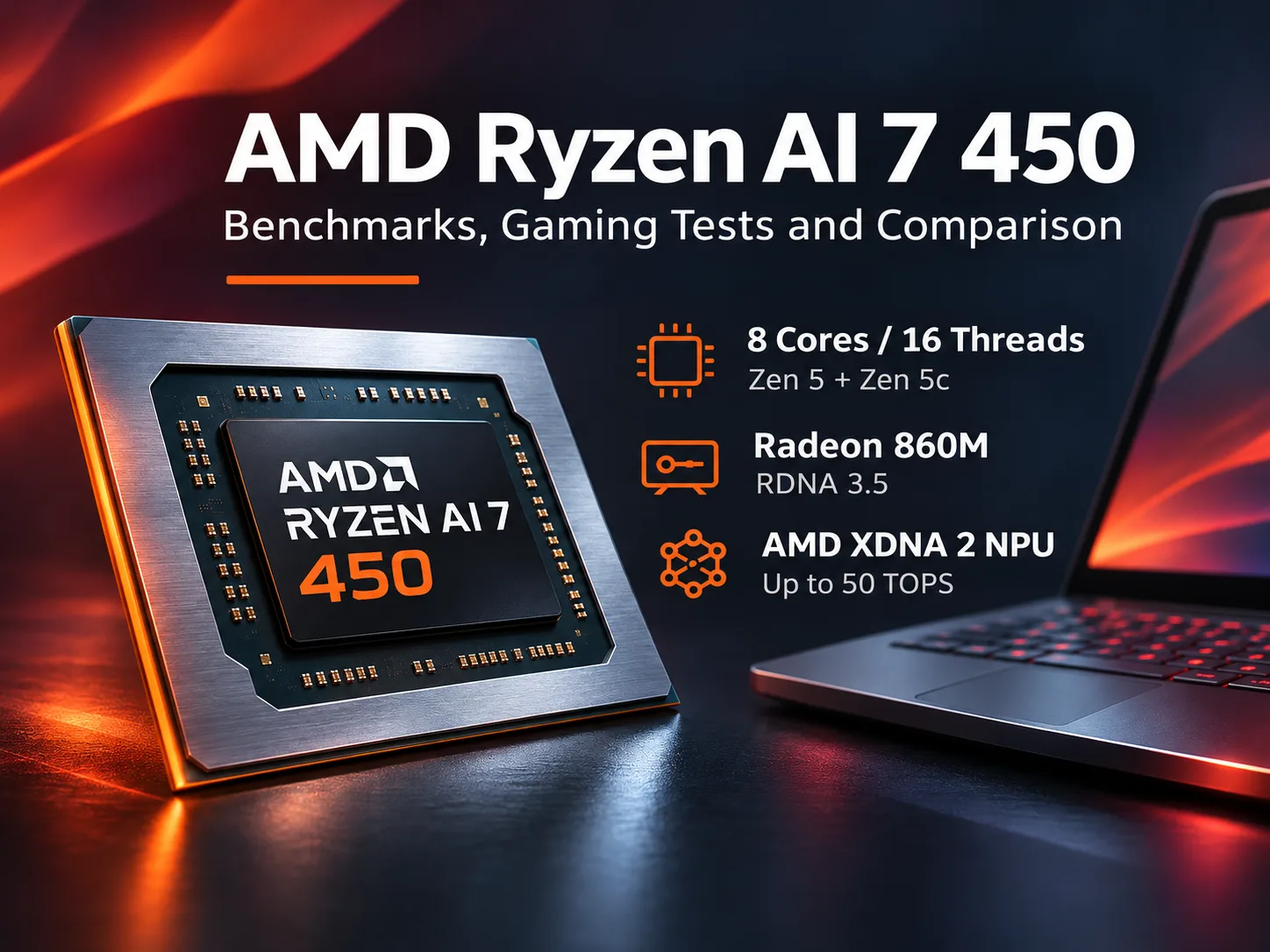
The AMD Ryzen AI 7 450 is a mobile processor from the Gorgon Point family, introduced in January 2026. It combines four Zen 5 cores, four compact Zen 5c cores, integrated Radeon 860M graphics, and a neural processing unit with performance of up to 50 TOPS. Compared with the Ryzen AI 7 350, AMD has slightly increased the maximum CPU and GPU frequencies and raised the supported LPDDR5X memory speed. In Lenovo IdeaPad Pro 5 laptop tests, the CPU performance gain over its predecessor amounted to only a few percent.
Architecture and Differences from the Ryzen AI 7 350
The Ryzen AI 7 450 uses four high-performance Zen 5 cores and four compact Zen 5c cores. All eight support SMT, allowing the processor to handle 16 threads simultaneously.
Zen 5c cores occupy less space and operate at lower maximum frequencies, but they support the same instruction set as Zen 5.
Four main specifications have changed compared with the Ryzen AI 7 350.
| Specification | Ryzen AI 7 350 | Ryzen AI 7 450 |
|---|---|---|
| Maximum Zen 5 frequency | 5.0 GHz | 5.1 GHz |
| Maximum Zen 5c frequency | 3.5 GHz | 3.6 GHz |
| Maximum Radeon 860M frequency | 3000 MHz | 3100 MHz |
| Maximum LPDDR5X speed | 8000 MT/s | 8533 MT/s |
The Zen 5 core frequency increased by 2%, while the integrated graphics frequency rose by approximately 3.3%. The core count, cache size, and graphics architecture remain unchanged.
LPDDR5X-8533 support could potentially benefit the Radeon 860M, which uses system RAM. However, the advantage depends on the laptop configuration. For example, the Lenovo IdeaPad Pro 5 14AGP11 with the Ryzen AI 7 450 is equipped with 32 GB of LPDDR5X-8533, yet it trails the previous model in synthetic graphics tests. Thus, higher memory speed alone does not guarantee an FPS increase.
Geekbench 6 Performance
Geekbench 6 results make it possible to compare the Ryzen AI 7 450 in laptops with different cooling systems and power settings.
| Processor | Laptop | Single-Core | Multi-Core |
|---|---|---|---|
| Ryzen AI 7 450 | Lenovo IdeaPad Pro 5 14AGP11 | 2928 | 14624 |
| Ryzen AI 7 450 | Lenovo Legion 5 15AGP11 | 2973 | 14213 |
| Ryzen AI 7 450 | HP EliteBook 8 G2a 14 | 2914 | 13611 |
| Ryzen AI 7 450 | HP EliteBook 8 G2a 16 | 2906 | 13696 |
| Ryzen AI 7 350 | Lenovo IdeaPad Pro 5 14AKP G10 | 2874 | 13988 |
| Core Ultra 7 355 | Dell XPS 14 | 2701 | 11394 |
The results apply to specific laptop configurations. They are affected by the Geekbench 6 version, power limits, power settings, and cooling.
The Ryzen AI 7 450 scores between 2906 and 2973 points in the single-threaded test and between 13611 and 14624 points in the multi-threaded test. The maximum difference between the listed Multi-Core results is 7.4%.
The two Lenovo IdeaPad Pro 5 models provide a useful comparison of the generational performance gain. The model with the Ryzen AI 7 450 is 1.9% faster than its Ryzen AI 7 350 predecessor in Single-Core and 4.5% faster in Multi-Core.
The difference is even smaller in Cinebench R23:
- Lenovo IdeaPad Pro 5 with the Ryzen AI 7 450 - 18316 points in Multi-Core.
- Lenovo IdeaPad Pro 5 with the Ryzen AI 7 350 - 17899 points in Multi-Core.
- Advantage of the newer model - 2.3%.
At the same time, results among laptops using the same Ryzen AI 7 450 vary more noticeably. The HP EliteBook 8 G2a 14, with PL1 and PL2 power limits of 41 W and 58 W, respectively, scored 16101 points in Cinebench R23 Multi-Core. The Lenovo Legion 5, with PL1 and PL2 limits of 90 W and 100 W, respectively, scored 18801 points-16.8% more.
The Legion does not have the same advantage in Geekbench 6: its Multi-Core result is even slightly lower than that of the IdeaPad Pro 5 with 65 W power limits. This is due to differences in workload characteristics and shows why a short test is insufficient for evaluating performance during sustained workloads.
Thus, power settings and cooling can have a greater impact on multi-threaded performance than the transition from the Ryzen AI 7 350 to the Ryzen AI 7 450.
Radeon 860M: Graphics Performance
The Ryzen AI 7 450 is equipped with Radeon 860M graphics based on the RDNA 3.5 architecture, with eight compute units. Compared with its predecessor, the maximum GPU frequency increased from 3000 to 3100 MHz.
However, the newer Lenovo IdeaPad Pro 5 produced lower results in synthetic tests.
| Test | IdeaPad Pro 5, Ryzen AI 7 350 | IdeaPad Pro 5, Ryzen AI 7 450 |
|---|---|---|
| 3DMark Time Spy Graphics | 2983 | 2365 |
| 3DMark Fire Strike Graphics | 7935 | 6496 |
In Time Spy Graphics, the Ryzen AI 7 450 model trailed by 20.7%, while in Fire Strike Graphics it was behind by 18.1%.
The HP EliteBook 8 G2a 14 with the Ryzen AI 7 450 produced a similar Time Spy Graphics result-2355 points. Therefore, results around 2360 are not limited to Lenovo IdeaPad models.
The cause of the lower results in these measurements cannot be determined. Results are affected by the distribution of power between the CPU and GPU, drivers, memory parameters, and laptop settings. At the same time, synthetic tests do not always reflect the actual difference in games.
Gaming Performance
Gaming tests of two generations of the Lenovo IdeaPad Pro 5 make it possible to determine how much of the 3DMark difference appears when using the Radeon 860M.
| Game and settings | Ryzen AI 7 350 | Ryzen AI 7 450 |
|---|---|---|
| Cyberpunk 2077, Ultra, without FSR | 19.9 FPS | 19.2 FPS |
| Baldur's Gate 3, Ultra | 23.1 FPS | 21.9 FPS |
| GTA V, Highest | 28.0 FPS | 32.8 FPS |
| ARC Raiders, Low | - | 67.9 FPS |
| ARC Raiders, Medium, TSR AA | - | 38.4 FPS |
All results were obtained at a resolution of 1920 × 1080. TSR AA was used for ARC Raiders at the Medium setting; the internal scaling level is not specified in the review.
In Cyberpunk 2077, the newer IdeaPad trails the previous model by approximately 3.5%, while in Baldur's Gate 3 it is behind by 5.2%. In GTA V, however, the Ryzen AI 7 450 delivers a higher average FPS.
Thus, the significant deficit in 3DMark is not accompanied by a comparable reduction in gaming performance. In the games tested, both generations of Radeon 860M perform at a similar level.
In ARC Raiders, the newer IdeaPad delivers 67.9 FPS at low settings and 38.4 FPS at medium settings. The maximum settings in Cyberpunk 2077 and Baldur's Gate 3 are too demanding: the frame rate remains below 25 FPS.
The Radeon 860M is suitable for less demanding games and modern titles at reduced settings. For demanding games with high graphics quality, a laptop with a discrete GPU is a better choice.
Neural Processing Unit and AI Capabilities
The Ryzen AI 7 450 is equipped with an XDNA 2 neural processing unit for accelerating supported machine-learning workloads. The processor meets the hardware requirements for Microsoft Copilot+ PCs and enables the use of local AI features in compatible applications.
In terms of stated NPU performance, the Ryzen AI 7 450 does not differ from the Ryzen AI 7 350-both deliver up to 50 TOPS. The actual performance of AI applications depends on the model being used and software support for the neural processing unit.
Practical Use
The eight cores and 16 threads make the Ryzen AI 7 450 suitable for programming, photo processing, multitasking, and moderately complex video editing.
For development involving IDEs, Docker, and virtual machines, it is advisable to choose a laptop with 32 GB of RAM. Power settings and cooling efficiency are important during prolonged compilation and other multi-threaded workloads.
The integrated Radeon 860M is sufficient for everyday graphics workloads and less demanding games, but its capabilities are limited in modern titles at high settings.
Conclusion
The Ryzen AI 7 450 differs from the Ryzen AI 7 350 through slightly higher frequencies and support for faster memory. In Lenovo IdeaPad Pro 5 tests, the CPU performance gain was 2-5%, while the Radeon 860M showed no consistent advantage in games.
Differences between laptops with the Ryzen AI 7 450 can be more significant than the difference between the processor generations. When choosing a device, it is more important to consider the price, cooling, RAM capacity, and overall configuration. A small increase in computing performance alone does not justify a substantial price premium.
CPU Comparison
Compare Ryzen AI 7 450 with other CPUs
Basic
CPU Specifications
Memory Specifications
GPU Specifications
Miscellaneous
Benchmarks
Compared to Other CPU
Related CPU Comparisons



Share in social media
Or Link To Us
<a href="https://cputronic.com/cpu/amd-ryzen-ai-7-450" target="_blank">AMD Ryzen AI 7 450</a>