Qualcomm Snapdragon X2 Plus X2P-64-100
Qualcomm Snapdragon X2 Plus X2P-64-100: Processor Review
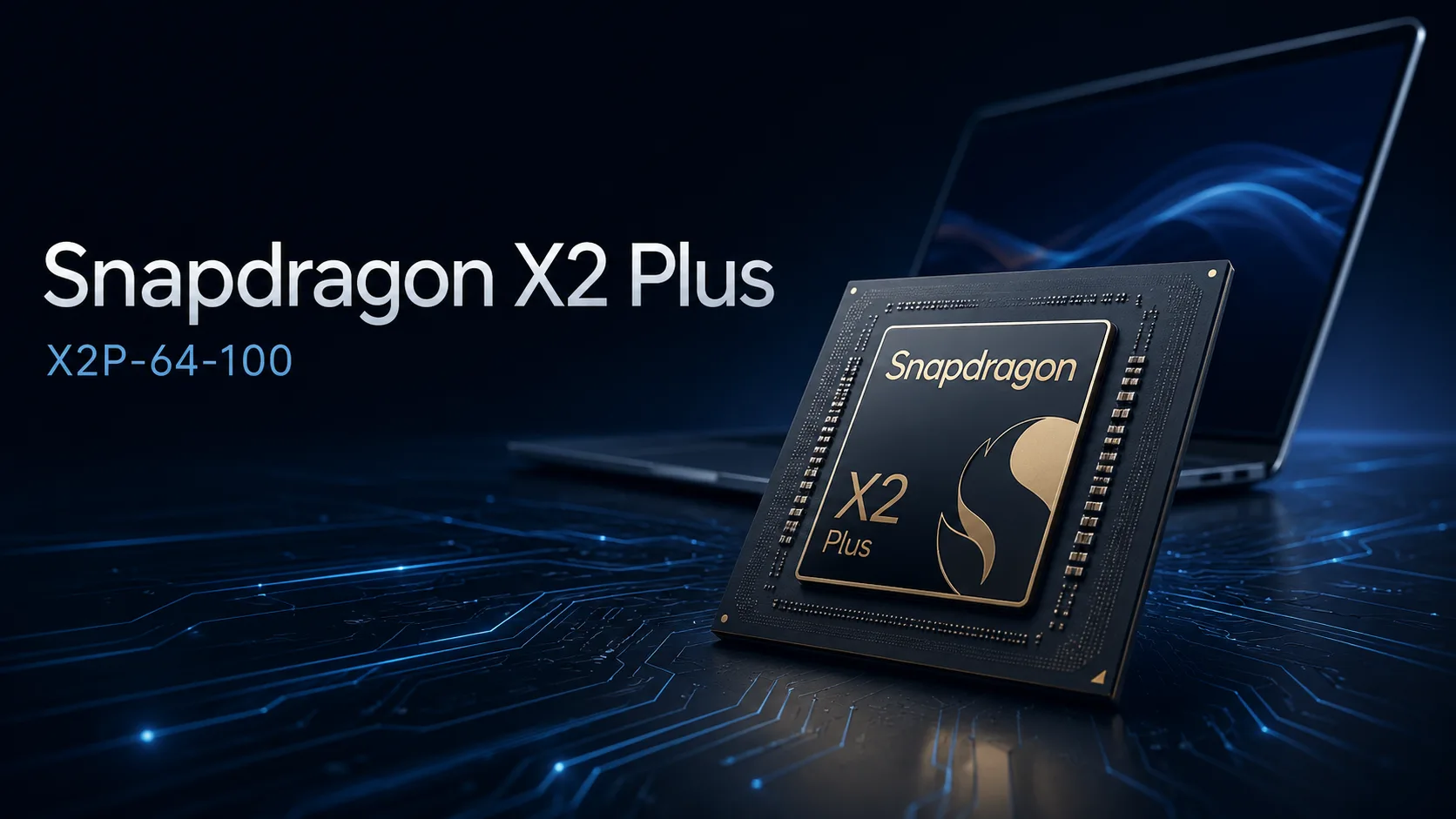
Qualcomm Snapdragon X2 Plus X2P-64-100 is the higher version of the Snapdragon X2 Plus for thin Windows laptops on ARM. Unlike the lower X2P-42-100, this model features a 10-core CPU, faster Adreno X2-45 graphics, increased cache, and the same NPU with 80 TOPS.
This is not just an office minimum, but an ARM platform for working thin laptops: web browsing, video calls, productivity applications, light editing, photo processing, and occasional rendering.
How X2P-64-100 Differs from the Lower X2P-42-100
| Parameter | X2P-64-100 | X2P-42-100 | Practical Implication |
|---|---|---|---|
| CPU | 10 cores | 6 cores | More cores for parallel tasks |
| Structure | 6 Prime + 4 Performance | 6 Prime | Better performance in simultaneous tasks |
| Cache | 34 MB | 22 MB | Better for heavy applications and multithreading |
| GPU | Adreno X2-45 up to 1.7 GHz | Adreno X2-45 up to 0.91 GHz | Higher performance of integrated graphics |
| NPU | 80 TOPS | 80 TOPS | NPU of the same level |
While both chips are part of the Snapdragon X2 Plus line, they differ in CPU and GPU levels. The X2P-42-100 is aimed at more affordable ARM laptops, while the X2P-64-100 is better suited as a foundation for a work laptop.
CPU Performance
In everyday use, the X2P-64-100 combines high single-core performance, quick system response, and 10 cores for parallel tasks. This profile suits web browsers, office applications, video calls, light editors, IDEs, and a large number of tabs well.
| Test | Approximate Result |
|---|---|
| Geekbench 6 Single-Core | around 3200-3400 |
| Geekbench 6 Multi-Core | around 14500-15500 |
For a thin laptop, this is a high level of performance. The X2P-64-100 exhibits strong single-core performance and surpasses its lower Snapdragon X Plus and Snapdragon X2 Plus counterparts in multi-threaded performance. Real-world results will depend on specific laptop configurations, power limits, cooling, and firmware versions.
Compared to the X2P-42-100, the higher version handles light editing, occasional rendering, batch photo processing, and heavy multitasking better. It is no longer just a chip for documents and browsers but a foundation for a work-focused thin laptop.
Adreno X2-45 Graphics
The integrated graphics is one of the main differentiators from the X2P-42-100. Formally, both processors use Adreno X2-45, but the X2P-64-100 has a GPU frequency of up to 1.7 GHz, while the lower model reaches only 0.91 GHz. Therefore, the higher version has a clear advantage in graphical tasks.
| Scenario | Assessment |
|---|---|
| Windows interface, browser, video | excellent |
| 4K video and external monitors | with reserves |
| Simple and old games | suitable |
| Light photo and video processing | suitable |
| Esports games | depends on the game and settings |
| Modern heavy games | a compromise option |
| GPU rendering and professional 3D | not a primary scenario |
The Adreno X2-45 is suitable for the interface, video, old games, simple projects, and light content processing. In heavy games and professional 3D work, limitations come not only from GPU power but also from the characteristics of Windows on ARM: drivers, anti-cheat, emulation, and the availability of ARM64 versions of applications.
AI and NPU
The NPU with 80 TOPS is an important part of the X2P-64-100 platform. This block does not accelerate regular rendering or replace a graphics card in games. Its role is to handle local AI functions that can operate without constant load on the CPU and GPU.
80 TOPS is crucial not for its own sake but in local AI scenarios: video calls, Windows system functions, image processing, speech recognition, and local assistants. However, the NPU works only where applications can utilize it. For large local models and heavy machine learning, a single NPU is insufficient; memory size, support for necessary applications and frameworks, and an appropriate graphics card are also important.
Practical Assessment and Compatibility
| Task | Assessment |
|---|---|
| Browser, office, documents | excellent |
| Many tabs and messengers | excellent |
| Video calls and presentations | excellent |
| Studying and working on-the-go | excellent |
| Programming | good, if the stack is ARM compatible |
| Light editing | suitable |
| Occasional rendering | better than X2P-42-100 |
| Batch photo processing | for moderate tasks |
| Gaming | depends on compatibility and settings |
| Old specific x86 software | check in advance |
Before purchasing a laptop with the X2P-64-100, it’s advisable to check the compatibility of working programs, professional software, VPN clients, plugins, old utilities, peripheral drivers, and games with anti-cheat systems. Windows on ARM runs x86 and x64 applications through emulation, but applications with a native ARM64 version perform best.
If the necessary applications have ARM64 versions or work reliably through emulation, the X2P-64-100 results in a fast and quiet laptop with good battery life.
Should You Buy a Laptop with Snapdragon X2 Plus X2P-64-100?
The Snapdragon X2 Plus X2P-64-100 is the most balanced model in the X2 Plus lineup. Compared to the X2P-42-100, it offers more cores, faster graphics, and better performance in parallel tasks, making it a better choice for a primary work laptop.
It is worth purchasing a laptop with this processor if you need a quick response, high battery life, quiet operation, an NPU with 80 TOPS, and stable multitasking performance. When choosing, not only the specifications of the chip matter but also the specific model of the laptop: memory, cooling, display, battery, price, and compatibility with required software.
In summary: Snapdragon X2 Plus X2P-64-100 is the higher-end ARM platform in the X2 Plus lineup for working thin laptops. It is significantly better suited than the X2P-42-100 for multitasking, light editing, occasional rendering, and content work.
CPU Comparison
Compare Snapdragon X2 Plus X2P-64-100 with other CPUs
Basic
CPU Specifications
Memory Specifications
GPU Specifications
AI Specifications
Connectivity
Interfaces and Ports
Miscellaneous
Benchmarks
Compared to Other CPU
Related CPU Comparisons
Share in social media
Or Link To Us
<a href="https://cputronic.com/cpu/qualcomm-snapdragon-x2-plus-x2p-64-100" target="_blank">Qualcomm Snapdragon X2 Plus X2P-64-100</a>