Apple M6 12 Cores

Apple M6 12 Cores: Apple’s First 2nm Chip and 12-Core CPU
The Apple M6 has two additional CPU cores compared with the M5 and delivers a noticeably larger gain in multi-threaded performance than in single-threaded performance. At the same time, Apple increased the GPU from 10 to 12 cores and moved to a 2nm process. In the production Mac mini, the new chip is approximately 20% faster than the M5 in heavy CPU workloads, while its graphics advantage exceeds 30% in some tests.
What Changed Compared with the M5
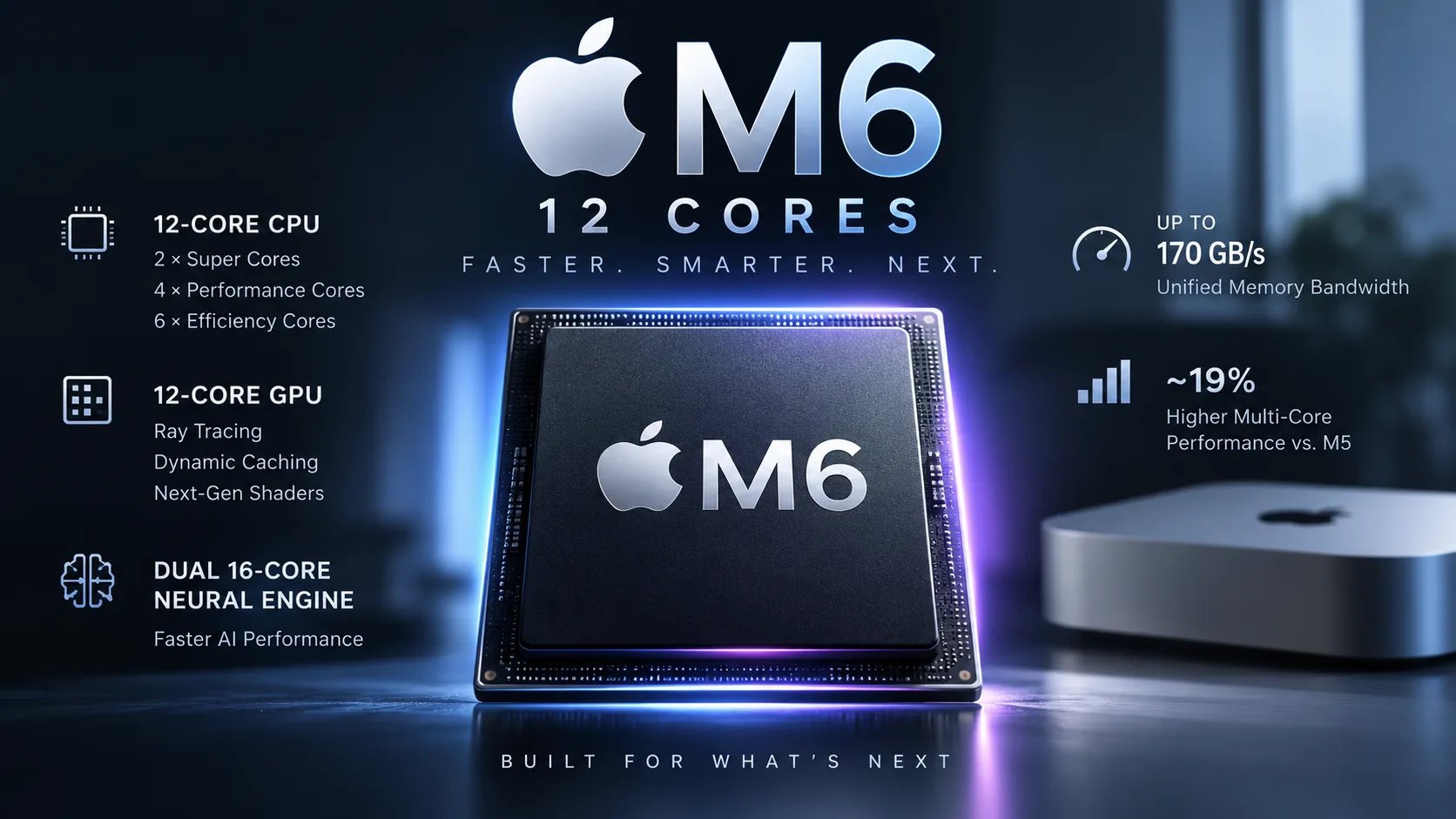
The M6’s 12-core CPU consists of two Super Cores, four Performance Cores, and six Efficiency Cores. The M5 had 10 CPU cores, so a significant portion of the Multi-Core performance gain is directly related to the increased core count.
Unified memory bandwidth increased from approximately 153 to 170 GB/s, while the maximum memory capacity remained at 32 GB. The GPU now has 12 cores instead of 10.
The main change is especially clear in multi-threaded tests: the additional cores allowed the M6 to pull significantly farther ahead of the M5 than it does in Single-Core performance.
CPU Performance
The results below were obtained on production devices.
| Device | Processor | Geekbench 6 Single | Geekbench 6 Multi | Cinebench 2024 Single | Cinebench 2024 Multi | Device starting price |
|---|---|---|---|---|---|---|
| Mac mini 2026 | Apple M6 | 4698 | 21302 | 221 | 1468 | $899 |
| MacBook Pro 14 2025 | Apple M5 | 4326 | 18054 | 200 | 1172 | $1599 |
| Mac mini 2024 | Apple M4 | 3838 | 15072 | 177 | 958 | $599 |
In Geekbench 6, the M6 is approximately 9% faster than the M5 in Single-Core and 18% faster in Multi-Core. In Cinebench 2024, the differences are approximately 11% and 25%, respectively.
The gap over the M4 is significantly larger. In Geekbench 6 Multi, the new processor is approximately 41% faster, while in Cinebench 2024 Multi it is more than 50% faster.
The comparison with the M4 Pro is also revealing. In Cinebench 2024 Multi, the M6 Mac mini scores 1468 points, compared with approximately 1455 for the M4 Pro version with a 12-core CPU. This does not make the base M6 a full replacement for Pro chips: they offer more powerful graphics, a higher memory limit, and more resources for sustained professional workloads. However, in pure CPU performance, the base M6 already reaches the level of the previous-generation Pro in some cases.
12-Core Graphics
The GPU increased from 10 to 12 cores. Apple retained Dynamic Caching and hardware-accelerated ray tracing, while Neural Accelerators are now built into every graphics core.
| Test | M6 12-core GPU | M5 10-core GPU | M4 10-core GPU |
|---|---|---|---|
| 3DMark Steel Nomad Light | 7069 | 5221 | 3989 |
| 3DMark Wild Life Extreme | 15842 | 12059 | - |
| Geekbench 6 Metal | 101981 | 77007 | 57948 |
In Steel Nomad Light, the M6 is approximately 35% faster than the M5 and 77% faster than the M4. In Wild Life Extreme, its advantage over the M5 is approximately 31%, while Geekbench Metal shows a difference of around 32%.
The gains are also noticeable in games. In Shadow of the Tomb Raider at 1080p with the maximum preset, the M6 Mac mini delivers approximately 76 fps, compared with 59 fps for the M5 and 41 fps for the M4. In Cyberpunk 2077 at 1080p Ultra without FSR, the result is approximately 37.5 fps, compared with 29.3 fps for the M5.
The 12-core GPU now provides reasonable 1080p performance, although the selection of games available for macOS and the capabilities of integrated graphics continue to limit the M6 as a gaming platform.
Neural Engine and Local AI
The M6 features a dual 16-core Neural Engine, while additional Neural Accelerators are built into all 12 GPU cores. Apple claims up to a twofold increase in peak Neural Engine performance compared with the previous generation.
For local AI tasks, the limiting factor may be not only computing performance but also memory capacity. The base M6 supports a maximum of 32 GB of unified memory, so Pro, Max, and Ultra configurations remain significantly more flexible for larger models.
Devices and Pricing
The Mac mini 2026 was the first production computer with the Apple M6. Its base configuration includes 16 GB of unified memory and a 256 GB SSD, with a starting price of $899.
For comparison, the M4 Mac mini started at $599. The price increased by $300, while the base 16 GB of memory and 256 GB SSD remained unchanged.
As a result, the M6 looks much stronger in performance terms than the M4 did at launch, but the Mac mini is no longer such an inexpensive entry point into Apple’s desktop computers.
Conclusion
The Apple M6 is a significantly larger upgrade than the M5. The two additional CPU cores are especially noticeable in multi-threaded workloads, while the 12-core GPU delivers gains of around 30% or more over the M5 in a number of graphics tests.
In CPU performance, the base M6 can already match the previous-generation 12-core M4 Pro in some cases, although Pro chips remain in a higher class in terms of graphics, memory capacity, and demanding professional workloads.
The main drawback of the new generation is not performance but the Mac mini’s price. The increase from $599 for the M4 to $899 for the M6 significantly worsens the price-to-performance ratio, especially considering the base configuration’s 16 GB of memory and 256 GB SSD.
For M1-M3 owners, the M6 delivers a substantial gain in both CPU and graphics performance. Upgrading from the M4 makes more sense for regular multi-threaded work, rendering, gaming, or local AI tasks where the additional CPU and GPU resources are actually used.
CPU Comparison
Compare Apple M6 12 Cores with other CPUs
Basic
CPU Specifications
Memory Specifications
GPU Specifications
AI Specifications
Interfaces and Ports
Benchmarks
Compared to Other CPU
Related CPU Comparisons


Share in social media
Or Link To Us
<a href="https://cputronic.com/cpu/apple-m6-12-cores" target="_blank">Apple M6 12 Cores</a>