Apple M5 Pro 15 Cores

Apple M5 Pro 15 Cores: How It Differs from the Lower M5 Pro
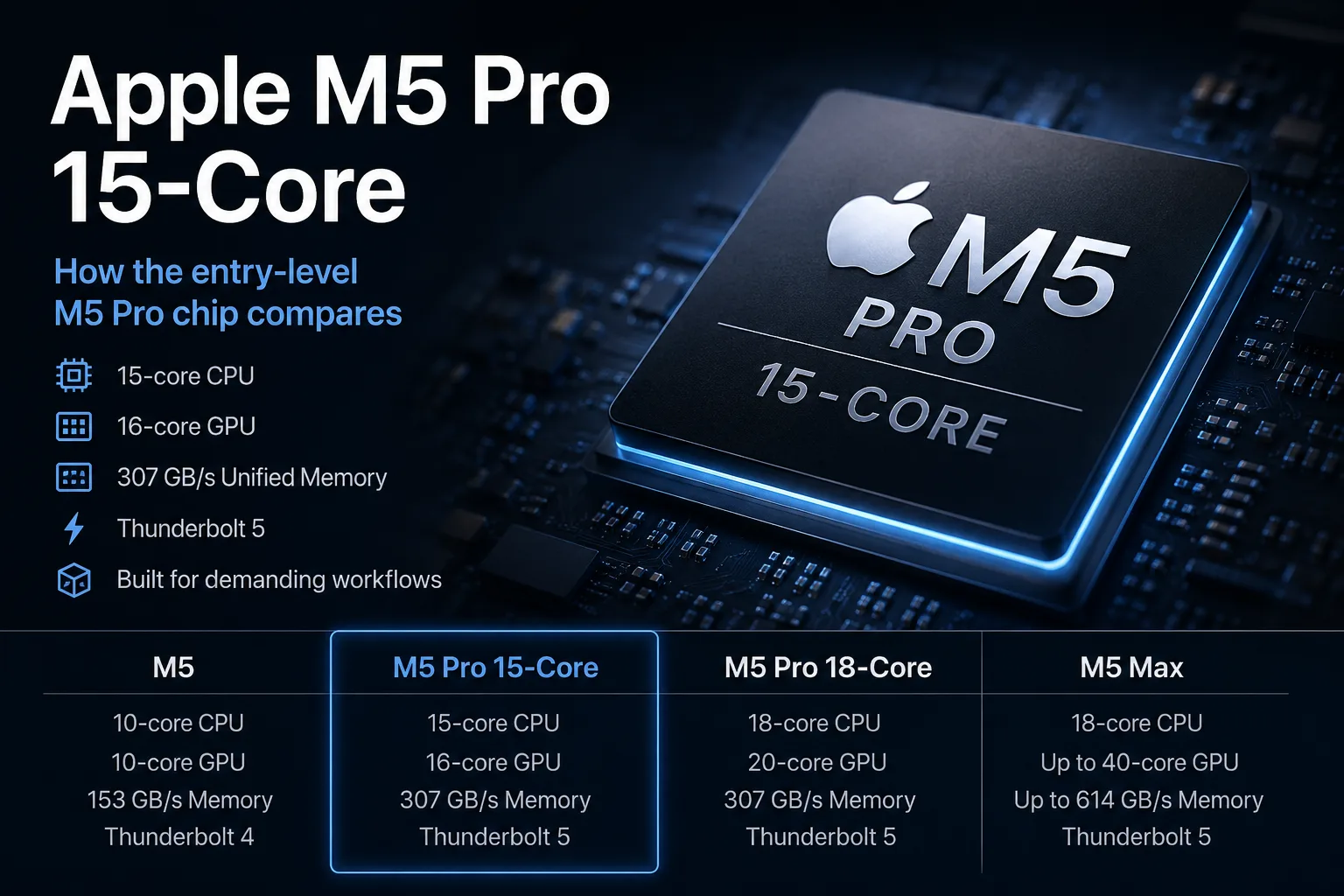
The Apple M5 Pro 15 cores is the base configuration of the M5 Pro for the MacBook Pro 2026. The chip features a 15-core CPU, a 16-core GPU, a 16-core Neural Engine, and a 307 GB/s unified memory bandwidth. Its strength lies in the CPU section and media blocks; the main limitation is its graphics compared to the M5 Pro with 18 cores and the M5 Max.
The M5 Pro has changed not only in the number of cores. Instead of the previous division into performance and efficiency cores, Apple specifies 5 super cores and 10 performance cores. Therefore, the comparison with the M4 Pro using the formula "15 cores versus 14" doesn’t explain much. The CPU architecture itself has changed in the M5 Pro.
What Is M5 Pro 15 Cores
The 15-core version of the M5 Pro uses 5 super cores and 10 performance cores. The higher M5 Pro has an 18-core CPU: 6 super cores and 12 performance cores. There is also a difference in graphics: 16 GPU cores versus 20.
For development, compiling, photo processing, and editing, the 15-core version is adequate. For 3D tasks, GPU rendering, complex scenes, and large local AI models, the higher configurations are better suited.
The memory operates at a bandwidth of 307 GB/s. For a mobile SoC, this is a high figure. The CPU, GPU, Neural Engine, and media blocks use a shared pool of memory, so data access speed is just as important as the number of cores.
How It Differs from the M4 Pro
The M4 Pro in its higher configuration had up to 14 CPU cores: 10 performance and 4 efficiency cores. The M5 Pro with 15 cores has a different layout: 5 super cores and 10 performance cores. On paper, the increase seems small, but a direct core comparison does not apply here.
The memory bandwidth has increased as well: it stands at 307 GB/s for the M5 Pro. This is significant for compiling, processing large photo archives, editing, and local AI tasks. In such scenarios, performance is often limited not only by the CPU but also by data handling speed.
Apple claims up to 30% improvement in multithreaded performance over the M4 Pro. This is an estimate for optimal scenarios, not a universal increment. In browsing and office tasks, the difference will be minimal. In long compilations, batch exports, and media processing, the gap should be more noticeable.
Performance in Benchmarks
One of the Geekbench 6 results for the MacBook Pro with the M5 Pro 15 cores shows around 4085 points in single-core and 25068 points in multi-core. This is not an official Apple test, but it provides a reference: single-thread performance is very high, and multi-thread performance is significantly above the levels of most mainstream mobile CPUs.
Geekbench does not replace tests in real applications. The M5 Pro 15 cores should perform best in tasks where both thread concurrency and speed of individual cores are important: Xcode, RAW processing, video export, archiving, project builds, and working with large files.
In terms of graphics, the 16-core GPU lags behind the 20-core version of the M5 Pro. If the task scales based specifically on the GPU, the difference will be more noticeable than in typical CPU workloads.
Graphics and Media Blocks
The 16-core GPU supports hardware ray tracing and is suitable for high-resolution interfaces, editing, GPU acceleration, and certain professional tasks. For 3D graphics, GPU rendering, heavy Metal workloads, and gaming, the higher versions will be faster.
In video editing, the M5 Pro 15 cores cannot be evaluated solely by the number of GPU cores. The chip features a Media Engine with hardware acceleration for H.264, HEVC, ProRes, ProRes RAW, and AV1 decoding. In Final Cut Pro, DaVinci Resolve, and other video editing software, this may be more important than the difference in a few GPU cores if codecs and workflows leverage Apple’s hardware media blocks.
For editing, exporting ProRes, working with HEVC, and typical content creator tasks, the M5 Pro 15 cores remains a justified choice. In heavy graphics, complex effects, 3D scenes, and GPU computing, the lower configuration is less advantageous.
Neural Engine and Local AI
The M5 Pro 15 cores has a 16-core Neural Engine. It is used in system functions of macOS, image and video processing, recognition tasks, and applications that support Apple’s neural network blocks.
The Neural Engine itself does not determine the speed of local AI. The amount of unified memory, bandwidth, GPU, and support for specific software are important. The M5 Pro 15 cores is suitable for local AI tasks that fit within available memory and work well through Apple’s tools. For larger models and prolonged computations, the M5 Max remains stronger.
M5 Pro 15 Cores or M5 Pro 18 Cores
The choice depends on workload. In browsing, office tasks, light editing, and most development scenarios, the M5 Pro 15 cores will not be a bottleneck. The difference will be noticeable under prolonged stress that effectively utilizes the extra cores.
The M5 Pro 18 cores features more CPU cores and a 20-core GPU. It is better suited for long compilations, batch processing, heavy editing, and GPU workloads. The M5 Pro 15 cores makes sense where Pro-level CPU and memory are needed but maximum graphics are not required.
What to Choose
| Scenario | More Logical Option |
|---|---|
| Development, photo, editing, Xcode | M5 Pro 15 Cores |
| Long compilation, batch processing, heavy editing | M5 Pro 18 Cores |
| 3D, GPU rendering, large AI models | M5 Max |
| Upgrading from M1 Pro, M2 Pro, or Intel Mac | M5 Pro 15 Cores |
| Already own M4 Pro | Upgrade only under regular heavy workloads |
Conclusion
The Apple M5 Pro 15 cores is the lower Pro chip with a strong CPU, fast unified memory, and full media blocks. Its weak point is the 16-core GPU. For development, photo work, editing, and CPU-intensive tasks, this configuration is justified. For 3D, GPU rendering, large ML models, and prolonged graphic loads, it’s better to choose the M5 Pro 18 cores or the M5 Max.
CPU Comparison
Compare Apple M5 Pro 15 Cores with other CPUs
Basic
CPU Specifications
Memory Specifications
GPU Specifications
AI Specifications
Connectivity
Interfaces and Ports
Miscellaneous
Benchmarks
Compared to Other CPU
Related CPU Comparisons





Share in social media
Or Link To Us
<a href="https://cputronic.com/cpu/apple-m5-pro-15-cores" target="_blank">Apple M5 Pro 15 Cores</a>