Qualcomm Snapdragon X2 Elite Extreme X2E-96-100
Snapdragon X2 Elite Extreme X2E-96-100: Faster than Core Ultra X9 and Ryzen AI 9 in Processor Tests
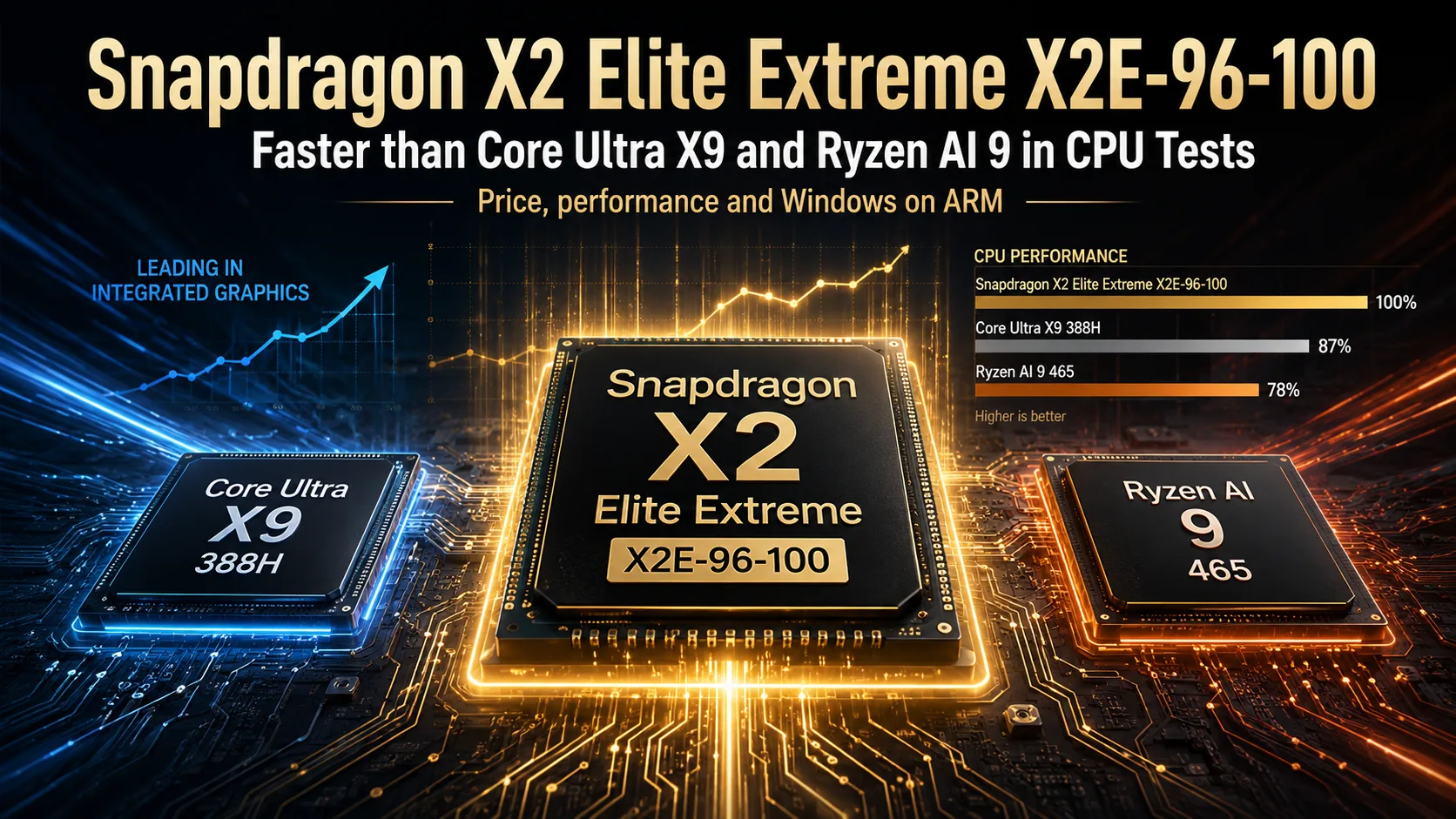
The Snapdragon X2 Elite Extreme X2E-96-100 is Qualcomm's flagship laptop processor with 18 Oryon cores and a clock speed of up to 5 GHz. In a recent comparison of serial ASUS Zenbook A16 laptops with the X2E-96-100, it significantly outperformed systems using Core Ultra X9 388H and Ryzen AI 9 465 in processor tests. However, Intel remained ahead in integrated graphics. The Signal65 test was commissioned by Qualcomm, and three different laptops were compared, so the results cannot be considered a straightforward comparison of the processors themselves.
18 Oryon Cores and Clock Speed up to 5 GHz
The X2E-96-100 combines 18 third-generation Oryon cores with a clock speed of up to 5 GHz, a 53 MB cache, and Adreno X2-90 clocked at up to 1.85 GHz. The Hexagon NPU delivers up to 80 TOPS, while the LPDDR5x bandwidth reaches up to 228 GB/s.
For Adreno X2-90, wide memory is especially important: the GPU uses the same LPDDR5x as the processor cores. Part of the X2 Elite has bandwidth limited to 152 GB/s; the Extreme, however, can achieve 228 GB/s.
The 96 Index Seems More Significant Than It Actually Is
The X2E-96-100 sits at the top of the lineup but differs much less from the X2E-94-100 than the name suggests.
| Model | Cores | Boost | GPU | GPU Clock | NPU | Memory |
|---|---|---|---|---|---|---|
| X2E-96-100 | 18 | 5.0 GHz | Adreno X2-90 | 1.85 GHz | 80 TOPS | 228 GB/s |
| X2E-94-100 | 18 | 4.7 GHz | Adreno X2-90 | 1.85 GHz | 80 TOPS | 228 GB/s |
| X2E-90-100 | 18 | 5.0 GHz | Adreno X2-90 | 1.70 GHz | 85 TOPS | 152 GB/s |
The X2E-96-100 and X2E-94-100 have the same 18 cores, GPU, memory subsystem, and NPU. The main difference is the boost of 5.0 GHz versus 4.7 GHz.
The X2E-90-100 also boosts to 5 GHz and is even specified at 85 TOPS NPU compared to 80 TOPS for the Extreme, but its GPU operates slower and has lower memory bandwidth. Thus, the 96 index does not necessarily indicate that this model is superior in every component.
X2E-96-100 vs. Core Ultra X9 388H and Ryzen AI 9 465
In August 2026, Signal65 compared three serial 16-inch laptops:
- ASUS Zenbook A16 - Snapdragon X2 Elite Extreme X2E-96-100;
- MSI Prestige 16 Flip AI+ - Intel Core Ultra X9 388H;
- HP OmniBook X Flip 16 - AMD Ryzen AI 9 465.
This is not a stand-alone processor test; the laptops differed in memory, firmware, and Windows builds.
Processor Tests: Snapdragon Leads by a Wide Margin
In Best Performance mode plugged in, the results were as follows:
| Test | X2E-96-100 | Core Ultra X9 388H | Ryzen AI 9 465 |
|---|---|---|---|
| Geekbench 7 Single-Core | 3 438 | 2 639 | 2 614 |
| Geekbench 7 Multi-Core | 27 519 | 17 990 | 15 023 |
| Cinebench 2026 Single-Thread | 622 | 502 | 460 |
| Cinebench 2026 Multi-Thread | 6 998 | 3 732 | 3 785 |
In Geekbench 7, the X2E-96-100 outperformed the Core Ultra X9 388H by 30% in single-core tests and by 53% in multi-core tests. The gap from the Ryzen AI 9 465 was 32% and 83%.
In Cinebench 2026 Multi, Snapdragon surpassed Intel by about 87% and AMD by 85%. In single-threaded workloads, the advantage was smaller: 24% and 35%, respectively.
The maximum lead for the X2E-96-100 is shown in heavy multi-threaded workloads.
What are the Prices of the Laptops in This Test?
The comparison becomes more interesting when looking at the prices of the devices themselves. For comparison, we will take regular retail prices in the USA without temporary discounts.
| Laptop | Processor | Memory / SSD | Price |
|---|---|---|---|
| ASUS Zenbook A16 UX3607OA-XS99 | X2E-96-100 | 48 GB / 1 TB | $1,999.99 |
| MSI Prestige 16 Flip AI+ | Core Ultra X9 388H | 32 GB / 1 TB | $2,299.99 |
| HP OmniBook X Flip 16 | Ryzen AI 9 465 | 32 GB / 512 GB | $1,849.99 |
The ASUS Zenbook A16 in the exact configuration UX3607OA-XS99 with the X2E-96-100, 48 GB LPDDR5X, and 1 TB SSD costs $1,999.99. The MSI Prestige 16 Flip AI+ with Core Ultra X9 388H, 32 GB of memory, and a 1 TB drive has a regular price of $2,299.99. The HP OmniBook X Flip 16 with Ryzen AI 9 465, 32 GB, and 512 GB SSD has a regular price of $1,849.99.
This paints an interesting picture: the best performance in processor tests was not delivered by the most expensive laptop. The Zenbook A16 is about $300 cheaper than the MSI with Core Ultra X9 388H. The HP with Ryzen AI 9 465 is only $150 away, while ASUS features 48 GB of memory and a 1 TB SSD against 32 GB and 512 GB from HP.
Calculating an exact "performance per dollar" from these figures would be incorrect: the price of a laptop includes the screen, case, memory, storage, and many other components. However, an important conclusion can be drawn - the advantage of the X2E-96-100 in processor tests was not obtained at the expense of a more expensive system.
In Everyday Work, the Gap is Much Smaller
In everyday applications, the difference no longer looks so radical.
In UL Procyon Office Productivity, Snapdragon scored 8,737 points - 16% higher than Intel and 20% more than AMD.
In Word, Snapdragon and Ryzen AI 9 465 are close - 8,759 versus 8,586 points. In Excel, the gap is more noticeable: 10,197 for Qualcomm, 8,030 for Intel, and 7,232 for AMD.
In Speedometer 3.1, Snapdragon scored 48.1 points against 39.7 for Intel and 34.9 for AMD. In WebXPRT 5, the difference between platforms was significantly smaller.
In heavy multi-threaded work, the advantage of Snapdragon sharply grows, while in Office it shrinks to 16-20%.
Arc B390 Faster than Adreno X2-90
On the processing side, Qualcomm confidently wins, but in integrated graphics, Intel takes first place.
| Integrated Graphics | 3DMark Steel Nomad Light DX12 |
|---|---|
| Intel Arc B390 | 5,848 |
| Adreno X2-90 | 5,419 |
| Radeon 880M | 3,373 |
The Arc B390 is about 8% faster than the Adreno X2-90. In Vulkan, Intel's advantage is around 12% - 6,203 versus 5,555 points.
Adreno X2-90 has a much larger advantage over the Radeon 880M: about 61% in DX12 and 80% in Vulkan.
The breakdown is simple: the X2E-96-100 leads in processor tests, the Core Ultra X9 388H excels in integrated graphics, and the Ryzen AI 9 465 lags behind both.
However, the speed of Adreno is only half the equation. For some games, drivers, and specialized software, compatibility with Windows on ARM still needs to be verified separately.
NPU: Fast but Not the Top Performer in the Lineup
In UL Procyon AI Computer Vision, the X2E-96-100 scored 4,414 points against 2,265 for Intel and 1,809 for AMD. In Computer Vision 2.0 using WinML, the gap was smaller: 2,170 versus 1,601 and 1,143.
However, the X2E-96-100 is not the leader in the family regarding the specified NPU performance: the X2E-90-100 is specified at 85 TOPS compared to 80 TOPS for the Extreme.
The Advantage Remains on Battery
In Balanced mode while running on battery, the X2E-96-100 scored 25,799 points in Geekbench 7 Multi, compared to 17,128 for Core Ultra X9 388H and 13,964 for Ryzen AI 9 465.
Cinebench 2026 Multi shows a more noticeable drop: from around 7,000 points down to 4,695. Intel scored 3,663, AMD 3,560. Snapdragon remains first, but Cinebench shows a significant drop in performance when operating on battery.
Tom's Hardware tests confirm that reduced battery performance depends not only on architecture but also on the power profile of the specific laptop.
The Main Limitation is No Longer in the Processor
In terms of processing performance, the X2E-96-100 no longer appears to be an experimental alternative to Core and Ryzen; in recent tests, it outperforms both current competitors.
The main limitation now is Windows on ARM. Browsers, Office, and many modern applications already work without serious caveats, but specialized software, old drivers, and some games still need individual compatibility checks before purchase.
Conclusion
The X2E-96-100 shows that Qualcomm's weak spot in Windows laptops is no longer the processor.
In processor tests, it is significantly faster than both Core Ultra X9 388H and Ryzen AI 9 465, while in Office, the gap narrows to 15-20%. Intel remains ahead in integrated graphics.
Prices make the result more interesting. The Zenbook A16 with the X2E-96-100 costs around $2,000 - about $300 cheaper than the tested MSI with Core Ultra X9 388H and only $150 more expensive than the HP with Ryzen AI 9 465. At the same time, ASUS offers 48 GB of memory and a 1 TB SSD. Thus, the high processor performance of Snapdragon in this comparison does not come with a higher price for the finished laptop.
Now, the main question is not speed or even price, but compatibility with Windows on ARM. If the necessary software works properly, the X2E-96-100 appears not only as a competitor to the higher mobile Core and Ryzen but also as one of the strongest offerings among high-performance thin Windows laptops.
When choosing between the X2E-96-100 and X2E-94-100, the deciding factor should be the price of the specific model. The 96 index mainly comes at an additional cost for the extra 300 MHz boost: the cores, Adreno X2-90, memory, and NPU are identical between the two processors.
CPU Comparison
Compare Snapdragon X2 Elite Extreme X2E-96-100 with other CPUs
Basic
CPU Specifications
Memory Specifications
GPU Specifications
AI Specifications
Connectivity
Interfaces and Ports
Miscellaneous
Benchmarks
Compared to Other CPU
Related CPU Comparisons



Share in social media
Or Link To Us
<a href="https://cputronic.com/cpu/qualcomm-snapdragon-x2-elite-extreme-x2e-96-100" target="_blank">Qualcomm Snapdragon X2 Elite Extreme X2E-96-100</a>