Apple M5 Ultra 36 Cores

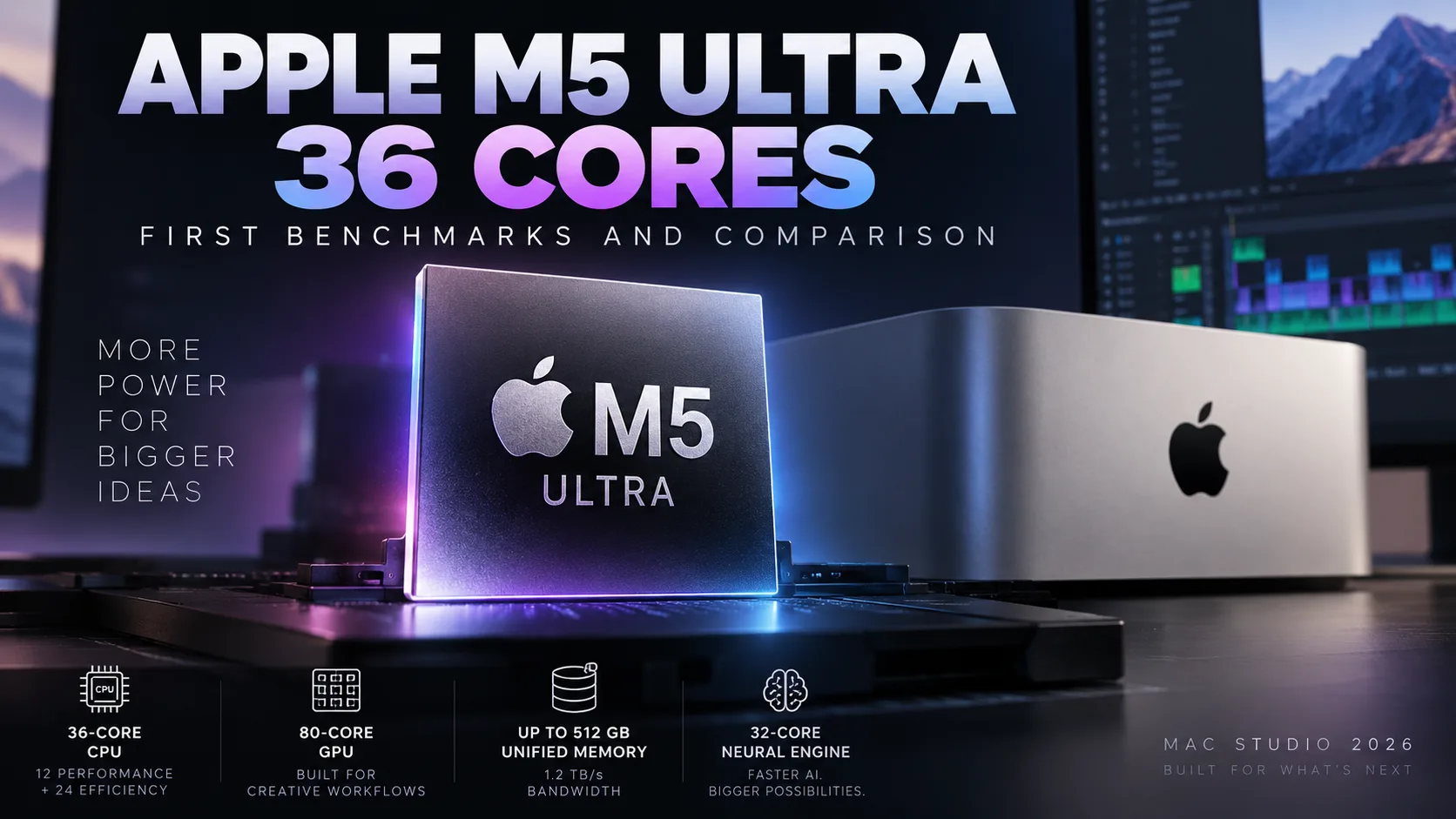
Apple M5 Ultra 36 Cores: 36-Core CPU, 80-Core GPU, and Up to 512 GB of Memory
Apple M5 Ultra 36 Cores is the higher-end version of the M5 Ultra for the 2026 Mac Studio. It features a 36-core CPU and an 80-core GPU, while unified memory bandwidth reaches 1.2 TB/s. In production-system benchmarks, the processor is approximately 29% faster than the M5 Max in Geekbench 6 Multi-Core and more than 50% faster in Cinebench 2024 Multi-Core. The price of a Mac Studio with this chip starts at $6,799.
How the 36-Core M5 Ultra Differs from the 30-Core Version
The M5 Ultra is available in two configurations. The lower-end version has 30 CPU cores and 64 GPU cores, while the higher-end version has 36 and 80, respectively.
| Specification | M5 Ultra 36 Cores | M5 Ultra 30 Cores |
|---|---|---|
| CPU | 36 cores | 30 cores |
| CPU configuration | 12 Super + 24 Performance | 10 Super + 20 Performance |
| GPU | 80 cores | 64 cores |
| Neural Engine | 32 cores | 32 cores |
| Memory bandwidth | 1.2 TB/s | 1.2 TB/s |
| Base memory | 96 GB | 96 GB |
| Maximum memory | 512 GB | 256 GB |
| Mac Studio starting price | $6,799 | $5,499 |
The higher-end chip costs an additional $1,300. The number of CPU cores increases by 20%, while the number of GPU cores increases by 25%. Memory bandwidth remains unchanged.
Another important difference concerns memory. Only the 36-core configuration can be ordered with 512 GB of unified memory. At the time of the Mac Studio’s launch, this version is not yet available and is expected to arrive in late October 2026.
CPU Performance
After the Mac Studio went on sale, results from production computers with the M5 Ultra 36 Cores became available. They differ from the early tests of engineering systems, so retail-device results are more useful for evaluating the processor.
| Device | Processor | Geekbench 6 Single | Geekbench 6 Multi | Cinebench 2024 Single | Cinebench 2024 Multi | Price |
|---|---|---|---|---|---|---|
| Mac Studio 2026 | M5 Ultra 36 Cores | 4337 | 38432 | 210 | 3705 | from $6,799 |
| MacBook Pro 14 2026 | M5 Max 18 Cores | 4310 | 29793 | 199 | 2456 | from $3,599 |
| Mac Studio 2025 | M3 Ultra 32 Cores | 3141 | 28870 | 141 | 2994 | from $4,999 |
In Geekbench 6 Single-Core, the M5 Ultra is virtually indistinguishable from the M5 Max, with a difference of less than 1%. This is expected: both processors use cores from the same generation with similar clock speeds.
In Multi-Core, the additional cores change the picture. The M5 Ultra scores 38432 points versus 29793 for the M5 Max, giving it an advantage of approximately 29%.
Cinebench 2024 responds more strongly to an increase in the number of cores. Here, the M5 Ultra scores 3705 points versus 2456 for the M5 Max-a difference of approximately 51%.
Compared with the M3 Ultra, the new processor is approximately 38% faster in Geekbench 6 Single-Core and 33% faster in Multi-Core. In Cinebench 2024, the advantages are approximately 49% and 24%, respectively.
The variation between benchmarks shows that there is no single percentage improvement for the M5 Ultra. The advantage depends on the workload and on how efficiently the application uses all 36 cores.
80-Core GPU
The higher-end M5 Ultra features an 80-core GPU, compared with 64 cores in the lower-end configuration. Each graphics core also includes a Neural Accelerator for machine-learning workloads.
This is an important difference from the M5 Max, since the M5 Ultra is designed for more than just CPU workloads. The additional graphics resources are used for 3D rendering, video processing, GPU computing, and local AI tasks.
For workloads that run almost entirely on the CPU, paying extra for the 80-core GPU provides less benefit. However, in workflows that use the CPU, GPU, and a large amount of shared memory simultaneously, the difference between the M5 Max and M5 Ultra becomes much more noticeable.
Up to 512 GB of Unified Memory
One of the main reasons to choose the 36-core M5 Ultra specifically is the option to install up to 512 GB of unified memory. The limit for the 30-core version is 256 GB.
The large shared memory pool is available to both the CPU and GPU without copying data between separate system and video memory. This is particularly useful when working with large AI models, large 3D scenes, scientific calculations, and complex video projects.
For most applications, 512 GB is excessive. However, memory capacity distinguishes the M5 Ultra from conventional desktop and mobile processors more strongly than its single-threaded benchmark results do.
Memory bandwidth is 1.2 TB/s for both M5 Ultra versions.
What the M5 Ultra 36 Cores Is For
The additional six CPU cores are most useful in sustained multithreaded workloads-rendering, compiling large projects, video encoding, simulations, and other tasks capable of loading all the cores.
For general software development, photo processing, and most everyday professional applications, the M5 Max is significantly cheaper and comes close to the M5 Ultra in single-threaded performance.
Moving to the M5 Ultra 36 Cores becomes more worthwhile when 36 CPU cores, 80-core graphics, and more than 128 GB of memory are needed simultaneously. For configurations with 256 or 512 GB, the M5 Max no longer has a direct alternative.
Price
A Mac Studio with the M5 Ultra 36 Cores, an 80-core GPU, 96 GB of unified memory, and a 1 TB SSD costs from $6,799.
The model with the M5 Ultra 30 Cores, a 64-core GPU, the same 96 GB of memory, and a 1 TB SSD starts at $5,499. Thus, upgrading to the fully enabled M5 Ultra increases the price by $1,300.
For ordinary multithreaded work, this surcharge is substantial relative to the increase in CPU cores. It is more justifiable if the application also uses the additional graphics performance or if a 512 GB memory configuration is required.
Conclusion
The Apple M5 Ultra 36 Cores is noticeably faster than the M5 Max in workloads capable of using all the cores, but it is almost indistinguishable from it in Single-Core performance. Its advantage is approximately 29% in Geekbench 6 Multi and approximately 51% in Cinebench 2024 Multi.
Compared with the M3 Ultra, the new processor is also significantly faster, especially in single-threaded workloads. However, the main advantage of the higher-end M5 Ultra is not limited to the CPU. It combines a 36-core processor, 80-core graphics, 1.2 TB/s of memory bandwidth, and support for up to 512 GB of unified memory.
Starting at $6,799, this is a specialized configuration for demanding professional work. If a 64-core GPU and 256 GB of memory are sufficient, the lower-end M5 Ultra saves $1,300. The M5 Ultra 36 Cores is primarily intended for situations where the additional CPU and GPU cores or the ability to install 512 GB of memory genuinely reduce processing time or make it possible to complete a task that does not fit within the lower-end configuration.
CPU Comparison
Compare Apple M5 Ultra 36 Cores with other CPUs
Basic
CPU Specifications
Memory Specifications
GPU Specifications
AI Specifications
Interfaces and Ports
Benchmarks
Compared to Other CPU
Related CPU Comparisons


Share in social media
Or Link To Us
<a href="https://cputronic.com/cpu/apple-m5-ultra-36-cores" target="_blank">Apple M5 Ultra 36 Cores</a>