AMD Ryzen 9 PRO 9965X3D

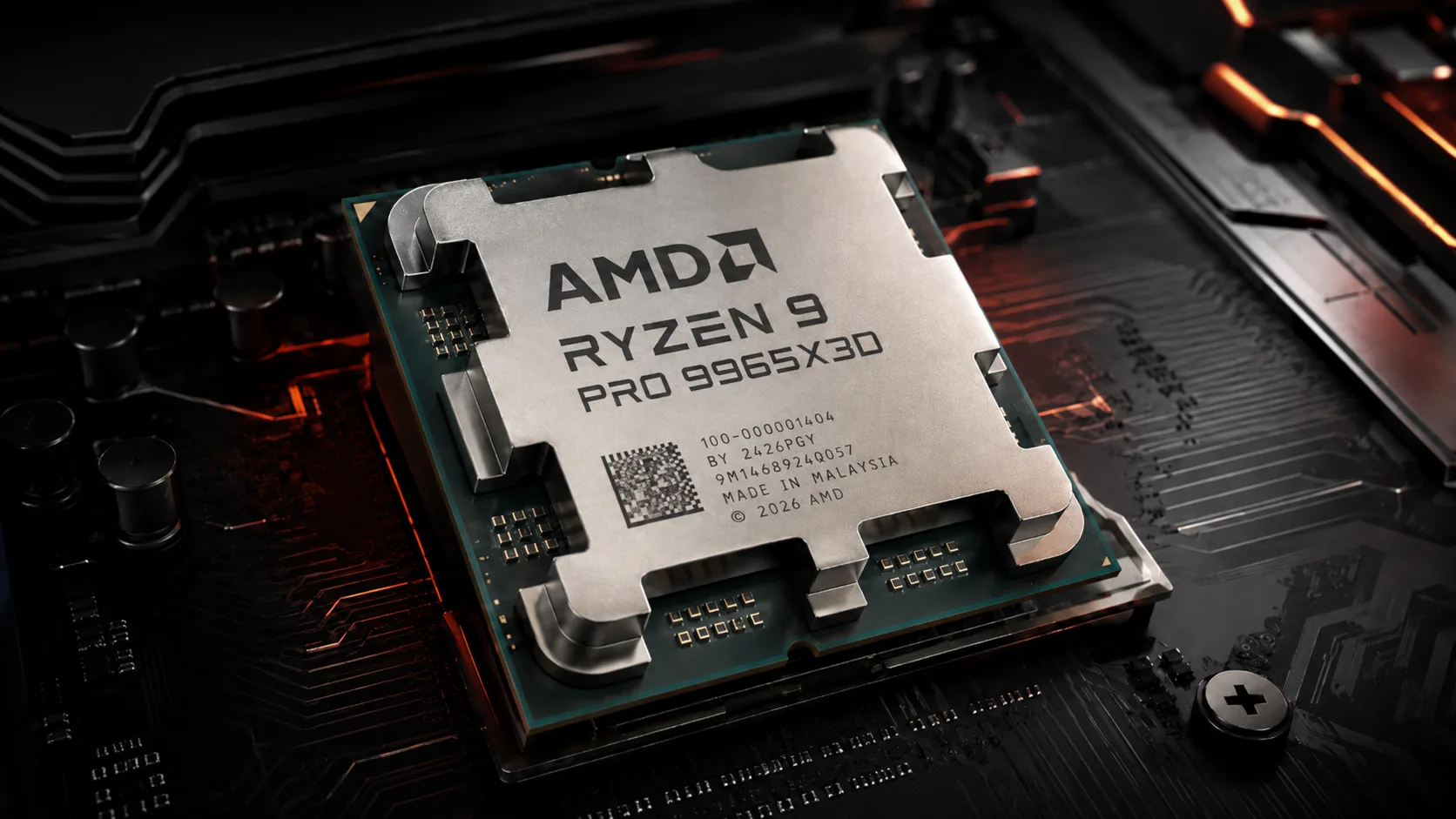
AMD Ryzen 9 PRO 9965X3D: 3D V-Cache Moves to Workstations
The AMD Ryzen 9 PRO 9965X3D is an unusual processor even by the standards of the high-end Ryzen lineup. On one hand, it's a 16-core Zen 5 with 3D V-Cache, which makes it a close relative of the Ryzen 9 9950X3D. On the other hand, it's not an ordinary retail model for enthusiasts, but a PRO chip tailored for corporate desktop systems and workstations.
The main idea here is not to simply create another fast gaming processor. The Ryzen 9 PRO 9965X3D combines 16 cores, 32 threads, high boost capabilities, 128 MB of L3 cache, and a suite of corporate features from AMD PRO. Thus, it’s more interesting to view it not as a replacement for the standard Ryzen 9 9950X3D in a home PC, but as a processor for ready-made professional systems, where performance, stability, remote management, and a long platform lifecycle are crucial.
What Makes the Ryzen 9 PRO 9965X3D Special
At the core of this processor lies the Zen 5 architecture. This is a modern AM5 desktop platform supporting DDR5, PCIe 5.0, and ECC memory when paired with a compatible motherboard. But the key detail is the 3D V-Cache. The Ryzen 9 PRO 9965X3D boasts 128 MB of L3 cache, which significantly distinguishes it from ordinary 16-core processors.
A large L3 cache is often associated with gaming, but its benefits aren't limited to FPS. It can assist in tasks where the CPU frequently accesses the same data sets: engineering calculations, simulations, large project compilations, some data analysis scenarios, and scientific or industrial applications. In such workloads, not only cores and frequencies are important, but also data access latencies.
That said, one should not turn the 3D V-Cache into magic. If an application scales well only across threads or is bandwidth-bound, the gain from a large cache may be modest. However, in mixed tasks, the Ryzen 9 PRO 9965X3D emerges as a very strong contender: it has both 16 full-fledged cores and a sizable cache, plus a modern platform.
Performance and Competitors in PassMark
PassMark does not replace comprehensive tests in real applications, but it serves as a good quick reference, especially when trying to understand where the processor stands in relation to closely competing models.
| Processor | CPU Mark | Single Thread | Comments |
|---|---|---|---|
| AMD Ryzen 9 9950X3D | 70 191 | 4 743 | Close retail X3D analog for enthusiasts |
| Intel Core Ultra 9 285K | 67 286 | 5 088 | Stronger in single-thread, different platform and architecture |
| AMD Ryzen 9 9950X | 65 747 | 4 728 | Standard 16-core Ryzen without 3D V-Cache |
| AMD Ryzen 9 PRO 9965X3D | 64 196 | 4 471 | Early result, only 1 sample |
According to these figures, the Ryzen 9 PRO 9965X3D does not yet appear faster than the Ryzen 9 9950X3D or Ryzen 9 9950X on average CPU Mark. However, it's important not to draw hasty conclusions: the PRO model has a very small sample size in the PassMark database, meaning the results could change significantly as more systems become available.
A more important takeaway here is that the Ryzen 9 PRO 9965X3D does not need to outperform the standard 9950X3D in every benchmark because it is a processor with a different purpose. The Ryzen 9 9950X3D is aimed at enthusiasts, gaming, and custom builds. In contrast, the Ryzen 9 PRO 9965X3D targets corporate PCs and workstations, where performance needs to be paired with manageability, security, and predictable configuration.
How It Differs from the Ryzen 9 9950X3D
At first glance, the Ryzen 9 PRO 9965X3D and the Ryzen 9 9950X3D appear very similar: both feature 16 cores, 32 threads, Zen 5 architecture, 128 MB L3 cache, an AM5 socket, and a TDP of 170 watts. However, the difference in positioning is significant.
The Ryzen 9 9950X3D is a retail processor for enthusiasts. It has a higher maximum boost frequency, supports overclocking, PBO, EXPO, and Curve Optimizer. It is better suited for those building a powerful home PC who wish to manually tune their system and maximize the potential of cooling, memory, and BIOS.
The Ryzen 9 PRO 9965X3D is designed differently. It has overclocking, EXPO, PBO, and Curve Optimizer disabled. At first glance, this appears to be a disadvantage, but for a corporate machine, this approach makes sense: for the workstation manufacturer, stability, certification, configuration repeatability, and minimizing variables in device maintenance are paramount.
That’s why it’s essential to evaluate the PRO version not only based on frequencies. Its advantage lies not in the freedom of manual tuning but in the combination of powerful hardware and corporate functions.
PRO Features: Why They Matter
The PRO suffix here is not just marketing. The Ryzen 9 PRO 9965X3D supports remote management, security, and maintenance features important to companies. These include DASH, remote hardware inventory, remote power management, AMD Memory Guard, Secure Processor, Secure Boot, Firmware TPM, and other functionalities beneficial for corporate infrastructure.
For the average home user, these features offer little value. However, for IT departments, such capabilities are crucial: it becomes easier to deploy, monitor, update, diagnose, and maintain the system remotely. In a workstation, these factors can outweigh a few percentage points in a synthetic benchmark.
Integrated Graphics and Platform
The processor includes integrated AMD Radeon Graphics with 2 graphics cores. This is sufficient for display output, diagnostics, and basic office tasks, but it’s not intended for gaming or professional graphics. In a real workstation, this processor will almost certainly be used alongside a discrete graphics card.
The AM5 platform makes the Ryzen 9 PRO 9965X3D fairly flexible: DDR5, PCIe 5.0, support for modern chipsets, and the capability to use up to 256 GB of memory. For professional tasks, this is a crucial point since a workstation is often limited not only by the processor but also by RAM capacity, storage speed, and graphics card capabilities.
Who Is the Ryzen 9 PRO 9965X3D For
The Ryzen 9 PRO 9965X3D is ideally suited for a complete workstation used by developers, engineers, architects, 3D graphics specialists, data analysts, and heavy multitasking applications. This processor is designed for situations where high performance is required, but the system needs to remain part of a managed corporate environment.
For a home gaming PC, looking at the Ryzen 9 9950X3D makes more sense. It's more straightforward, more accessible as a retail product, and provides greater tuning freedom. For a general-purpose workstation without PRO requirements, the standard Ryzen 9 9950X or 9950X3D may also be a more obvious choice.
However, when it comes to a ready-made business system that requires 16 cores, a large cache, AM5, ECC support with the appropriate motherboard, and AMD PRO corporate features, the Ryzen 9 PRO 9965X3D appears more like a distinct and logical product rather than a peculiar variation of the 9950X3D.
Conclusion
The AMD Ryzen 9 PRO 9965X3D is not simply a Ryzen 9 9950X3D under a different name. It is a 16-core X3D processor for workstations where benchmarks, manageability, security, stability, and platform predictability are not just secondary considerations.
Based on early PassMark data, it currently does not outperform the Ryzen 9 9950X3D, but it is still too early to draw final conclusions: the sample size for the PRO model is too small. The strength of the Ryzen 9 PRO 9965X3D lies not in setting records for the sake of records, but in combining Zen 5, 3D V-Cache, 16 cores, and the corporate capabilities of AMD PRO.
If you need a processor for a home gaming or enthusiast PC, the Ryzen 9 9950X3D appears to be the more natural choice. However, if a powerful workstation in a corporate environment is required, the Ryzen 9 PRO 9965X3D may prove to be the more appropriate selection.
CPU Comparison
Compare Ryzen 9 PRO 9965X3D with other CPUs
Basic
CPU Specifications
Memory Specifications
GPU Specifications
Miscellaneous
Benchmarks
Compared to Other CPU
Share in social media
Or Link To Us
<a href="https://cputronic.com/cpu/amd-ryzen-9-pro-9965x3d" target="_blank">AMD Ryzen 9 PRO 9965X3D</a>