Apple M5 Pro 18 Cores

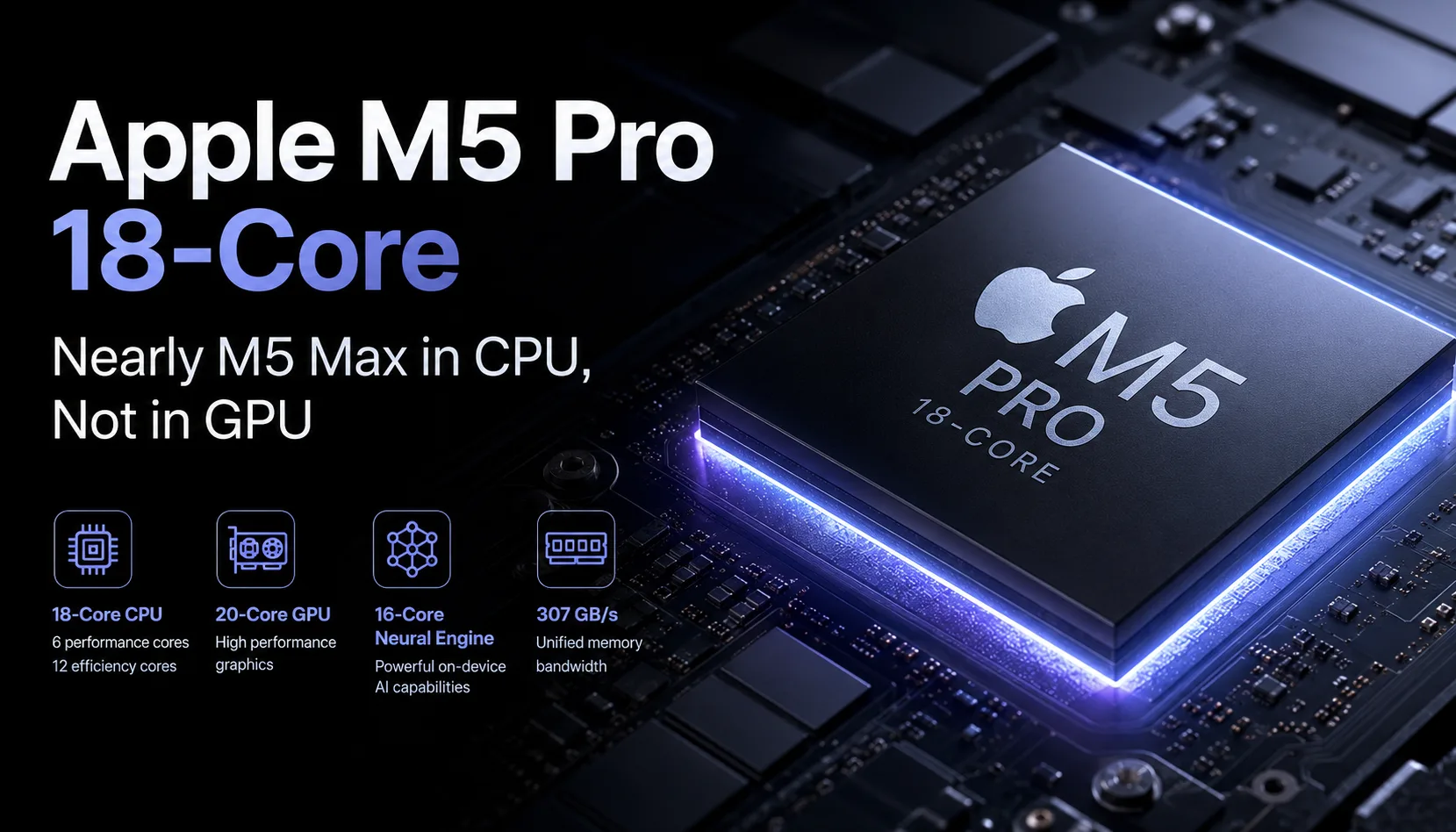
Apple M5 Pro 18-Core: Almost M5 Max in CPU, but Not in Graphics
The Apple M5 Pro 18-Core is the higher version of the M5 Pro for the 2026 MacBook Pro. This chip features an 18-core CPU with 6 super cores and 12 performance cores, a 20-core GPU, a 16-core Neural Engine, and 307 GB/s memory bandwidth.
The main highlight of this version is the CPU. In processor benchmarks, the M5 Pro 18-Core nearly matches the M5 Max and noticeably outperforms the M4 Pro. The difference between Pro and Max begins not in the CPU, but in graphics, memory, and the media block.
Models with Apple M5 Pro 18-Core
The Apple M5 Pro 18-Core appears in the higher configurations of the MacBook Pro:
- MacBook Pro 14-inch - M5 Pro 18-core CPU / 20-core GPU;
- MacBook Pro 16-inch - M5 Pro 18-core CPU / 20-core GPU.
This is not the base M5 or the lower M5 Pro with a 15-core CPU. The M5 Pro 18-Core occupies an intermediate position between the lower M5 Pro models and the versions with the M5 Max.
Benchmarks and Comparison
Below are the results from Notebookcheck for the tested configurations. The values depend on the chassis, cooling, power limits, version of the test, and memory configuration, so they should be taken as a comparative basis rather than a fixed result for each laptop.
| Chip / Configuration | Geekbench 6.6 Single | Geekbench 6.6 Multi | Cinebench 2024 Multi |
|---|---|---|---|
| Apple M5 Pro 18-Core | 4295 | 28436 | 2347 |
| Apple M5 Max 16-inch | 4335 | 29256 | 2437 |
| Apple M4 Pro 14-Core | 3836 | 22509 | 1729 |
| Snapdragon X2 Elite Extreme | 4080 | 23491 | 1988 |
| AMD Ryzen AI Max+ 395 | 2975-2978 | 19364-21269 | 1648-1673 |
The main takeaway from the table is that the M5 Pro 18-Core is nearly on par with the M5 Max in CPU tests. In Geekbench 6.6 Single, the difference is less than 1%, in Geekbench 6.6 Multi, around 3%, and in Cinebench 2024 Multi, about 4%. Buying the M5 Max solely for its CPU is not always justified.
Compared to the M4 Pro, the gain is more pronounced: about 12% in Geekbench 6.6 Single, around 26% in Geekbench 6.6 Multi, and approximately 36% in Cinebench 2024 Multi. Thus, transitioning from the M4 Pro to the M5 Pro 18-Core is justified primarily for tasks that heavily load the CPU: compiling, CPU rendering, exporting, batch processing, and local calculations.
Comparison with Snapdragon X2 Elite Extreme and Ryzen AI Max+ 395 showcases the CPU level, not the overall value of the laptop. In selected tests, the M5 Pro 18-Core outperforms both external benchmarks, but Windows laptops offer different advantages: discrete graphics, gaming capabilities, price, cooling, and configuration choices.
CPU: The Main Reason to Choose the 18-Core Version
The M5 Pro 18-Core utilizes a 6 super cores + 12 performance cores scheme. These 12 cores cannot be labeled as efficiency cores: Apple describes them as performance cores, so a direct comparison with the old performance/efficiency scheme is incorrect.
The six super cores are responsible for single-threaded speed. The twelve performance cores add resources for parallel loads. The practical meaning is simple: the M5 Pro 18-Core is needed where the laptop regularly utilizes all cores.
Typical scenarios include building large projects, Xcode, Swift, C++, Rust, Go, batch processing RAW, CPU rendering, exporting, containers, virtual machines, and working with multiple heavy applications.
For browsing, office tasks, light editing, and occasional photo processing, the lower M5 Pro models are sufficient. The higher 18-core version is not for “future-proofing,” but for real CPU loads.
M5 Pro 18-Core vs. M5 Max
In terms of CPU, the M5 Pro 18-Core and M5 Max are close. In some tests, the Max is slightly faster, while in others the difference is minimal. This does not make the M5 Pro equal to the M5 Max as a chip, but it illustrates that the CPU aspect is not the main reason to upgrade to the Max.
The main differences of the M5 Max include:
- 32 or 40 GPU cores instead of 20;
- 460 or 614 GB/s memory bandwidth instead of 307 GB/s;
- a larger maximum unified memory capacity;
- an advanced media block with two encoding engines and two ProRes encode/decode engines.
The M5 Max is necessary for 3D rendering, heavy Metal loads, large local AI models, complex video editing, and tasks where memory or graphics are critical. If the primary workload involves compiling, photo editing, data, CPU calculations, and moderate editing, the M5 Pro 18-Core is more rational.
Windows Competitors: Strong CPU, but Not the Whole Picture
The M5 Pro 18-Core is impressive not only within Apple's lineup. In selected CPU benchmarks, it outperforms the Snapdragon X2 Elite Extreme and AMD Ryzen AI Max+ 395. The difference with the Ryzen AI Max+ 395 is especially noticeable in single-threaded Geekbench and Cinebench 2024 Multi.
However, this is not a universal conclusion about laptops as a whole. Windows models offer a broader range of configurations, often feature discrete graphics, higher gaming compatibility, and more price options. Therefore, comparison with AMD and Qualcomm highlights the CPU level rather than replacing a comprehensive choice between MacBook Pro and Windows laptops.
GPU, AI, Memory, and Video
The 20-core GPU of the M5 Pro is suitable for editing, photo processing, Metal applications, moderate 3D tasks, and some games under macOS. However, it is not M5 Max. In GPU rendering, heavy 3D, large scenes, games, and GPU AI loads, the Max's advantage will be significant.
The AI block consists of a 16-core Neural Engine and Neural Accelerators in the GPU. This is sufficient for Core ML, image processing, video effects, noise reduction, transcription, and local AI tasks of moderate size. For large models, unified memory volume, bandwidth, and GPU are more important, making the M5 Max stronger in those scenarios.
The memory bandwidth of the M5 Pro 18-Core stands at 307 GB/s. This is sufficient for development, photography, editing, multitasking, and local AI tools. Limitations will appear in tasks involving large models, heavy 3D scenes, GPU rendering, and large media projects.
The media block supports H.264, HEVC, ProRes, ProRes RAW, and AV1 decode. This is adequate for 4K editing, ProRes, color correction, and routine exports. The M5 Max is necessary if work revolves around multiple video streams, heavy timelines, and continuous professional export.
Who is the Apple M5 Pro 18-Core For
The M5 Pro 18-Core is designed for those who need maximum CPU power in the Pro series without moving to the M5 Max. This includes developers, photographers, engineers, analysts, and content creators who work with heavy projects but do not rely on the GPU daily.
Rational scenarios include Xcode, large projects, Swift, C++, Rust, Go, RAW, exporting, local calculations, containers, virtual machines, data work, 4K editing, and multitasking.
The M5 Max is needed for other tasks: GPU rendering, heavy 3D, large AI models, complex video editing, multiple ProRes streams, maximum unified memory, and prolonged graphics workloads.
Conclusion
The Apple M5 Pro 18-Core is not just a higher M5 Pro. In CPU benchmarks, it nearly reaches the level of the M5 Max and noticeably outperforms the M4 Pro. The main advantage of the chip is its 18-core CPU, which shines in compiling, exporting, calculations, CPU rendering, and heavy multitasking.
The limitations are found in other blocks: a 20-core GPU, lower memory bandwidth, smaller maximum unified memory capacity, and a less extensive media block compared to the M5 Max.
If work tasks stress the CPU rather than the GPU and memory, the M5 Pro 18-Core is the most rational choice in the Pro series. If graphics, large AI models, maximum unified memory, or heavy video editing are more critical, it's better to look at the M5 Max.
CPU Comparison
Compare Apple M5 Pro 18 Cores with other CPUs
Basic
CPU Specifications
Memory Specifications
GPU Specifications
AI Specifications
Connectivity
Interfaces and Ports
Miscellaneous
Benchmarks
Compared to Other CPU
Related CPU Comparisons





Share in social media
Or Link To Us
<a href="https://cputronic.com/cpu/apple-m5-pro-18-cores" target="_blank">Apple M5 Pro 18 Cores</a>