Intel Core Ultra X7 358H
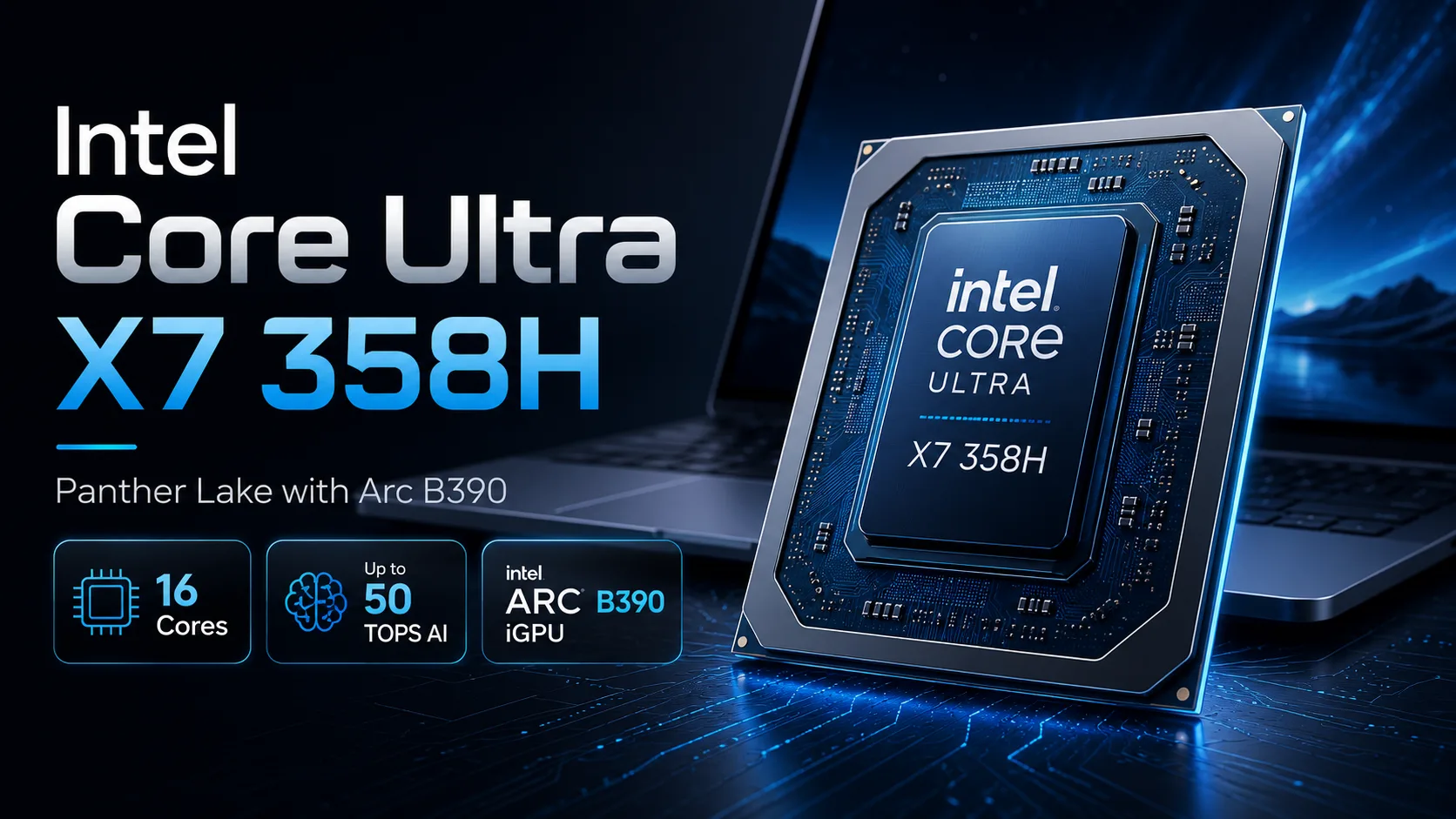
Intel Core Ultra X7 358H

Intel Core Ultra X7 358H: The New Flagship for Thin and Powerful Laptops. Review and Analysis

In the world of mobile processors, the titanic battle for every nanometer, watt, and performance point continues unabated. A new generation has arrived - Intel Core Ultra series X based on Panther Lake architecture, manufactured using the cutting-edge 3nm process technology. The flagship of this line, Core Ultra X7 358H, is positioned as the quintessence of balance between power and efficiency. Let’s break down what these figures and specifications mean and who should really consider a laptop with such a chip.

1. Panther Lake Architecture: A Revolution in Efficiency

At the heart of the Core Ultra X7 358H is a completely new microarchitecture, marking a stage in evolution focused not on unbridled megahertz growth, but on fundamentally increasing efficiency.

3nm Process Technology: This is a key aspect. Transitioning from 4nm (Meteor Lake) to 3nm is not just a number. The denser transistor layout allows for more computing blocks to fit in the same area or significantly reduces power consumption while maintaining performance. For Panther Lake, this means substantial gains in "computational power per watt."

Core Configuration: 16 Cores / 16 Threads. Here lies an important nuance. Unlike the hybrid architectures of previous generations, which separated Performance (P) and Efficient (E) cores, in this case we see a configuration comprised solely of next-generation Performance cores (P-cores). The absence of E-cores in the conventional sense may raise questions, but the answer lies within the architecture itself: these new P-cores are designed with a focus on energy efficiency across a wide range of workloads. They can operate at very low frequencies when idle and scale up to high frequencies under load. Specifically, in the X7 358H, there are 16 such versatile, high-efficiency cores.

Clock Frequencies: Balance and Turbo. The base frequency of 2.2 GHz is a conservative figure that defines the thermal design power (TDP) during extended loads. However, the real power unfolds in Turbo Boost up to 4.8 GHz. This means that one or more cores can momentarily "boost" to such a high frequency for instant system response - opening heavy applications, processing short clips, or speeding up in a browser. In multi-core tasks, the frequency is likely to hover in the range of 3.5-4.2 GHz depending on the laptop's cooling system.

Integrated Graphics (iGPU): While the exact model is not specified in the documentation, the Panther Lake architecture continues the trend of enhancing integrated GPUs. The new generation of graphic cores, likely the Xe-LPG+ or its evolution, is expected to support technologies like XeSS (upscaling), hardware acceleration for modern AV1 codecs, and improved performance in light and mid-level gaming. This will be a full replacement for entry-level discrete cards in thin ultrabooks.

Cache and Interconnects: 18 MB of L3 cache is a solid amount that reduces latency in data access and positively impacts performance in gaming and demanding applications. An important element of the architecture is the new ring bus or "tile" topology, providing high-speed connections between computing blocks, the GPU, and memory controllers.

2. TDP 20-28W: Power Within Strict Limits

The specified thermal package range (20-28W) is classic for the thin and light high-performance laptop segment (premium ultrabooks). This indicates:

  • Flexibility for manufacturers: Brands can adjust the power system (PL1/PL2) within these limits. Laptops with passive or modest active cooling will operate closer to 20W, aiming for silence and battery life. Models with advanced cooling systems (two fans, three to four heat pipes) can allow the processor to work at higher frequencies near 28W, squeezing out more performance.
  • Focus on a thin form factor: Such a TDP allows for devices with thicknesses from 14 to 17 mm, without turning them into rocket stoves. The processor is designed so that its peak performance fits within the cooling capabilities of such form factors.

3. Performance in Real Tasks: Numbers and Practice

Results in Geekbench 6 (2735 / 10486) serve as an excellent theoretical benchmark. Let’s translate these into the realm of everyday tasks.

Office Work and Everyday Use: For a browser with dozens of tabs, office suites (Microsoft 365, Google Workspace), Zoom conferences, and PDF handling, this processor is absolutely overkill. Everything will fly. The system will respond instantly, and due to the efficient architecture and 3nm process technology, the fans in such scenarios will likely not even turn on.

Multimedia and Creativity: Here, the X7 358H will shine fully.

  • Photo Editing: Working in Adobe Lightroom or Photoshop with large RAW files will be comfortable. Applying filters, retouching, and exporting - all processes will proceed very quickly.
  • Video Editing: Editing Full HD and 4K projects in DaVinci Resolve or Premiere Pro will become a manageable task. The integrated GPU with hardware acceleration for H.264/HEVC/AV1 codecs will significantly speed up rendering and decoding. For professional 8K editing or complex effects, a discrete graphics card (RTX 4050/4060 and above) will still be needed, but for 90% of tasks faced by amateur editors and content creators, this CPU is more than sufficient.

Gaming: Don’t expect wonders from the iGPU in modern AAA titles on ultra settings. However, it is an excellent processor for mid-range mobile gaming:

  • Esports and Casual Games: CS2, Dota 2, Valorant, League of Legends - all will run at high settings with frame rates well over 60 FPS at Full HD resolution.
  • Modern Games on Settings: With reasonable adjustments to graphical presets (often down to medium) and the use of Intel XeSS technology, you can comfortably play many new releases at 1080p. This is an ideal option for a player who wants one laptop for both work/study and evening gaming, but is not ready to carry a kilogram gaming "machine."

Turbo Mode: Its behavior greatly depends on the laptop model. In a well-cooled device, turbo mode (up to 4.8 GHz) will be more actively and longer sustained, providing instant responsiveness. In a thinner and lighter ultrabook, this boost will be shorter but sufficient for smooth perception.

4. Use Cases: Who Needs This?

  1. Mobile Professionals: Designers, engineers, analysts, programmers who need maximum performance in a portable chassis. Code compilation, working in CAD (on medium projects), statistical analysis - all will be accelerated.
  2. Content Creators: Bloggers, video editors, photographers who work a lot on the go or in coworking spaces. The ability to quickly process material “here and now” is invaluable.
  3. Students in Technical and Creative Fields: Power for complex academic projects, simulations, editing, while also being able to carry the laptop all day.
  4. Demanding Users who just want their laptop to not lag under any circumstances for the next 4-5 years and appreciate premium design and portability.
  5. Versatile Gamers, as described above.

5. Battery Life: Not Just the Processor, but the Entire Package

The 3nm process technology is the main ally for long battery life. Lower power consumption when idle and under light load directly translates into extra hours.

  • Dynamic Management: The Panther Lake architecture continues to use advanced Intel Thread Director algorithms and dynamic load and voltage distribution among cores to always utilize the most energy-efficient path for task execution.
  • Importance of the Entire Device: Battery life is not determined just by the CPU, but by the battery (capacity in Wh) and optimization of the entire platform. In an ultrabook with the X7 358H processor and a battery capacity of 70-90 Wh, expect 8-12 hours of work in web surfing and office tasks. Active creative work or editing will naturally reduce this time to 3-5 hours. Fast charging technologies in such devices are a must-have.

6. Comparison with Competitors

  • AMD Ryzen 7/9 8045/8945HS (core "Hawk Point"): A direct competitor in the 28-35W segment. AMD processors are traditionally strong in multi-core performance and chip-level energy efficiency. Their iGPU Radeon 780M is still one of the strongest on the market. The X7 358H should challenge particularly in single-core performance (important for system responsiveness and certain applications) and overall platform efficiency with the new process technology. The battle will be fierce.
  • Apple M3/M3 Pro: A closed ecosystem with macOS. Apple chips set a phenomenal standard for performance per watt and battery life. The X7 358H may match the M3 Pro in multi-core tests, but the key is the platform comparison (Windows vs macOS) and price range. Intel-based laptops typically offer more configuration options (RAM, SSD), gaming capabilities, and software compatibility.
  • Previous Generation Intel (Meteor Lake): The Core Ultra X7 358H is expected to provide a 15-25% performance increase at the same or slightly lower power consumption. The main advantage is cooler and quieter operation under load.

7. Pros and Cons

Pros:

  • High single-core and multi-core performance for its TDP class.
  • Cutting-edge 3nm process technology, promising excellent energy efficiency.
  • Powerful integrated graphics, removing the need for a discrete card for many users.
  • Ideal balance for a ultraportable and powerful device.
  • Modern technologies: Support for PCIe 5.0, Thunderbolt 4/5, Wi-Fi 7, AI accelerators NPU.

Cons (potential):

  • Price. Laptops with such processors will fall into the premium segment, starting around $1400-1600 and going well over $2000.
  • Dependence on cooling. Real performance under sustained loads will vary significantly from model to model.
  • Competitors are not resting. AMD offers very strong alternatives that may be more advantageous in specific scenarios.

8. Recommendations for Choosing a Laptop

Look for a device clearly positioned as a "premium ultrabook" or "compact creative workstation." For example, Dell XPS 13/15, Lenovo Yoga Slim 9i, ASUS Zenbook S, HP Spectre x360, Acer Swift Edge.

What to pay attention to:

  1. Cooling system: Look for information on noise, temperatures, and declared performance (sustained power PL1) in reviews. Two fans are better than one.
  2. Display: A quality display is mandatory for such a processor. Minimum - IPS matrix covering 100% sRGB; better - OLED or mini-LED with high resolution (2.8K, 4K) and wide color gamut (DCI-P3).
  3. RAM: 16 GB is the necessary minimum in 2024-2025. For creative tasks, confidently opt for 32 GB. Ensure the memory is dual-channel.
  4. Storage: SSD of at least 1 TB with PCIe 4.0 or 5.0 interface.
  5. Ports: Having Thunderbolt 4/USB4 (for connecting everything) and HDMI 2.1 will be a big plus.
  6. Battery: Don't look at the number of cells, look for the declared capacity in Wh. A figure of 70 Wh and above is a good sign.

9. Final Conclusion

Intel Core Ultra X7 358H is not for everyone, but for those who refuse to compromise between portability and power. It is a dream processor for mobile professionals who reject bulky workstations in favor of an elegant but equally powerful tool. It provides key benefits: freedom from the outlet for an entire workday under light tasks, confidence in tackling the most resource-intensive projects, and the ability to game without buying a separate gaming laptop.

If your budget allows for investment in the top segment of thin laptops, and you want a device at the forefront of technology that will remain relevant for many years, then a laptop based on the Intel Core Ultra X7 358H (Panther Lake) is one of the most reasonable and balanced choices on the market. This is the vanguard of mobile computing, packaged in a chassis less than two centimeters thick.

Basic

Label Name
Intel
Platform
Laptop
Launch Date
December 2025
Model Name
?
The Intel processor number is just one of several factors - along with processor brand, system configurations, and system-level benchmarks - to be considered when choosing the right processor for your computing needs.
358H
Code Name
Panther Lake

CPU Specifications

Total Cores
?
Cores is a hardware term that describes the number of independent central processing units in a single computing component (die or chip).
16
Total Threads
?
Where applicable, Intel® Hyper-Threading Technology is only available on Performance-cores.
16
Performance-cores
4
Efficient-cores
12
Performance-core Base Frequency
2.2 GHz
Efficient-core Base Frequency
1.7 GHz
Performance-core Max Turbo Frequency
?
Maximum P-core turbo frequency derived from Intel® Turbo Boost Technology.
4.8 GHz
L1 Cache
112 K per core
L2 Cache
3 MB per core
L3 Cache
18 MB shared
Bus Frequency
100 MHz
Multiplier
22
Unlocked Multiplier
No
CPU Socket
?
The socket is the component that provides the mechanical and electrical connections between the processor and motherboard.
FCBGA-2049
Technology
?
Lithography refers to the semiconductor technology used to manufacture an integrated circuit, and is reported in nanometer (nm), indicative of the size of features built on the semiconductor.
3 nm
TDP
20-28 W
Max. Operating Temperature
?
Junction Temperature is the maximum temperature allowed at the processor die.
110 °C
PCIe Version
?
PCI Express is a high-speed serial computer expansion bus standard used for connecting high-speed components, replacing older standards such as AGP, PCI, and PCI-X. It has gone through multiple revisions and improvements since its initial release. PCIe 1.0 was first introduced in 2002, and in order to meet the growing demand for higher bandwidth, subsequent versions have been released over time.
5.0
Instruction Set
?
The instruction set is a hard program stored inside the CPU that guides and optimizes CPU operations. With these instruction sets, the CPU can run more efficiently. There are many manufacturers that design CPUs, which results in different instruction sets, such as the 8086 instruction set for the Intel camp and the RISC instruction set for the ARM camp. x86, ARM v8, and MIPS are all codes for instruction sets. Instruction sets can be extended; for example, x86 added 64-bit support to create x86-64. Manufacturers developing CPUs that are compatible with a certain instruction set need authorization from the instruction set patent holder. A typical example is Intel authorizing AMD, enabling the latter to develop CPUs compatible with the x86 instruction set.
x86-64

Memory Specifications

Memory Type
?
Intel® processors come in four different types: Single Channel, Dual Channel, Triple Channel, and Flex Mode. Maximum supported memory speed may be lower when populating multiple DIMMs per channel on products that support multiple memory channels.
LPDDR5-8400,LPDDR5x-8400,DDR5-6400
Max Memory Size
?
Max memory size refers to the maximum memory capacity supported by the processor.
128 GB
Memory Channels
?
The number of memory channels refers to the bandwidth operation for real world application.
2
Max Memory Bandwidth
?
Max Memory bandwidth is the maximum rate at which data can be read from or stored into a semiconductor memory by the processor (in GB/s).
137 GB/s
ECC Memory Support
No

GPU Specifications

Integrated Graphics Model
?
An integrated GPU refers to the graphics core that is integrated into the CPU processor. Leveraging the processor's powerful computational capabilities and intelligent power efficiency management, it delivers outstanding graphics performance and a smooth application experience at a lower power consumption.
true
GPU Base Frequency
800 MHz
GPU Max Dynamic Frequency
2300 MHz
Execution Units
?
The Execution Unit is the foundational building block of Intel’s graphics architecture. Execution Units are compute processors optimized for simultaneous Multi-Threading for high throughput compute power.
12

Miscellaneous

PCIe Lanes
28

Benchmarks

Geekbench 6
Single Core Score
2735
Geekbench 6
Multi Core Score
10486
Passmark CPU
Single Core Score
4282
Passmark CPU
Multi Core Score
29426

Compared to Other CPU

Geekbench 6 Single Core
3132 +14.5%
2864 +4.7%
2542 -7.1%
Geekbench 6 Multi Core
11748 +12%
11142 +6.3%
9897 -5.6%
9468 -9.7%
Passmark CPU Single Core
4622 +7.9%
4474 +4.5%
4173 -2.5%
Passmark CPU Multi Core
32488 +10.4%
30832 +4.8%
28065 -4.6%
26905 -8.6%