AMD Ryzen 9 8945H
AMD Ryzen 9 8945H: A Familiar Flagship with Chinese Roots
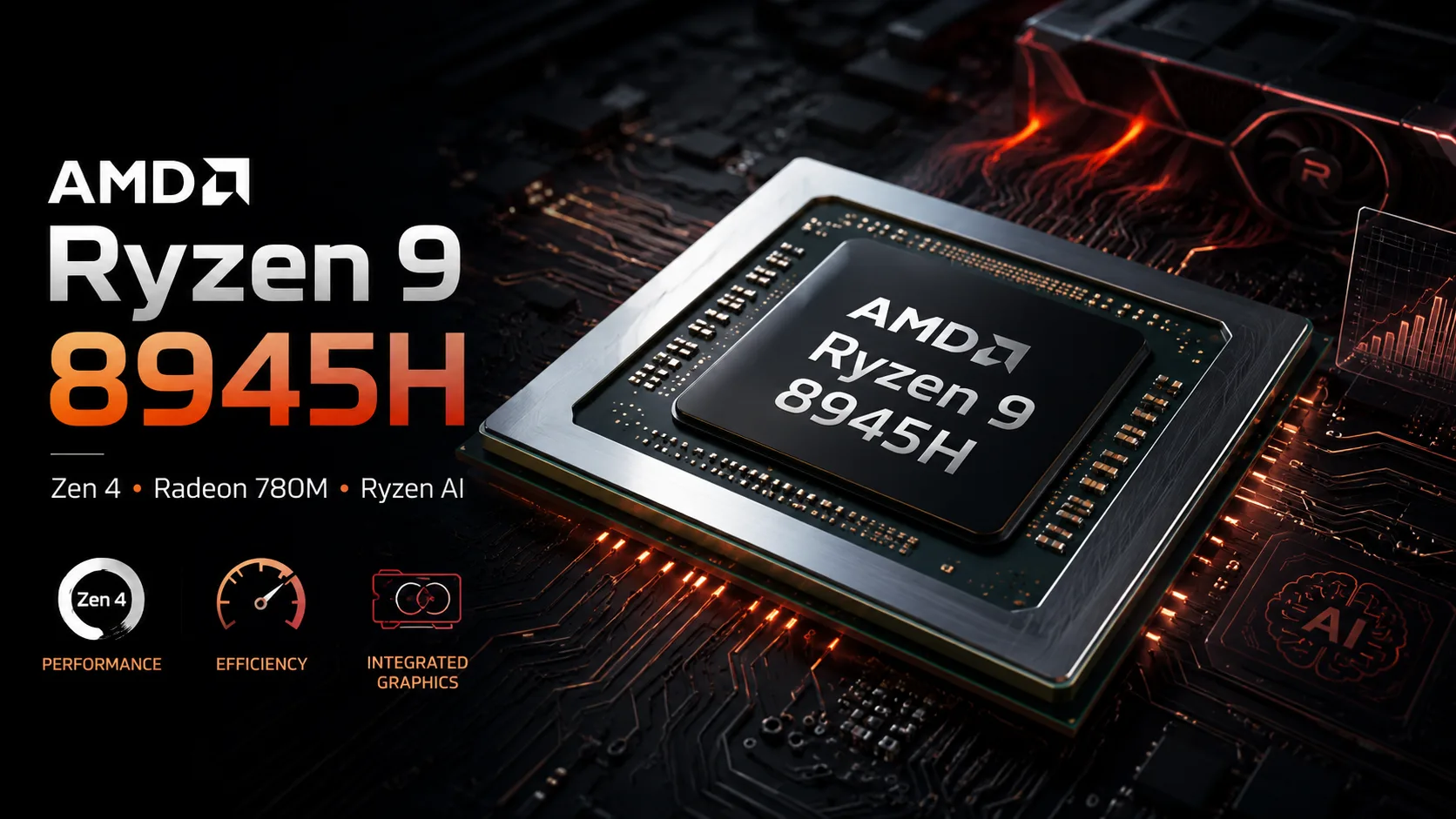
The AMD Ryzen 9 8945H appears to be a distinct performance model positioned between the HS and HX series, but its name is somewhat misleading. This is an official AMD mobile processor targeted at the Chinese market; however, its specifications closely mirror those of the global Ryzen 9 8945HS. There is no new die, increased power limit, or additional cores hiding behind the H designation.
We still have the Hawk Point: eight Zen 4 cores, a powerful Radeon 780M, and a dedicated Ryzen AI neural block. The processor is suitable for gaming and general-purpose laptops, but its main advantage lies not in peak performance but in a successful balance between speed, graphics, and power consumption.
Ryzen 9 8945H - Not the 8945HX
Due to their similar names, the Ryzen 9 8945H can easily be confused with the Ryzen 9 8945HX. In practice, these are completely different processors.
The Ryzen 9 8945HX features 16 cores and 32 threads, with 64 MB of L3 cache, designed for large gaming laptops with robust cooling solutions. In contrast, the Ryzen 9 8945H is considerably more compact: it offers eight cores, 16 threads, and 16 MB of L3 with a standard TDP of 45 W.
In terms of architecture, the 8945H is significantly closer to the Ryzen 9 8945HS. Moreover, AMD specifies the same frequencies, graphics, power limits, and even identical identifiers for the chips supplied to manufacturers for both H and HS versions. The main documented difference is the sales region: the Ryzen 9 8945H is officially intended for China, while the Ryzen 9 8945HS is available globally.
Eight Full Zen 4 Cores
The processor features eight identical Zen 4 cores with SMT support, allowing the operating system access to 16 threads. The base frequency is 4.0 GHz, while the maximum can reach 5.2 GHz. The L2 cache size is 8 MB, and the L3 cache is 16 MB.
This configuration handles most modern tasks well: programming, photo processing, video editing, multitasking, and gaming. Unlike Intel's hybrid processors, there is no division between performance and efficiency cores- all eight cores possess identical capabilities.
In heavy rendering tasks, the Ryzen 9 8945H lags behind larger HX models with 12 or 16 cores. However, for a typical performance laptop, eight Zen 4 cores are still sufficient, especially when the processor operates in the upper part of the available power range.
The die itself is manufactured using TSMC's 4nm technology process. The standard TDP is 45 W, and the laptop manufacturer can configure the processor in a range from 35 to 54 W. As a result, two systems with the Ryzen 9 8945H can differ significantly in speed, temperature, and noise.
Radeon 780M Remains a Strong Advantage
The Ryzen 9 8945H is equipped with integrated Radeon 780M graphics based on RDNA 3 architecture. It features 12 compute units and operates at a frequency of up to 2.8 GHz. Among its generation of integrated solutions, it is still a robust graphics option capable of running many games at 1080p with low to medium settings.
Performance heavily depends on memory. Radeon 780M does not have its own VRAM and uses system RAM, so a dual-channel configuration and high bandwidth are critical. The processor supports DDR5-5600 and LPDDR5X-7500.
For gaming laptops with discrete GeForce graphics, the integrated graphics are also useful. They allow the separate GPU to be turned off when running on battery, reducing power consumption. Additionally, the Radeon 780M supports hardware encoding and decoding of modern video formats, including AV1.
Ryzen AI is Present, But Its Capabilities are Limited
The processor includes a first-generation NPU based on AMD's XDNA architecture. Its performance reaches 16 TOPS, and the combined computational power of the CPU, GPU, and NPU is claimed to be up to 39 TOPS.
The neural block can accelerate compatible video conferencing effects, image processing, and some local AI functions without taxing CPU and discrete graphics resources. However, it should not be compared to the newer Ryzen AI 300 and more recent platforms.
For the Copilot+ PC category, Microsoft requires an NPU with a performance of over 40 TOPS. The Ryzen 9 8945H only has 16 TOPS on its dedicated AI block, thus the presence of the Ryzen AI label does not imply support for the full set of Copilot+ PC features.
Modern Peripheral Support without Transitioning to PCIe 5.0
The Ryzen 9 8945H supports up to 20 PCIe 4.0 lanes, as well as two native USB4 ports with speeds of up to 40 Gbps. This is sufficient for a mobile system: PCIe 4.0 does not limit modern laptop GPUs and fast NVMe drives in real-world scenarios.
The lack of PCIe 5.0 cannot be considered a serious drawback. Corresponding SSDs typically run hotter, consume more power, and rarely provide noticeable benefits outside specialized tasks. What is far more important is whether the laptop manufacturer has implemented USB4, installed a fast drive, and provided a second M.2 slot.
Who Should Consider Ryzen 9 8945H
It is worth considering in the following cases:
- A powerful laptop with eight full cores is needed;
- Strong integrated graphics are important;
- A balance between performance and battery life is required;
- The laptop is being purchased in China or imported from the Chinese market;
- The price is significantly lower than models with newer Ryzen AI.
When purchasing, it is important to look at more than just the processor. The Ryzen 9 8945H can operate in a relatively thin model with a limit around 35 W as well as in a gaming laptop tuned closer to 54 W. Cooling systems and power limits can significantly influence performance, more so than the difference between the 8945H and 8945HS names.
Conclusion
The AMD Ryzen 9 8945H is not a new level between HS and HX, but rather a regional version of the Ryzen 9 8945HS for the Chinese market. The processors match in core count, frequencies, graphics, NPU, and power range.
The chip remains a solid choice for a powerful laptop. Eight Zen 4 cores provide high speeds in everyday and professional tasks, while the Radeon 780M allows for gaming without needing a discrete graphics card in less demanding titles. The main limitations are a relatively weak NPU by modern standards and the absence of significant progress compared to the previous Ryzen 9 7940HS.
Purchasing the Ryzen 9 8945H makes sense not for its unusual index but for the specific laptop with good cooling, fast memory, and a reasonable price. There is no point in overpaying for it relative to the identical Ryzen 9 8945HS.
CPU Comparison
Compare Ryzen 9 8945H with other CPUs
Basic
CPU Specifications
Memory Specifications
GPU Specifications
AI Specifications
Interfaces and Ports
Miscellaneous
Benchmarks
Compared to Other CPU
Related CPU Comparisons


Share in social media
Or Link To Us
<a href="https://cputronic.com/cpu/amd-ryzen-9-8945h" target="_blank">AMD Ryzen 9 8945H</a>