AMD Ryzen 9 PRO 9955

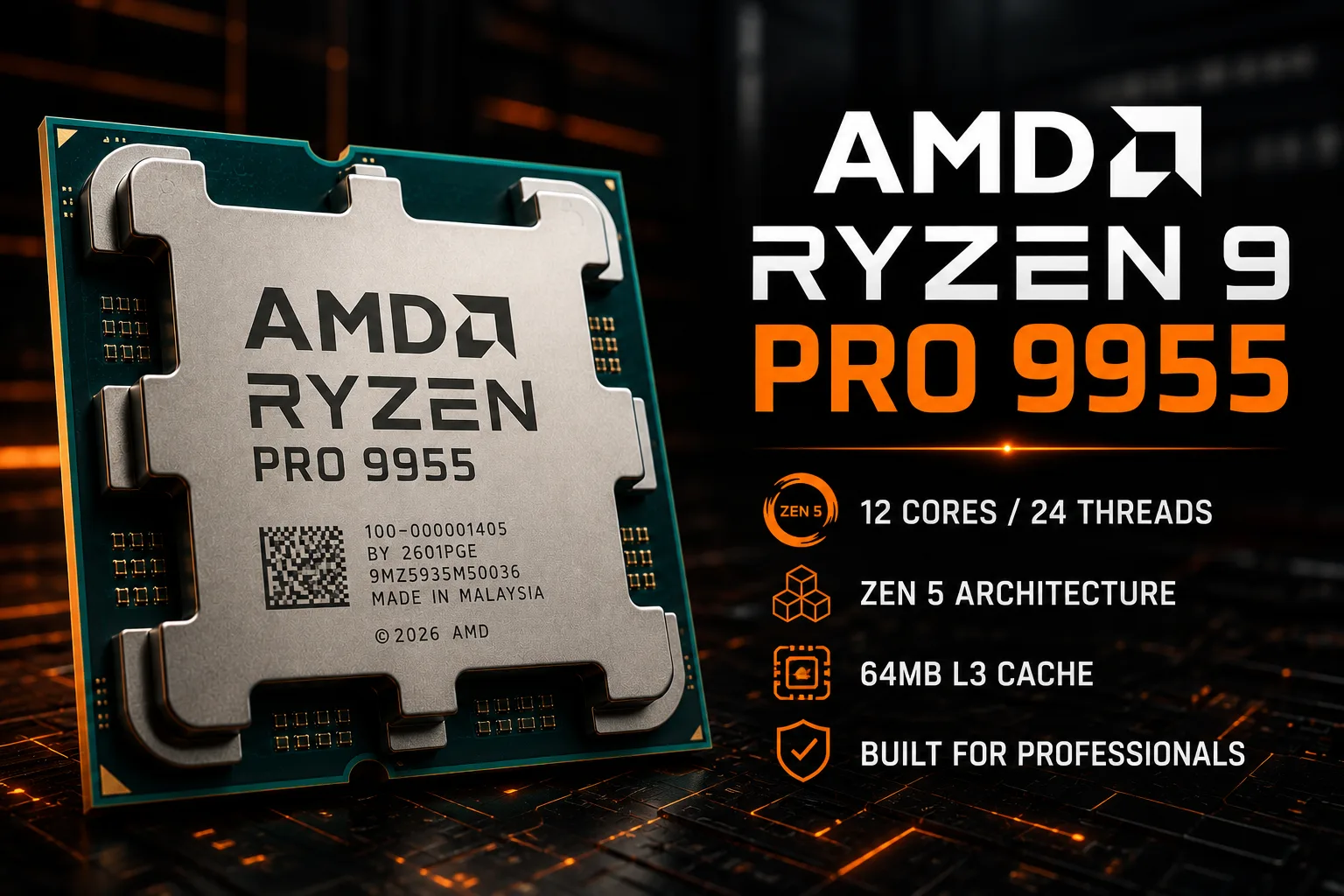
AMD Ryzen 9 PRO 9955: 12 Zen 5 Cores for Powerful Workstations
The AMD Ryzen 9 PRO 9955 is one of the most practical processors in the Ryzen PRO 9000 lineup. It is not a basic corporate chip, nor is it the maximum 16-core option like the Ryzen 9 PRO 9965. By formula, it occupies the middle of the high-end segment: 12 Zen 5 cores, 24 threads, 64 MB of L3 cache, a TDP of 120W, and an AM5 platform.
The main idea of the Ryzen 9 PRO 9955 is to provide workstations with a high level of multi-threaded performance without switching to the more expensive Threadripper platform. This processor is intended for ready-made professional systems where stability, manageability, security, and long-term support are as important as frequencies and benchmarks.
Why This Processor is Interesting
The Ryzen 9 PRO 9955 fits nicely between two extremes. On one hand, it is significantly more powerful than typical 6- and 8-core business processors: 12 cores and 24 threads provide a solid margin for compilation, engineering software, media processing, virtual machines, and heavy multitasking. On the other hand, it is still a desktop AM5 platform, not a Threadripper with more expensive boards and a different ecosystem.
An important point is the TDP of 120W. Compared to the Ryzen 9 PRO 9945 with the same 12 cores but 65W, the Ryzen 9 PRO 9955 looks like a more performance-oriented option for sustained workloads. In short tasks, the difference may not be as noticeable, but in rendering, compilation, and other long-duration multi-threaded tasks, a higher thermal envelope usually gives the processor more headroom for stable frequencies.
At the same time, this is not an X3D model. The Ryzen 9 PRO 9955 features standard 64 MB of L3 cache, without 3D V-Cache. Therefore, its strength lies not in cache-dependent scenarios, but in classic performance: many fast cores, high per-core speeds, and a modern platform.
Performance and Benchmarks in PassMark
There are currently no direct public PassMark results for the Ryzen 9 PRO 9955. Therefore, it is useful to look at the nearest models for reference: the Ryzen 9 9900X as a retail 12-core equivalent, the Ryzen 9 9900X3D as an X3D reference, the Ryzen 9 PRO 9945 as a more economical PRO model, and the Intel Core Ultra 7 265K as a current Intel benchmark in the upper desktop segment.
| Processor | CPU Mark | Single Thread | Comments |
|---|---|---|---|
| Intel Core Ultra 7 265K | 58 695 | 4 930 | Strong Intel benchmark, more cores, and different platform |
| AMD Ryzen 9 9900X3D | 56 227 | 4 645 | 12-core X3D reference with increased L3 cache |
| AMD Ryzen 9 9900X | 54 413 | 4 677 | Closest retail 12-core equivalent without PRO |
| AMD Ryzen 9 PRO 9945 | 48 634 | 4 619 | 12-core PRO model with 65W TDP |
This table shows which processors to base evaluations of the Ryzen 9 PRO 9955 on. The closest consumer equivalent is the Ryzen 9 9900X: it also has 12 cores, 24 threads, and 64 MB of L3 cache, but it is designed for regular consumer and enthusiast builds.
The Ryzen 9 PRO 9945 illustrates a more economical PRO branch with 65W, while the Ryzen 9 PRO 9955 should be more interesting in prolonged workloads, where 120W provides more latitude for performance. The Intel Core Ultra 7 265K serves here not as a direct analog but as an external reference: it has a different architecture, more cores, and strong single-thread performance.
How the Ryzen 9 PRO 9955 Differs from the Ryzen 9 9900X
The Ryzen 9 PRO 9955 and Ryzen 9 9900X are similar in basic logic: both have 12 cores, 24 threads, and 64 MB of L3 cache. However, their intended purposes are different.
The Ryzen 9 9900X is a retail processor for standard desktop PCs, gaming builds, and enthusiast work systems. It is better suited for users who want to choose their own motherboard, memory, cooling, and wish to have flexible control over the platform.
The Ryzen 9 PRO 9955 is a processor for pre-built commercial PCs and workstations. It features AMD PRO Technologies, remote management, security, and enterprise service functions. Overclocking, AMD EXPO, Precision Boost Overdrive, and Curve Optimizer are officially disabled. For the home user, this limitation may be a drawback, but for a corporate system, it makes sense: less manual tuning leads to more predictability.
How It Differs from the Ryzen 9 PRO 9945
At first glance, the Ryzen 9 PRO 9945 and Ryzen 9 PRO 9955 are very close: both have 12 cores, 24 threads, Zen 5 architecture, 64 MB of L3 cache, and boost up to 5.4 GHz. However, the key difference is the TDP. The Ryzen 9 PRO 9945 has a rated 65W, while the Ryzen 9 PRO 9955 has a 120W TDP.
Because of this, the Ryzen 9 PRO 9945 appears to be a more economical option for compact and quiet corporate systems. In contrast, the Ryzen 9 PRO 9955 is better suited for workstations where stable performance under prolonged load is important.
To simplify: the Ryzen 9 PRO 9945 is a 12-core PRO chip focused on energy efficiency, while the Ryzen 9 PRO 9955 is a more powerful version for workstations with serious tasks.
How It Differs from the Ryzen 9 PRO 9965
The Ryzen 9 PRO 9965 ranks higher in the lineup. It has 16 cores and 32 threads, thus it should be significantly stronger in heavy multi-threaded workloads. The Ryzen 9 PRO 9955 does not aim to replace the 16-core model: its job is to fill the gap between the economical 12-core PRO 9945 and the higher-end 16-core PRO 9965.
For certain workstations, this may be the most sensible balance. Not everyone needs 16 cores, especially if the primary workload is mixed: compilation, CAD, several heavy applications, a browser, office tools, local computations, and occasional media processing. In such scenarios, 12 fast cores often appear more practical than paying extra for the higher model.
Where the Ryzen 9 PRO 9955 Will Excel
The Ryzen 9 PRO 9955 is suitable for work environments where 8 cores are already insufficient, but transitioning to 16 cores or Threadripper is not always justified. This could include development, compilation, CAD/CAM, engineering applications, virtual machines, photo and video processing, analytics, local computations, and heavy multitasking.
For purely gaming PCs, it does not seem to be the most logical option. It is easier to look at the Ryzen 7 9800X3D, Ryzen 7 9850X3D, or Ryzen 9 9900X3D. For maximum CPU rendering, the Ryzen 9 PRO 9965, Ryzen 9 PRO 9965X3D, or Threadripper would be better suited. The Ryzen 9 PRO 9955 is interesting as a balanced 12-core processor for ready-made professional systems.
Platform and Integrated Graphics
The processor uses an AM5 socket and supports DDR5, PCIe 5.0, up to 256 GB of memory, and ECC with motherboard support. For a workstation, this is an important set: performance depends not only on the CPU but also on the amount of RAM, the speed of storage, the graphics card, and the stability of the entire platform.
There is also integrated graphics - AMD Radeon Graphics with 2 graphics cores and a frequency of 2200 MHz. This is useful for outputting images, diagnostics, and basic office work but not for professional 3D graphics. In a real workstation, this processor will almost certainly work alongside a discrete graphics card.
Conclusion
The AMD Ryzen 9 PRO 9955 may not be the most exuberant processor in the Ryzen PRO 9000 lineup, but it can turn out to be one of the most practical. It lacks 3D V-Cache like the X3D models, and it doesn't have 16 cores like the Ryzen 9 PRO 9965. However, it boasts 12 Zen 5 cores, 24 threads, 64 MB of L3 cache, a TDP of 120W, AM5 support, and a suite of AMD PRO features.
Its strength lies in balance. The Ryzen 9 PRO 9955 appears to be a processor for workstations that need high performance without moving into a more expensive class. It is more powerful than the economical Ryzen 9 PRO 9945, simpler and more accessible in terms of platform than Threadripper, and better suited for a corporate environment than a regular Ryzen 9 9900X.
If a gaming PC is needed, one should look towards X3D models. If maximum multi-threaded power is required, the Ryzen 9 PRO 9965 or Threadripper would make more sense. But if a powerful, manageable, and balanced AM5 workstation for business is needed, the Ryzen 9 PRO 9955 appears to be a very reasonable option.
CPU Comparison
Compare Ryzen 9 PRO 9955 with other CPUs
Basic
CPU Specifications
Memory Specifications
GPU Specifications
Miscellaneous
Benchmarks
Compared to Other CPU
Related CPU Comparisons

Share in social media
Or Link To Us
<a href="https://cputronic.com/cpu/amd-ryzen-9-pro-9955" target="_blank">AMD Ryzen 9 PRO 9955</a>