Qualcomm Snapdragon X2 Elite Extreme X2E-94-100
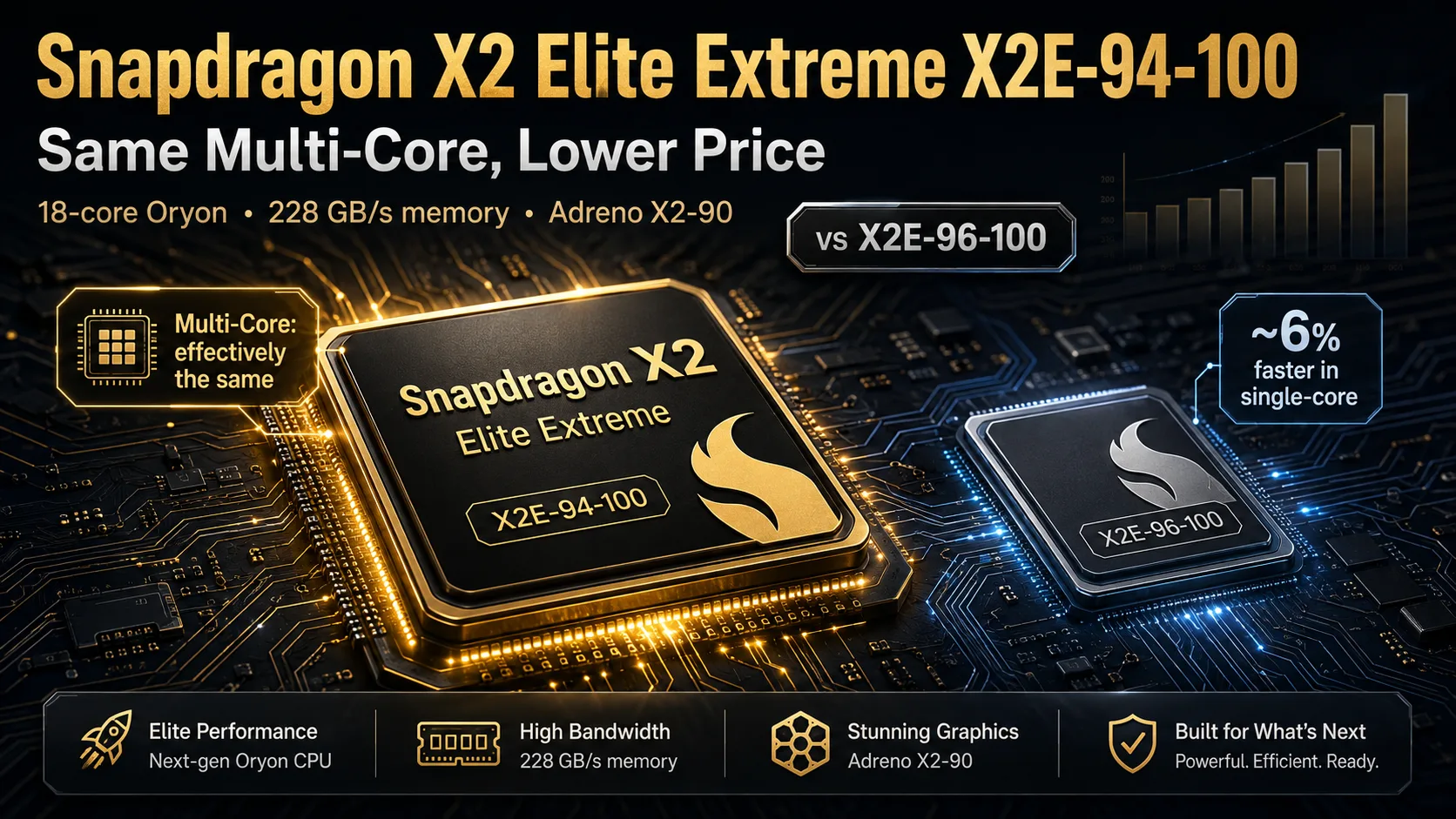
Snapdragon X2 Elite Extreme X2E-94-100: the same Multi-Core but cheaper than X2E-96-100
The Snapdragon X2 Elite Extreme X2E-94-100 differs from the higher-end X2E-96-100 mainly in boost frequency: 4.7 GHz vs. 5.0 GHz. The cores, multi-threaded frequencies, Adreno X2-90, memory, and NPU are the same for both models. In published tests, the ASUS Zenbook A16 shows no difference in Geekbench Multi, while the laptop with X2E-94-100 is cheaper.
X2E-94-100 is limited only by peak boost
X2E-94-100 uses 18 third-generation Oryon cores: 12 Prime and 6 Performance. During multi-threaded workloads, the Prime cores operate up to 4.4 GHz and the Performance cores up to 3.6 GHz; X2E-96-100 has the same limits.
The only difference remains in the boost of one or two Prime cores: 4.7 GHz vs. 5.0 GHz.
| Model | Cores | Prime Multi | Performance Multi | Boost 1-2 Cores | GPU | NPU | Memory |
|---|---|---|---|---|---|---|---|
| X2E-96-100 | 18 | 4.4 GHz | 3.6 GHz | 5.0 GHz | X2-90, 1.85 GHz | 80 TOPS | 228 GB/s |
| X2E-94-100 | 18 | 4.4 GHz | 3.6 GHz | 4.7 GHz | X2-90, 1.85 GHz | 80 TOPS | 228 GB/s |
| X2E-90-100 | 18 | 4.0 GHz | 3.4 GHz | 5.0 GHz | X2-90, 1.70 GHz | 85 TOPS | 152 GB/s |
The index 94 exaggerates the difference. In terms of sustained multi-threaded frequency, X2E-94-100 does not differ from X2E-96-100; Qualcomm has only reduced the short boost of one or two cores.
The Adreno X2-90 is also not downclocked: it runs at 1.85 GHz and has 228 GB/s memory bandwidth. For regular X2 Elite models with the same GPU, the GPU frequency may be lower, and memory bandwidth decreases to 152 GB/s.
This is already the third generation of Oryon: Qualcomm used the second generation in the Snapdragon 8 Elite; thus, the X2 Elite differs from the first Snapdragon X not only in clock speeds but also in the microarchitecture itself.
Real Zenbook A16 vs. Core Ultra X9 388H
The ASUS Zenbook A16 UX3607OA with X2E-94-100, 48 GB of LPDDR5x, and a 1 TB SSD has already been tested in its production configuration. The Verge compared it with the ASUS Zenbook Duo on Core Ultra X9 388H and the 15-inch MacBook Air on Apple M5.
| Test | X2E-94-100 | Core Ultra X9 388H | Apple M5 |
|---|---|---|---|
| Geekbench 6 Single | 3 643 | 3 009 | 4 175 |
| Geekbench 6 Multi | 22 044 | 17 268 | 16 567 |
| Cinebench 2026 Single | 628 | 528 | 727 |
| Cinebench 2026 Multi | 6 327 | 3 993 | 3 413 |
| Geekbench OpenCL | 41 101 | 56 839 | 47 661 |
In Geekbench 6, the Zenbook with X2E-94-100 outperformed the Core Ultra X9 388H system by about 21% in Single and 28% in Multi. In Cinebench 2026, the margin was about 19% in Single and 58% in Multi.
Apple M5, on the other hand, is faster in single-core performance. In Geekbench Single, it has an advantage of about 13%, while X2E-94-100 wins by approximately 33% in Multi. The same trend is seen in Cinebench: M5 is stronger in Single, while X2E-94-100 shines under full multi-threaded workloads.
In terms of integrated graphics, Intel has the advantage. The Arc B390 scored 56,839 points in Geekbench OpenCL compared to 41,101 for the Adreno X2-90 - a difference of about 38%. Thus, the advantage of X2E-94-100 lies primarily in the CPU; regarding this graphic test, the Arc B390 is significantly faster.
So where is the advantage of X2E-96-100?
Geekbench 6.7 shows where the additional 300 MHz of X2E-96-100 goes. X2E-94-100 in the Zenbook A16 scored 3,826 points in Single and 23,204 in Multi. The average score for X2E-96-100 is 4,062 and 23,166 points, respectively.
| Geekbench 6.7 | X2E-94-100 | X2E-96-100 | Difference |
|---|---|---|---|
| Single-Core | 3 826 | 4 062 | +6% for X2E-96 |
| Multi-Core | 23 204 | 23 166 | within margin of error |
This is not a direct A/B test of two processors in the same system, so a few points in Multi cannot be interpreted as a victory for X2E-94-100. However, the result aligns with the logic of specifications: the additional 300 MHz mainly benefits low numbers of active cores, and the multi-threaded frequencies for both Extremes are the same.
In rendering, compiling, and other prolonged multi-threaded workloads, the difference between the two Extremes is naturally less than in Single-Core scenarios.
Power limit is more important than the additional 300 MHz
The power profile affects the X2E-94-100 more than the additional 300 MHz between the two Extremes.
| Zenbook A16 Mode | Cinebench 2024 Multi |
|---|---|
| low limit | 1,203 |
| Standard | 1,619 |
| Performance | 1,761 |
Standard maintains about 92% of the Performance result. For prolonged workloads, this is more important than the difference between boosts of 4.7 and 5.0 GHz: the cooling and power limits of a specific laptop can significantly alter the results.
X2E-94-100 is $300 cheaper
The Zenbook A16 with X2E-94-100, 48 GB of memory, and a 1 TB SSD is priced at around $1,699.99 in the US. The version with X2E-96-100 and the same memory and storage sizes is around $1,999.99.
The configurations are not entirely identical: the screen and the edition of Windows differ, so not all $300 can be considered a pure extra charge for the processor.
With a $300 difference, X2E-94-100 appears more rational if maximum single-thread speed is not required. In Geekbench 6.7 Multi, the published results for both Extremes virtually match, while X2E-96-100 wins about 6% in Single.
In real applications, ARM can still be a hindrance
In Blender and Premiere, the advantage seen in CPU benchmarks did not hold.
Blender Classroom took 198 seconds on the Zenbook A16 as opposed to 61 seconds on the Core Ultra X9 system; Premiere 4K export was 6:38 against 3:03.
The reason is that such tasks depend not only on the CPU cores but also on graphic acceleration, codecs, drivers, and the quality of the ARM64 version of the specific application.
Before purchasing X2E-94-100 for professional software, it's more important to check the specific programs rather than relying solely on Cinebench.
Conclusion
X2E-94-100 appears to be the most rational of the two Extremes. It retains the multi-threaded frequencies, GPU, memory, and NPU of the higher model, mainly falling behind in single-core boost.
In published results, Geekbench 6.7 Multi shows the two models are virtually neck and neck, while X2E-96-100 wins about 6% in single-core performance. If the price gap between the laptops remains around $300, the premium for the higher model is justified mainly for maximum single-thread speed.
For prolonged multi-threaded work, cooling and the power limits of the specific laptop are more important.
The main limitation of X2E-94-100 is not the processor but Windows on Arm. If the required programs run natively or properly through emulation, X2E-94-100 appears to be stronger than X2E-96-100 in terms of price-to-performance ratio. If the workflow relies on poorly optimized ARM software, drivers, or GPU acceleration, the advantage seen in CPU tests quickly loses significance.
CPU Comparison
Compare Snapdragon X2 Elite Extreme X2E-94-100 with other CPUs
Basic
CPU Specifications
Memory Specifications
GPU Specifications
AI Specifications
Connectivity
Interfaces and Ports
Miscellaneous
Benchmarks
Compared to Other CPU


Share in social media
Or Link To Us
<a href="https://cputronic.com/cpu/qualcomm-snapdragon-x2-elite-extreme-x2e-94-100" target="_blank">Qualcomm Snapdragon X2 Elite Extreme X2E-94-100</a>