Apple M4 Max 14 Cores

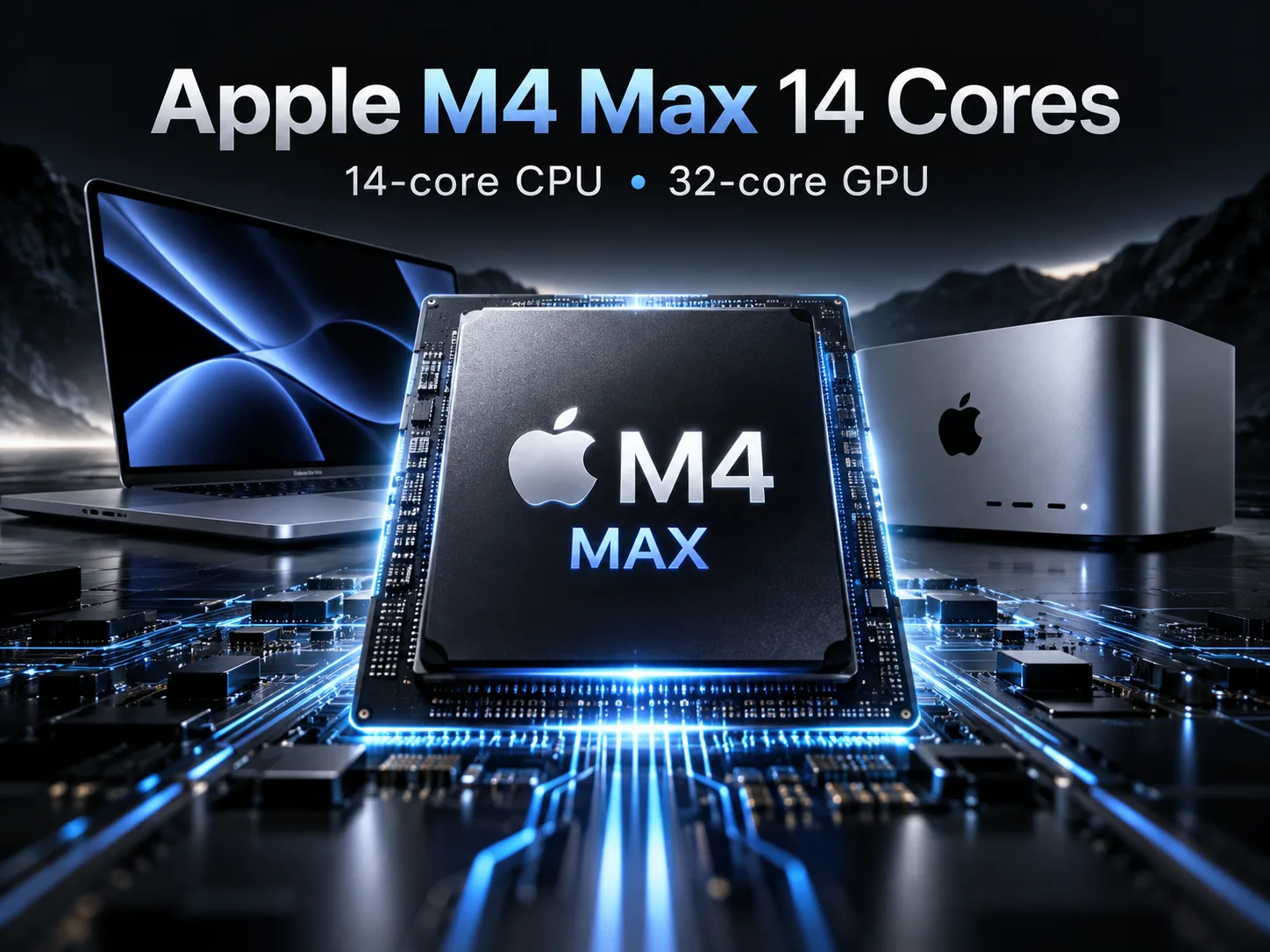
Apple M4 Max 14 Cores: 14-Core CPU and 32-Core Graphics
Apple M4 Max 14 Cores was released in October 2024 as the lower-end M4 Max configuration. The chip features a 14-core CPU, a 32-core GPU, and unified memory with 410 GB/s of bandwidth. In compute performance, it is close to the M4 Pro with the same 14 cores, but significantly faster in graphics workloads. The processor was used in the 2024 MacBook Pro and 2025 Mac Studio.
Architecture and CPU
The M4 Max is manufactured using TSMC’s second-generation 3 nm process. Its CPU consists of 10 performance cores and 4 efficiency cores. The performance cores reach a maximum frequency of approximately 4.5 GHz.
The CPU configuration matches that of the 14-core M4 Pro. The higher-end M4 Max has 16 cores, including 12 performance cores, giving it an advantage in multithreaded rendering and other multithreaded workloads.
CPU Performance
In Geekbench 6, the M4 Max 14 Cores scores around 4,000 points in Single-Core and 23,200 in Multi-Core. In the single-threaded test, it is approximately 29% faster than the M3 Max 16 Cores.
| Processor | Geekbench 6 SC | Geekbench 6 MC | Cinebench 2024 SC | Cinebench 2024 MC |
|---|---|---|---|---|
| Apple M4 Pro 14 Cores | 3,852 | 22,455 | 178 | 1,696 |
| Apple M4 Max 14 Cores | 4,021 | 23,158 | 177 | 1,756 |
| Apple M4 Max 16 Cores | 3,917 | 25,743 | 178 | 2,042 |
| Apple M3 Max 16 Cores | 3,128 | 20,969 | 141 | 1,607 |
Approximate results from comparison databases. Cinebench 2024 has a smaller sample of measurements, so its results are less consistent than those of Geekbench 6.
In Geekbench 6 Multi-Core, the lower-end M4 Max outperforms the M4 Pro by approximately 3%. Moving to the 16-core M4 Max increases the score by another 11%, while in Cinebench 2024 Multi-Core, the higher-end version’s advantage reaches 16%.
Geekbench 7 on Specific Devices
| Device and processor | Single-Core | Multi-Core |
|---|---|---|
| MacBook Pro 16 (2024), M4 Pro 14C | 3,377 | 24,907 |
| MacBook Pro 16 (2024), M4 Max 14C | 3,398 | 25,334 |
| Mac Studio (2025), M4 Max 14C | 3,500 | 25,911 |
| MacBook Pro 16 (2024), M4 Max 16C | 3,380 | 28,244 |
Average Geekbench 7 results for the listed models. Geekbench 7 scores cannot be directly compared with Geekbench 6 scores.
M4 Max 32-Core GPU Graphics
The integrated GPU contains 32 graphics cores, compared with 20 in the M4 Pro and 40 in the higher-end M4 Max. Its architecture supports Dynamic Caching, second-generation hardware ray tracing, and mesh shading.
Compared with the M4 Pro, the number of GPU cores is 60% higher, while memory bandwidth increases from 273 to 410 GB/s.
GPU Performance in Geekbench 7 Metal
| Device and graphics | Metal Score |
|---|---|
| MacBook Pro 16 (2024), M4 Pro 20-core GPU | 114,875 |
| MacBook Pro 16 (2023), M3 Max 40-core GPU | 167,136 |
| MacBook Pro 16 (2024), M4 Max 32-core GPU | 168,956 |
| Mac Studio (2025), M4 Max 32-core GPU | 169,376 |
| MacBook Pro 16 (2024), M4 Max 40-core GPU | 204,839 |
Average Geekbench 7 Metal results. The test measures GPU compute performance rather than gaming frame rates.
The 32-core M4 Max outperforms the M4 Pro by approximately 47% and delivers a result comparable to the M3 Max with a 40-core GPU. The higher-end M4 Max with 40-core graphics is approximately 21% faster.
Blender Rendering
Blender Benchmark measures the speed of rendering scenes on the GPU using the Cycles engine.
| Graphics processor | Blender GPU Score | Number of tests |
|---|---|---|
| Apple M4 Pro 20-core GPU | 2,530 | 407 |
| Apple M3 Max 30-core GPU | 3,203 | 222 |
| Apple M3 Max 40-core GPU | 3,854 | 447 |
| Apple M4 Max 32-core GPU | 4,446 | 214 |
| Apple M4 Max 40-core GPU | 5,208 | 464 |
Median Blender Open Data results for GPUs under macOS. Scores reflect the number of samples processed per minute. The database combines different Blender versions, so percentage differences are approximate.
In Blender, the lower-end M4 Max outperforms the M4 Pro by 76% and the M3 Max with 40-core graphics by 15%. The higher-end M4 Max makes rendering another 17% faster.
Memory and Video Processing
The M4 Max 14 Cores came with 36 GB of LPDDR5X unified memory with 410 GB/s of bandwidth. Configurations with more memory are available only with the M4 Max 16 Cores.
The Media Engine supports hardware decoding of H.264, HEVC, ProRes, ProRes RAW, and AV1. Encoding is handled by two video engines and two ProRes accelerators-twice as many as in the M4 Pro.
Computers Using the M4 Max 14 Cores
| Device | Memory | SSD | Launch price |
|---|---|---|---|
| MacBook Pro 14 (2024) | 36 GB | 1 TB | $3,199 |
| MacBook Pro 16 (2024) | 36 GB | 1 TB | $3,499 |
| Mac Studio (2025) | 36 GB | 512 GB | $1,999 |
Starting prices in the United States, excluding taxes. Current prices may differ.
The 16-inch MacBook Pro is better suited to sustained workloads than the 14-inch model thanks to its larger cooling system.
Conclusion
The Apple M4 Max 14 Cores outperforms the M4 Pro primarily in graphics workloads. The difference in Geekbench 6 Multi-Core is approximately 3%, whereas in Blender, the lower-end M4 Max is 76% faster. For compilation and other CPU workloads, the premium over the M4 Pro provides only a small performance increase, but in 3D rendering, the additional graphics cores significantly reduce processing time.
When choosing between the 14-core and 16-core M4 Max, it is important to consider the memory limitation. The lower-end configuration is available only with 36 GB, while the higher-end version supports more memory.
CPU Comparison
Compare Apple M4 Max 14 Cores with other CPUs
Basic
CPU Specifications
Memory Specifications
GPU Specifications
AI Specifications
Connectivity
Interfaces and Ports
Benchmarks
Compared to Other CPU
Related CPU Comparisons


Share in social media
Or Link To Us
<a href="https://cputronic.com/cpu/apple-m4-max-14-cores" target="_blank">Apple M4 Max 14 Cores</a>