Intel Core 7 253PQE

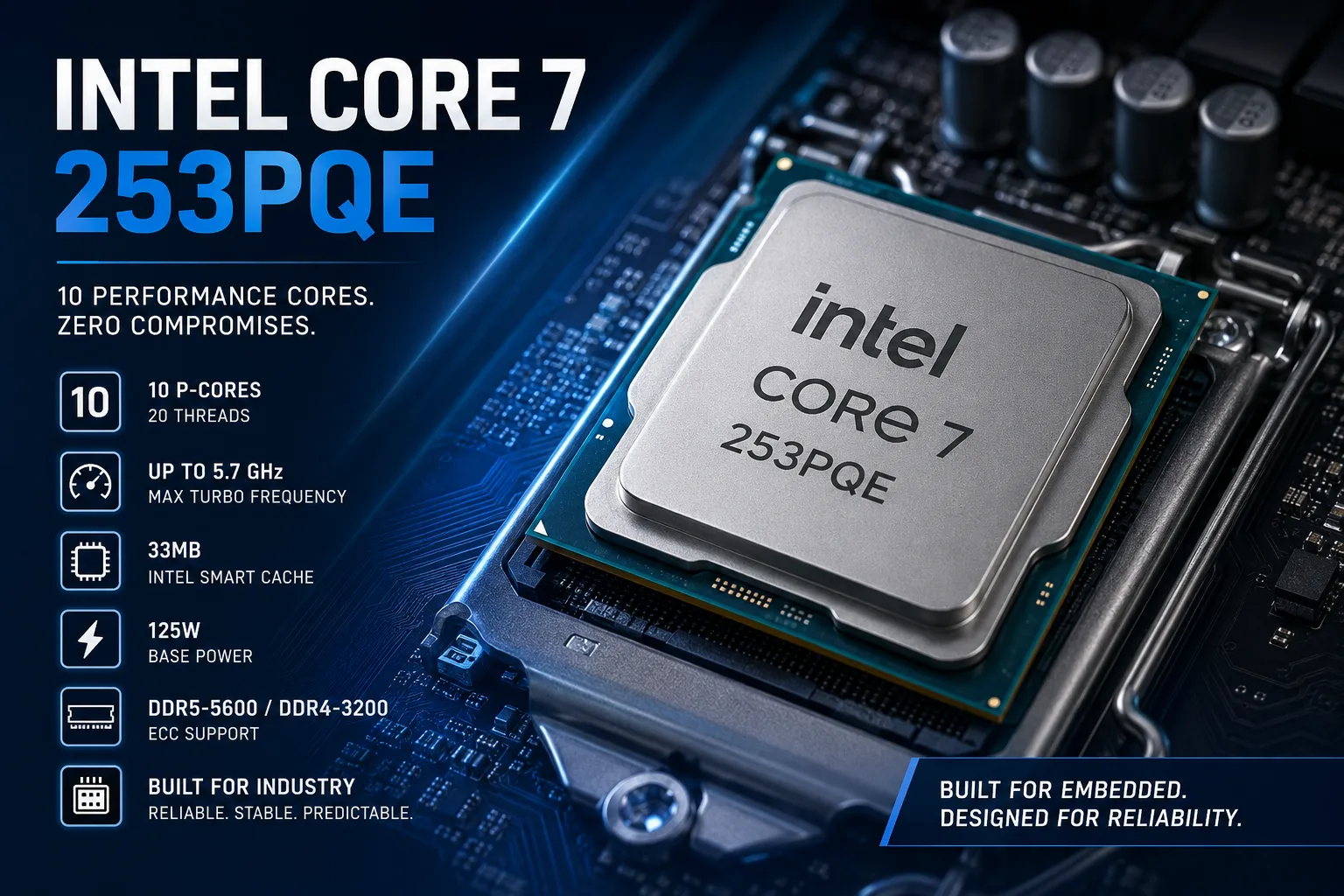
Intel Core 7 253PQE: Ten P-Cores Without Hybrid Architecture
Most Intel processors for LGA1700 combine performance and efficiency cores. The Core 7 253PQE is different: it features ten identical P-cores with support for 20 threads and completely forgoes E-cores.
Such a configuration appears unusual, but the model is not designed as a hidden upgrade to the Core i7 for home PCs. It belongs to the embedded series Bartlett Lake and is intended for industrial computers, networking equipment, edge servers, and systems where predictable latencies and long platform support are essential.
Why Intel Needed a Processor Without E-Cores
The hybrid architecture is effective in a typical computer. Heavy threads run on P-cores while background tasks are handled by compact E-cores. This allows for increased multithreaded performance without a significant rise in power consumption.
In specialized systems, priorities may differ. If an application uses thread affinity, processes network traffic, or operates in real-time, the differences between cores complicate tuning. The operating system's scheduler has to consider two classes of compute blocks, and developers must ensure that critical threads do not end up on slower cores.
With the Core 7 253PQE, all ten cores are identical. This does not automatically make the processor faster than hybrid models but simplifies load distribution and reduces dependence on the scheduler's behavior.
This is the primary idea behind Bartlett Lake: not the maximum number of cores, but a more homogeneous computing environment.
Ten P-Cores Are Rare for LGA1700
The Core 7 253PQE features ten performance cores with Hyper-Threading, 20 threads, and a frequency of up to 5.7 GHz. This configuration is unusual for the LGA1700 platform: mainstream Core i7 processors of recent generations typically offered eight P-cores supplemented by a group of E-cores.
For instance, the Core i7-14700 has eight P-cores and twelve E-cores. In well-parallelizable tasks, it often outperforms the Core 7 253PQE due to the greater number of physical cores. Therefore, Bartlett Lake cannot be seen as a universal alternative to higher-end desktop Cores.
Its advantage manifests itself in other scenarios:
- when pinning virtual machines to specific cores;
- in real-time systems;
- during network packet processing;
- in industrial controllers;
- in applications sensitive to latency variation.
The processor is chosen not because ten P-cores are always faster than a hybrid configuration, but because their behavior is easier to predict.
Familiar Architecture Without a Technological Leap
The Core 7 253PQE is based on the Bartlett Lake architecture and is manufactured using Intel 7 process technology. The P-cores are based on the familiar Raptor Cove architecture, so there is no significant increase in performance per clock compared to Raptor Lake.
This is not a new generation in the usual sense. Intel has repurposed the processor's configuration for a specific market but has not transitioned the model to a newer architecture or process technology.
This approach is understandable. Embedded platforms value long availability, compatibility, and predictability more than annual architectural updates. A proven foundation is often more critical here than maximum power efficiency.
Differences Between PQE, PE, and PTE Versions
Intel releases the ten-core Bartlett Lake in three variants. They use the same core configuration but differ in power limits and frequencies.
| Model | Cores and Threads | Max Frequency | Base Power |
|---|---|---|---|
| Core 7 253PQE | 10 / 20 | up to 5.7 GHz | 125 W |
| Core 7 253PE | 10 / 20 | up to 5.5 GHz | 65 W |
| Core 7 253PTE | 10 / 20 | up to 5.4 GHz | 45 W |
The Core 7 253PQE is intended for systems where maximum performance under sustained loads is essential. The PE and PTE versions are better suited for compact cases, passive cooling, and equipment with strict power consumption limits.
The difference between them lies not in the number of computing resources but in how long the processor can maintain high frequencies under load.
LGA1700 Is Not a Guarantee of Compatibility
The Core 7 253PQE uses the LGA1700 socket and supports DDR4 and DDR5. It is physically compatible with the platform known from Alder Lake and Raptor Lake processors.
However, it cannot be installed in just any consumer motherboard. To operate, suitable microcode and processor support in the BIOS are required. Manufacturers of mainstream boards may not release corresponding updates as Bartlett Lake is primarily aimed at commercial and industrial systems.
Therefore, socket matching guarantees very little here. Before purchasing, you need to check the list of supported processors for a specific board, not just the type of socket.
For the Core 7 253PQE, it is more logical to use industrial boards with chipsets Q670E, R680E, Q670, or W680. They better match the processor's intended use and often support features necessary for corporate systems.
Support for ECC and Corporate Features
One reason to choose the Core 7 253PQE is the support for ECC memory. For a home computer, this is rarely mandatory, but in systems running 24/7, error-correcting memory reduces the risk of data corruption and unexpected failures.
The processor also supports Intel Time Coordinated Computing and Time-Sensitive Networking technologies. These are designed for equipment where operations must be completed within a specified time interval: industrial networks, automation, robotics, and telecommunication infrastructure.
Against the backdrop of these features, it becomes clearer why Intel forwent E-cores. The main task of the processor is not to outperform the desktop Core i7 in rendering but to provide a controlled platform for specialized software.
Integrated Graphics - For Output and Video
The Core 7 253PQE features Intel UHD Graphics 770. This is the familiar integrated graphics from the Raptor Lake generation, primarily intended for output, video decoding, and operation without a discrete graphics card.
For gaming, it remains a weak point of the system. The processing part can work with a high-performance discrete accelerator, but the UHD Graphics 770 itself is not designed for modern games at high settings.
In industrial systems, its capabilities are usually sufficient. It can handle the interface, multiple displays, video streams, and hardware encoding via Quick Sync. For terminals, surveillance systems, and information panels, this is more valuable than high gaming performance.
##Capabilities in AI Tasks
The Core 7 253PQE does not have a separate NPU. The processor supports Intel Deep Learning Boost and can perform inference on the CPU but lags behind modern Core Ultra processors with dedicated neural blocks in local AI capabilities.
For small models, computer vision, and data preprocessing, ten P-cores may be sufficient. However, for generative AI, large language models, or heavy image processing, a discrete graphics card or specialized accelerator will be needed.
In such systems, the Core 7 253PQE is more likely to manage the compute pipeline rather than handle the main AI workload.
Is It Worth Using in a Home PC?
For the average user, the Core 7 253PQE has nearly no practical sense. It is harder to acquire, requires compatibility checks with the BIOS, and does not offer architectural advantages over modern desktop processors.
In gaming, the absence of E-cores does not ensure guaranteed gains. In multithreaded tasks, hybrid Core i7s and Core i9s may be faster due to a greater number of physical cores. Modern AMD and Intel platforms also offer newer process technologies and better power efficiency.
Interest in Bartlett Lake may arise among enthusiasts who need a rare ten-core configuration for LGA1700. But this is more of a technical experiment than a rational upgrade for a home system.
Conclusion
The Intel Core 7 253PQE is a specialized processor with ten identical P-cores and support for 20 threads. It does not seek to replace mainstream Core i7s, nor does it claim leadership in multithreaded benchmarks.
Its strength lies in the homogeneous core configuration, conducive to thread pinning, virtualization, network processing, and real-time systems. Support for ECC, industrial chipsets, and latency management technologies further underscores the model's intended purpose.
For a home PC, the Core 7 253PQE remains an exotic choice. For an industrial system, its lack of E-cores appears not as a limitation but as a deliberate choice.
CPU Comparison
Compare Core 7 253PQE with other CPUs
Basic
CPU Specifications
Memory Specifications
GPU Specifications
Interfaces and Ports
Benchmarks
Compared to Other CPU
Share in social media
Or Link To Us
<a href="https://cputronic.com/cpu/intel-core-7-253pqe" target="_blank">Intel Core 7 253PQE</a>