Intel Graphics 64EU (Arrow Lake-U)

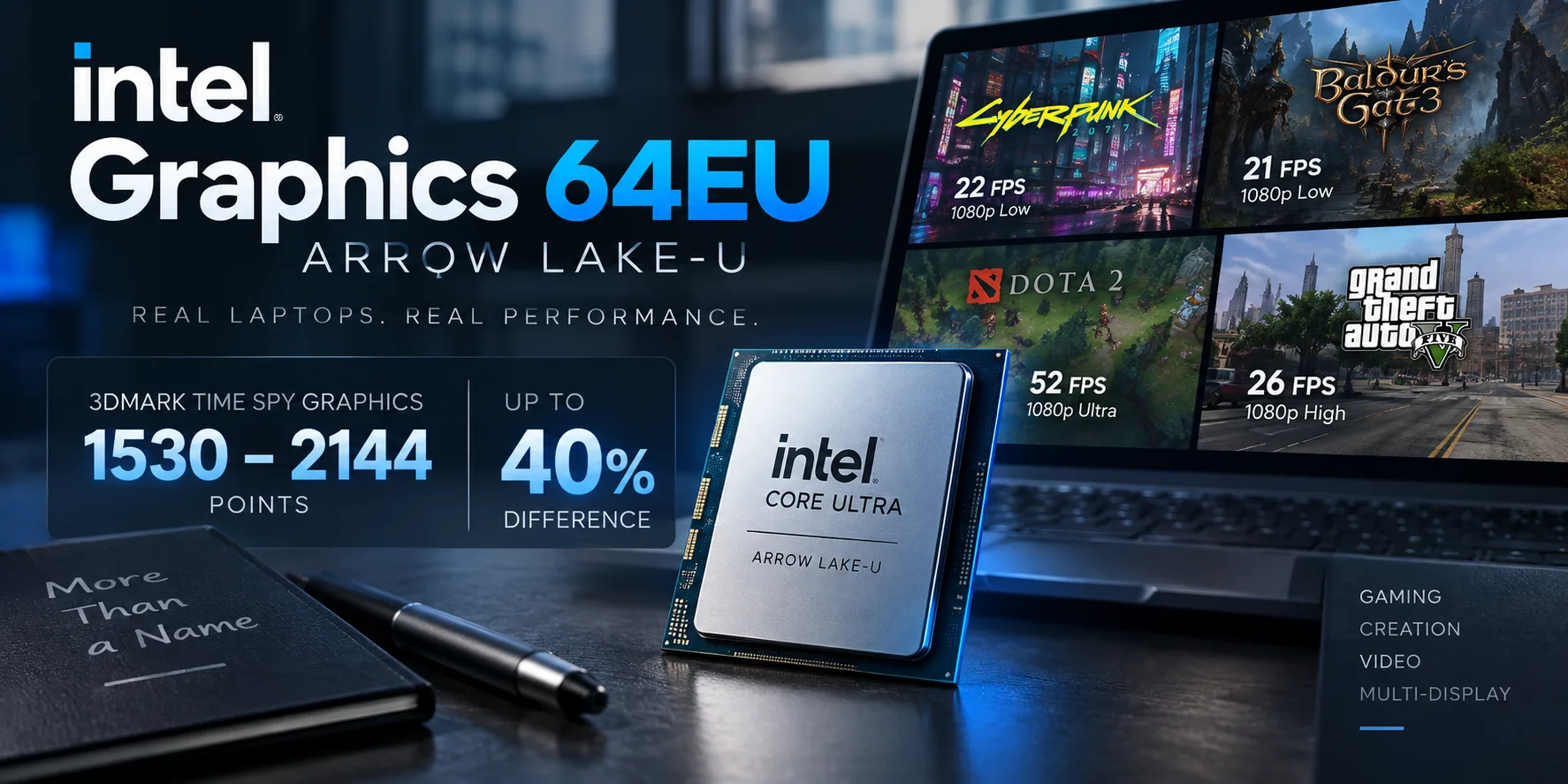
Intel Graphics 64EU (Arrow Lake-U): 1,530 to 2,144 Points in Time Spy
Intel Graphics 64EU in Arrow Lake-U processors features 4 Xe cores clocked at up to 2.1 GHz. In the 3DMark Time Spy Graphics test, laptops with this iGPU score between 1,530 and 2,144 points. The difference reaches 40%, so performance depends noticeably on the memory and the settings of the specific laptop.
4 Xe Cores and Up to 2.1 GHz
This iGPU is used in Core Ultra 200U mobile processors. The Core Ultra 5 225U has a maximum GPU clock speed of 2.0 GHz, while the Core Ultra 7 255U reaches 2.1 GHz.
There is no dedicated video memory: the iGPU uses the laptop's system memory. Arrow Lake-U processors support DDR5-6400 and LPDDR5X-8400, so the memory operating mode and bandwidth directly affect GPU performance.
Intel's official name for this graphics solution is Intel Graphics. Intel Graphics 64EU should not be confused with the Arc 130T and Arc 140T in Arrow Lake-H processors: those GPUs have more Xe cores and higher performance.
Performance in Real-World Laptops
Results vary noticeably depending on the laptop's memory and settings.
| Laptop | Processor | Memory | Time Spy Graphics | Fire Strike Graphics |
|---|---|---|---|---|
| Lenovo ThinkPad E16 G3 | Core Ultra 5 225U | DDR5-5600, single-channel | 1530 | 3838 |
| Lenovo IdeaPad 5 2-in-1 16IAL10 | Core Ultra 7 255U | LPDDR5X-8000, dual-channel | 1810 | 5185 |
| HP 17t-cn500 | Core Ultra 7 255U | DDR5-5600, dual-channel | 1985 | 4614 |
| Lenovo ThinkPad T14s 2-in-1 Gen 1 | Core Ultra 7 255U | 32 GB | 2144 | 5118 |
The ThinkPad E16 G3 has the lowest result. Its Core Ultra 5 225U operates with a single DDR5-5600 module in single-channel mode, reducing the memory bandwidth available to the integrated graphics.
The difference between 1,530 and 2,144 points in Time Spy Graphics is about 40%. The Core Ultra 7 255U has a higher GPU clock speed, but clock speed alone does not explain this spread: the result also depends on the memory and the laptop's power limits.
The three laptops with the Core Ultra 7 255U score 1,810, 1,985, and 2,144 points. The difference between the minimum and maximum values is about 18%.
Gaming Performance
The ThinkPad T14s 2-in-1 with the Core Ultra 7 255U delivers some of the best results among the laptops with Intel Graphics 64EU that were found.
| Game | Settings | FPS |
|---|---|---|
| Dota 2 Reborn | 1080p Ultra | 51.8 |
| Strange Brigade | 1080p Ultra | 35.2 |
| GTA V | 1080p High | 25.8 |
| Cyberpunk 2077 | 1080p Low | 22.5 |
| Cyberpunk 2077 | 1080p Medium | 18.3 |
| Cyberpunk 2077 | 1080p Ultra | 13.7 |
| Baldur's Gate 3 | 1080p Low | 21.1 |
| Baldur's Gate 3 | 1080p Ultra | 13.6 |
Dota 2 Reborn runs at approximately 52 FPS at 1080p Ultra. In Strange Brigade, the frame rate reaches 35 FPS, while GTA V delivers around 26 FPS at 1080p High.
In Cyberpunk 2077, performance drops to 22.5 FPS at 1080p Low and 13.7 FPS at Ultra. Baldur's Gate 3 delivers 21.1 FPS at 1080p Low and 13.6 FPS at Ultra.
To increase FPS in these games, you will have to lower the resolution and settings or enable upscaling.
Core Ultra 200U Does Not Mean Arc
Core Ultra 200U and Core Ultra 200H belong to the same generation, but their integrated graphics differ substantially.
For example, the Core Ultra 5 225H is equipped with an Arc 130T featuring 7 Xe cores, whereas the Core Ultra 5 225U gets Intel Graphics with 4 Xe cores.
In Time Spy Graphics, the Arc 130T scores around 2,400 points, while the ThinkPad E16 G3 with the Core Ultra 5 225U scores 1,530 points.
Gaming performance cannot be assessed based on the processor designation alone. A Core Ultra 5 from the H series may have faster integrated graphics than a Core Ultra 7 from the U series.
Video and Displays
Intel Graphics 64EU supports hardware encoding and decoding of H.264, HEVC, and AV1, as well as Intel Quick Sync Video.
Support for DirectX 12.2, OpenGL 4.6, and OpenCL 3.0 is specified. Up to four displays can be connected simultaneously. DisplayPort supports resolutions of up to 7680 x 4320 at 60 Hz, while eDP supports up to 3840 x 2400 at 120 Hz.
Conclusion
In real-world laptops, Intel Graphics 64EU scores between 1,530 and 2,144 points in Time Spy Graphics. Even the three systems with the Core Ultra 7 255U score between 1,810 and 2,144 points, confirming that performance depends on the configuration of the specific laptop.
Dota 2 Reborn runs at approximately 52 FPS at 1080p Ultra, while Cyberpunk 2077 and Baldur's Gate 3 do not reach 30 FPS even at low settings. For gaming, Arrow Lake-H processors with the Arc 130T or Arc 140T are significantly faster.
GPU Comparison
Compare Graphics 64EU (Arrow Lake-U) with other GPUs
Basic
Memory Specifications
Display and Media
Theoretical Performance
AI Features
Miscellaneous
Benchmarks
Compared to Other GPU


Share in social media
Or Link To Us
<a href="https://cputronic.com/en/gpu/intel-graphics-64eu-arrow-lake-u" target="_blank">Intel Graphics 64EU (Arrow Lake-U)</a>