Intel Core Ultra 5 225U

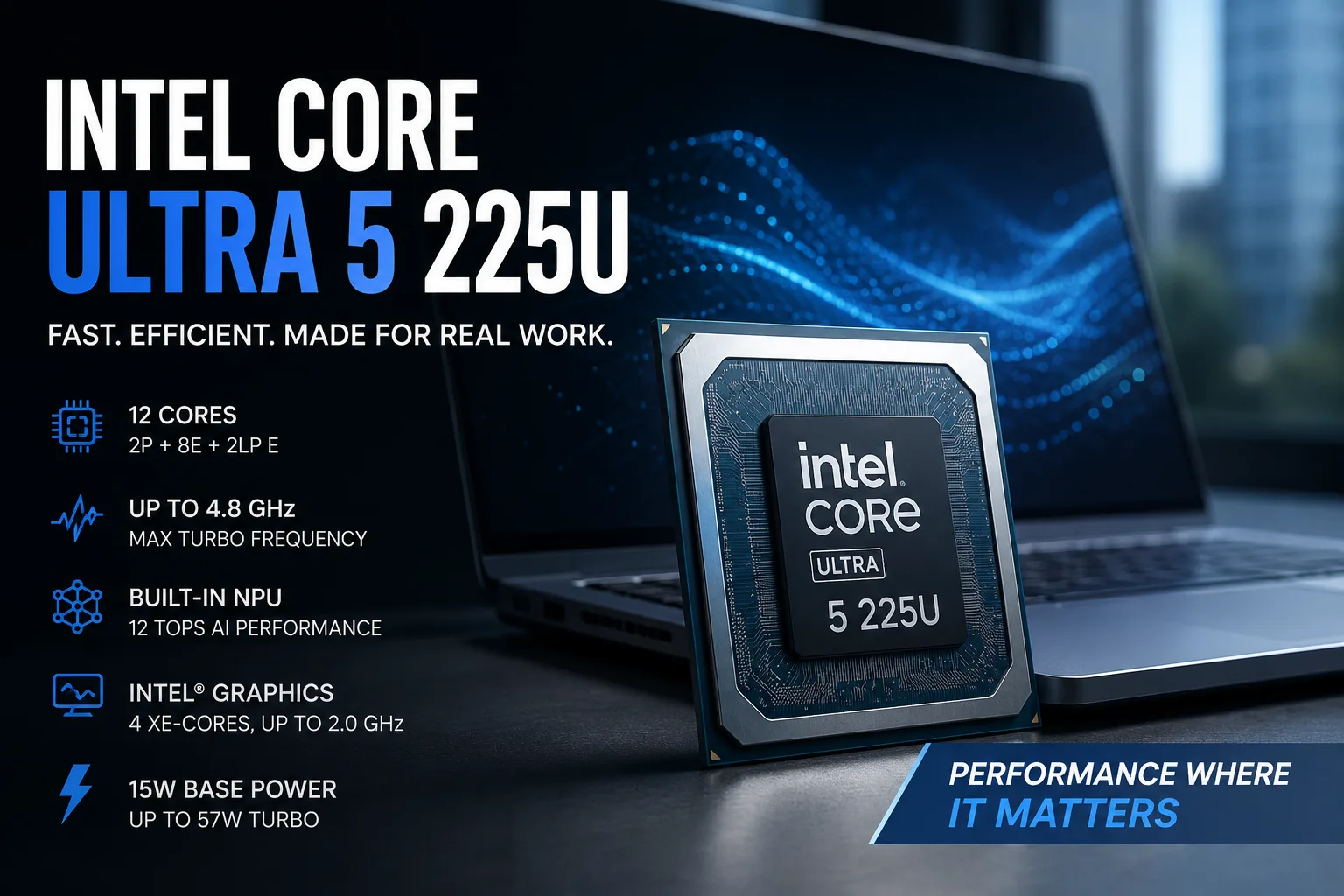
Intel Core Ultra 5 225U: A Fast Chip for Thin Laptops, but Not the Junior 225H
Intel Core Ultra 5 225U may easily be mistaken for the junior version of the Core Ultra 5 225H, but the letter U is much more important than the almost identical index. It is designed for thin work laptops: it quickly handles short tasks but is not required to maintain maximum frequency for hours.
The Core Ultra 5 225U features 12 processor cores, integrated graphics with four Xe cores, and a separate NPU. The maximum frequency reaches 4.8 GHz. The processing power here is significantly stronger than the graphics and the neural unit: the Core Ultra name promises more than these two components can deliver.
Twelve Cores, but Only Two Performance Cores
The processor consists of three groups of cores:
- 2 performance P-cores;
- 8 efficient E-cores;
- 2 low-power LP E-cores.
Hyper-Threading is available only for the two P-cores, so the processor supports a total of 14 threads. The P-cores boost up to 4.8 GHz, the E-cores up to 3.8 GHz, and the LP E-cores up to 2.4 GHz.
The high frequency of the two P-cores helps with short workloads: launching applications, web browsing, and calculations in spreadsheets. The eight E-cores provide headroom for multi-threaded tasks, while the two LP E-cores enable light background work without waking the more powerful cores.
This configuration suits the U-series well: the processor quickly accelerates in short tasks and saves energy during idle periods.
15W - A Base Guideline Only
The base power limit for the Core Ultra 5 225U is 15W, and the laptop manufacturer can reduce it to 12W. In short turbo mode, power consumption rises up to 57W.
Thus, two laptops with the Core Ultra 5 225U can run at different speeds. In models with good cooling, the processor can maintain high frequencies for longer, while in thin cases it drops them sooner under sustained loads.
The difference is most noticeable in prolonged multi-threaded tasks such as compiling, archiving, and video exporting. A well-tuned laptop with the 225U can outperform a poorly cooled model with a Core Ultra 7 U-series processor.
Faster than Core i5-1335U, but Far from 225H
In most processor benchmarks, the Core Ultra 5 225U outperforms the Core i5-1335U by 14-31%.
| Test | Core Ultra 5 225U | Core i5-1335U | Difference |
|---|---|---|---|
| Cinebench 2024, single core | 101 | 95 | +6% |
| Cinebench 2024, all cores | 520 | 397 | +31% |
| Geekbench 6, single core | 2425 | 2126 | +14% |
| Geekbench 6, all cores | 9965 | 8288 | +20% |
| PassMark CPU Mark | 17,765 | 13,912 | +28% |
The most noticeable gains are in multi-threaded mode, where the additional cores provide up to 31%.
However, the identical index does not make the U and H versions comparable in capabilities. The Core Ultra 5 225H has more P-cores, significantly stronger graphics, and a higher allowable power consumption.
For regular rendering, video editing, and prolonged compilation, it makes more sense to choose an H-series processor.
Integrated Graphics: Modern but Entry-Level
The Core Ultra 5 225U has Intel Graphics integrated with four Xe cores and a frequency of up to 2 GHz. It can hardware-decode AV1 and supports multiple external displays.
Its capabilities are sufficient for a 4K display, video calls, video playback, and basic photo editing. Intel Quick Sync accelerates video encoding in compatible programs.
However, four Xe cores are the minimum option for this graphics. In terms of gaming performance, it significantly lags behind the integrated graphics of the Core Ultra 200H and Radeon 760M, 780M, or 880M.
Older games and less demanding online projects can run at low settings, but for new heavy games, this graphics solution is too weak.
The main limitation of the Core Ultra 5 225U remains its graphics: CPU performance in games will often exceed the capabilities of the integrated GPU.
NPU Available, but It’s Not Copilot+ PC
The processor is equipped with an Intel AI Boost neural block with a performance of 12 TOPS. Intel also specifies a total of 24 TOPS for the CPU, GPU, and NPU, but for Copilot+ functionality, the performance of the neural block itself is crucial.
The NPU can handle background blurring, gaze correction, and noise reduction in applications that support such acceleration. However, for the Copilot+ PC category, an NPU with at least 40 TOPS is required.
Therefore, a laptop with the Core Ultra 5 225U does not meet the Copilot+ PC requirements. Here, the NPU remains a supplementary block, and paying extra for such a laptop just for AI features does not make sense.
Fast Memory Available, but Upgrade Depends on Laptop
The Core Ultra 5 225U supports DDR5-6400, LPDDR5X-8400, PCI Express 4.0, and Thunderbolt 4.
However, the possibility of upgrading depends not on the processor but on the laptop's design. In thin models, the memory is often soldered, so it’s better to buy a 32 GB unit from the start or choose a laptop with SO-DIMM slots if you want longevity.
Who Should Consider Core Ultra 5 225U
The Core Ultra 5 225U is suitable for a laptop intended for office work, study, programming, video calls, and basic photo or video editing.
For new games, constant 3D rendering, complex video editing, and running large local models, it is better to look for a laptop with an H-series processor and discrete graphics.
Conclusion
Intel Core Ultra 5 225U is a typical U-series processor with a strong CPU component and strict limitations on graphics and NPU. In terms of CPU core speed, it confidently outperforms the Core i5-1335U, supports fast memory, and does not lag behind more expensive platforms in key interfaces.
However, the Ultra branding does not make it a processor suitable for gaming, rendering, and heavy editing. The integrated graphics remain entry-level, and the NPU does not meet Copilot+ PC requirements.
The Core Ultra 5 225U makes sense for a thin work laptop that requires high CPU speed without H-series level cooling. The main consideration here is not the processor itself but the laptop surrounding it: cooling, soldered memory capacity, and price. Under equal conditions, 225U is a reasonable choice for work, but overspending for the word Ultra or promises of AI is not worthwhile.
CPU Comparison
Compare Core Ultra 5 225U with other CPUs
Basic
CPU Specifications
Memory Specifications
GPU Specifications
Interfaces and Ports
Benchmarks
Compared to Other CPU
Related CPU Comparisons


Share in social media
Or Link To Us
<a href="https://cputronic.com/en/cpu/intel-core-ultra-5-225u" target="_blank">Intel Core Ultra 5 225U</a>