Intel Core Ultra 7 258V
Intel Core Ultra 7 258V: Arc 140V and 32 GB without Upgrading to Core Ultra 9
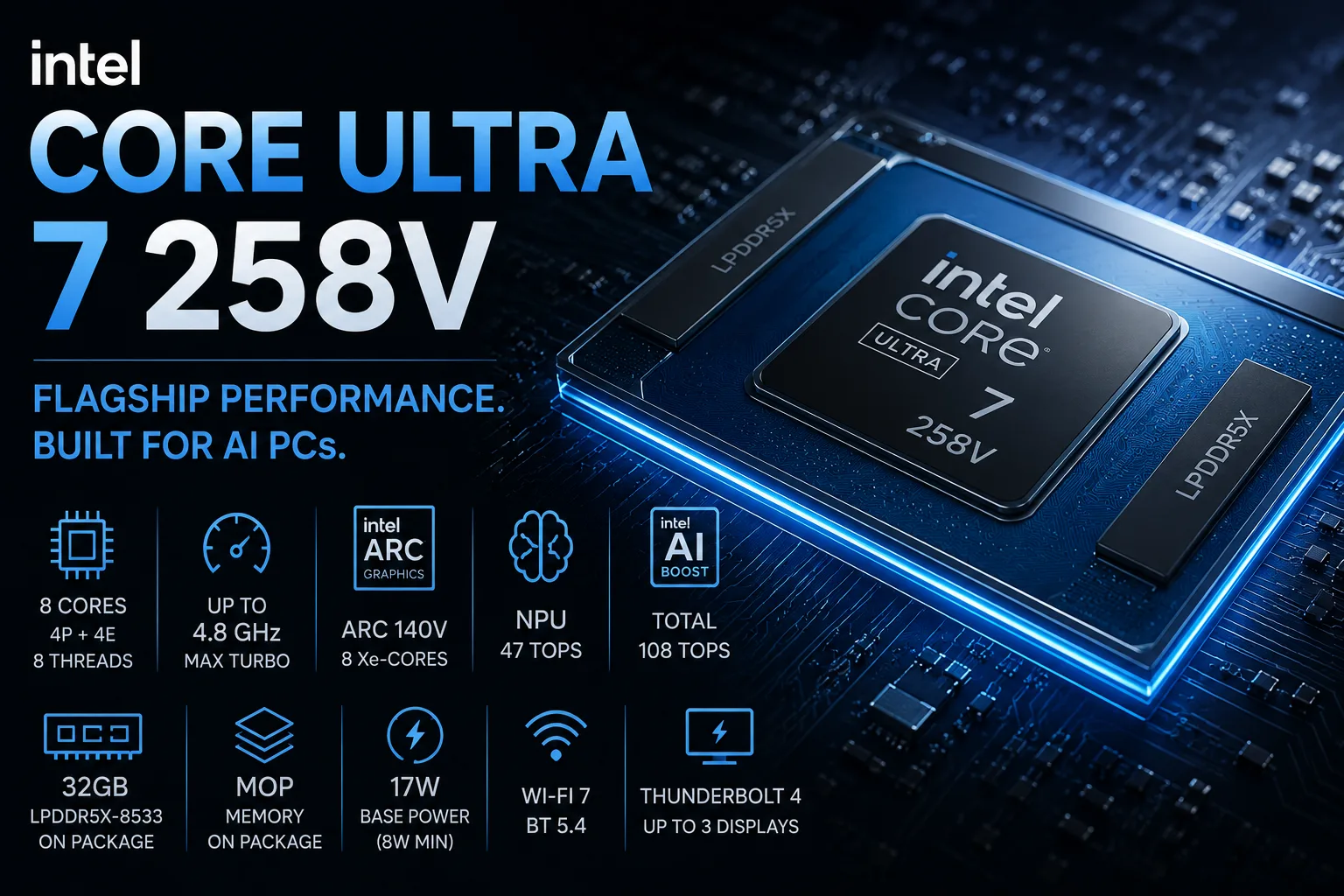
The Core Ultra 7 258V combines 32 GB of MOP memory, Arc 140V graphics, and a base power consumption of 17 W. More expensive Lunar Lake models increase frequencies but do not add cores, memory, or graphical units.
It differentiates from the Core Ultra 5 model with more powerful integrated graphics and an increased cache while maintaining a moderate power range, unlike the Core Ultra 9 288V, which has a base power of 30 W. Therefore, the 258V is one of the most rational versions of the series for slim laptops without a discrete graphics card.
Where Eight Threads are Enough and Where They Are Not
The Core Ultra 7 258V features four performance cores (Lion Cove) and four energy-efficient cores (Skymont). Hyper-Threading is not supported, so the eight cores operate with eight threads. The maximum frequency of the P-cores reaches 4.8 GHz, and the level 3 cache is 12 MB.
Lunar Lake is designed for compact laptops where fast response time, moderate power consumption, and simple cooling are important. The base power of the 258V is 17 W, with a minimum guaranteed power of 8 W, and maximum turbo power limited to 37 W.
Eight threads are sufficient for office programs, development, photo processing, and basic video editing, provided the work does not involve prolonged calculations. In rendering and compiling large projects, models from the H and HX series with a higher core count are noticeably faster.
MOP: 32 GB on a Single Substrate with the Processor
The Lunar Lake uses the Memory on Package, or MOP, layout. LPDDR5X chips are located on a common substrate close to the processing chiplets. The memory is not part of the computing die but is in the same package.
This layout shortens connection lengths, reduces the power consumption of the memory interface, and frees up space on the motherboard, facilitating the placement of the battery and cooling system in a slim chassis.
The downside of MOP is that the memory cannot be replaced or expanded. The Core Ultra 7 258V always comes with 32 GB of LPDDR5X-8533. A laptop with this processor cannot have a different memory size, and adding memory after purchase is impossible.
The Core Ultra 7 256V differs from the 258V only in memory volume. The cores, frequencies, cache, graphics, and NPU are identical: the 256V comes with 16 GB, while the 258V has 32 GB.
For a laptop without upgrade options, the additional 16 GB provides a significantly larger headroom for several years. They are useful when handling large photos, video editing, working with virtual machines, containers, and heavy development environments. The extra volume is also important for the Arc 140V since the integrated graphics use system memory.
Arc 140V - The Main Advantage Over Core Ultra 5
The Core Ultra 7 258V features Arc 140V graphics with eight Xe cores based on the Xe2 architecture and a frequency of up to 1.95 GHz. This is the higher graphical configuration of Lunar Lake. The 268V and 288V have the same eight Xe cores but slightly higher frequencies.
The Arc 140V handles esports games, AAA projects from past years, and some modern releases without a discrete graphics card. In demanding games, settings will need to be lowered, XeSS enabled, or resolution decreased.
Key differences from the Core Ultra 5 228V include:
- Eight Xe cores instead of seven;
- Graphics frequency up to 1.95 instead of 1.85 GHz;
- 12 MB cache instead of 8 MB;
- CPU frequency up to 4.8 instead of 4.5 GHz.
The increase in processor performance is modest. The main advantage of the 258V manifests in games and applications that utilize integrated graphics.
Since the Arc 140V uses system LPDDR5X, the 32 GB provides greater leeway for simultaneous operation of games and background applications.
The graphics also support hardware encoding and decoding for H.264, H.265, and AV1. The VVC format is supported for decoding. Hardware codec processing reduces CPU load during playback and export of supported formats.
NPU at 47 TOPS
The Intel AI Boost neural processor reaches up to 47 TOPS. It handles supported AI functions-such as noise cancellation, camera effects, and speech recognition-without a constant load on the CPU and graphics.
The difference between 40 TOPS in the Core Ultra 5 and 47 TOPS in the 258V is not sufficient to choose the processor solely for the NPU. Real benefits depend on specific application support, and programs without that support do not run faster.
When choosing between the Core Ultra 5 and Core Ultra 7, graphics and memory volume matter more than the difference in TOPS.
How 258V Differs from Neighboring Models
Core Ultra 7 256V
The cores, frequencies, graphics, and NPU are the same, but the memory volume is reduced to 16 GB. This is sufficient for office tasks, but memory cannot be increased later.
If the price difference is small, the extra 16 GB justifies the additional cost for the 258V.
Core Ultra 7 268V
This model features the same eight cores, 12 MB cache, 32 GB memory, and Arc 140V. The maximum CPU frequency is increased from 4.8 to 5.0 GHz, and the graphics frequency from 1.95 to 2.0 GHz.
The increase is not significant. Cooling and the power limits of a specific laptop affect actual speed more. When choosing between the 258V and 268V, it’s better to select the laptop itself rather than the processor index.
Core Ultra 9 288V
The Core Ultra 9 uses the same eight cores, 32 GB memory, and Arc 140V, but raises the frequencies and increases the base power to 30 W.
The higher power limit helps maintain frequencies for longer but increases power consumption and cooling requirements. If autonomy is a priority, the 258V is more rational than the 288V.
Who is the Core Ultra 7 258V Suitable For
The Core Ultra 7 258V is suitable for mobile laptops that do not require a discrete graphics card. Its performance is adequate for development, office work, photo processing, basic video editing, and gaming at low or medium settings.
For regular rendering, complex editing, and modern games at high settings, it is better to choose a laptop with a more multi-core processor or discrete graphics card. In such tasks, the limitations are the eight threads and the capabilities of the Arc 140V.
The same 258V may perform differently in different laptops. Noise, battery life, and stable performance depend more on cooling, battery, and power settings than on the difference between the 258V and the 268V.
Conclusion
The Core Ultra 7 258V already features the higher graphics of Lunar Lake and the maximum memory capacity for this platform. The main combination here is 32 GB of MOP memory, Arc 140V, and a base power of 17 W.
The 256V is limited to 16 GB. The 268V only slightly raises frequencies. The Core Ultra 9 288V gets a base power of 30 W.
Further upgrades within the lineup are primarily focused on the last few hundred megahertz.
CPU Comparison
Compare Core Ultra 7 258V with other CPUs
Basic
CPU Specifications
Memory Specifications
GPU Specifications
Benchmarks
Compared to Other CPU
Related CPU Comparisons





Share in social media
Or Link To Us
<a href="https://cputronic.com/en/cpu/intel-core-ultra-7-258v" target="_blank">Intel Core Ultra 7 258V</a>