Intel Core Ultra 9 386H

Intel Core Ultra 9 386H: A Powerful Panther Lake for Laptops, But Not for Integrated Graphics
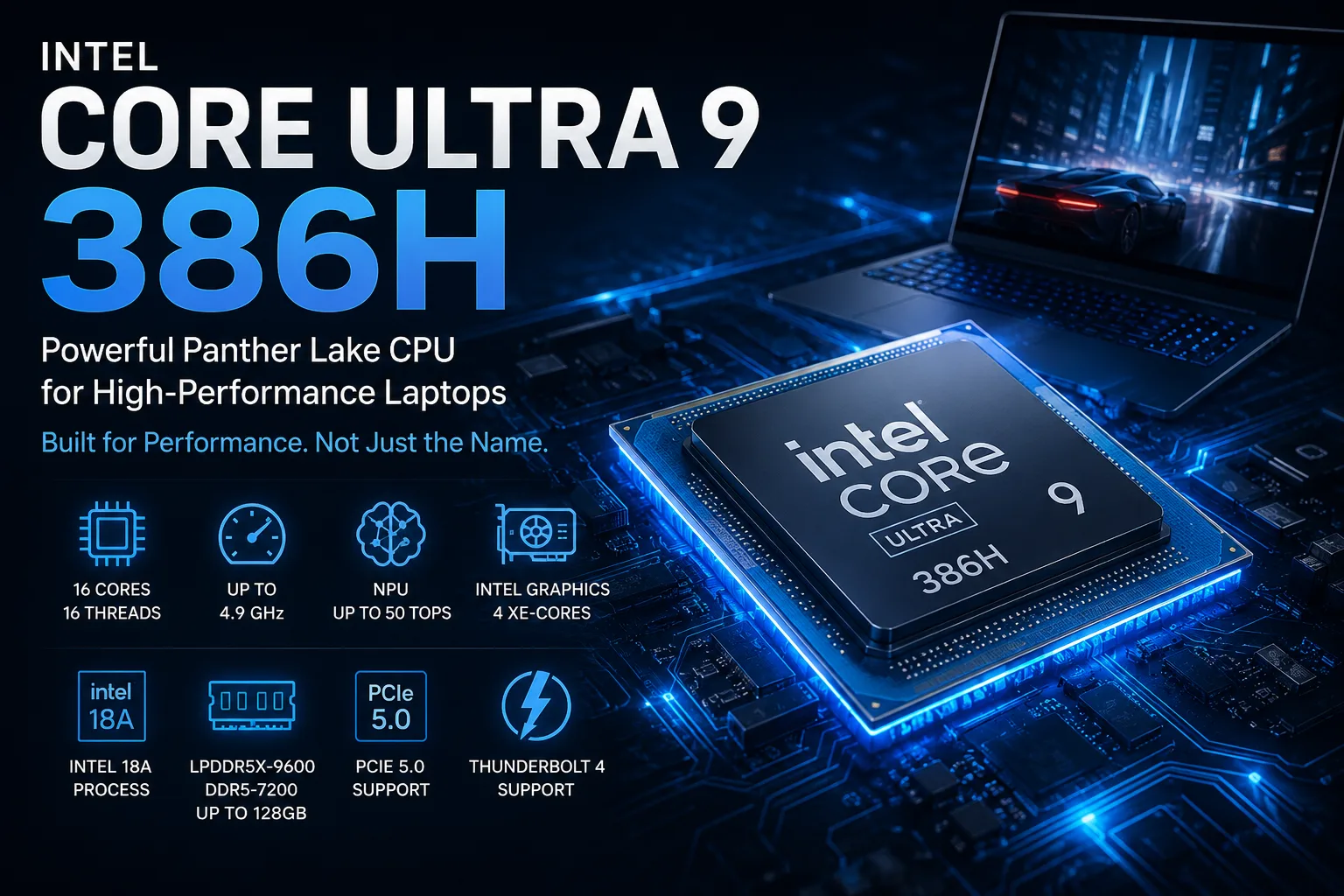
The Intel Core Ultra 9 386H appears to be the flagship mobile processor of Intel's Panther Lake generation: 16 cores, a frequency of up to 4.9 GHz, Intel's 18A process technology, NPU performance up to 50 TOPS, and a modern platform featuring fast memory, PCIe 5.0, and Thunderbolt 4. However, its main distinction is not the appealing name Core Ultra 9. This chip is primarily interesting as a strong CPU foundation for high-performance laptops, especially those equipped with a discrete graphics card.
Here’s an important nuance: the Core Ultra 9 386H is not the best choice for those expecting top-notch integrated graphics. Despite its more advanced name, its iGPU is noticeably simpler compared to some other Panther Lake models. Thus, the 386H should be understood not as a universal “best in everything” processor, but rather as a powerful H-chip for work and gaming laptops with adequate cooling.
Architecture: 16 Physical Cores Without Hyper-Threading
The Core Ultra 9 386H employs a hybrid Panther Lake configuration: 4 performance cores, 8 energy-efficient cores, and 4 low-power efficient cores. This results in a total of 16 cores and 16 threads.
This is an important detail: there isn’t the classic scheme where the number of threads is double the number of cores. Multi-threaded performance is built not on Hyper-Threading, but on the number of physical cores, frequencies, and the effective distribution of tasks among different clusters.
The maximum frequency of the P-cores reaches 4.9 GHz, E-cores can boost up to 3.7 GHz, and LP E-cores can reach 3.5 GHz. The size of the Intel Smart Cache is 18 MB. In terms of class, this is not an extreme HX processor for bulk gaming machines, but a strong H-chip for performance laptops, where a balance between speed, temperature, and power consumption is important.
Performance: Strong Geekbench, But Not Dominating Competitors
In recent benchmarks, the Intel Core Ultra 9 386H exhibits significantly improved performance over earlier results. In Geekbench 6, it scores about 2882 points in single-core and 16400 points in multi-core. This is no longer just a cautious increase over the Core Ultra 9 285H, but a more confident step forward, especially in multi-threaded testing.
In PassMark, the processor registers 4241 points in single-thread and 35831 points in CPU Mark. Here, the picture is less straightforward: overall, the 386H slightly surpasses the Core Ultra 9 285H and is close to the Ryzen AI 9 HX 370, but in single-thread performance, the older 285H can still appear stronger.
| Processor | Geekbench 6 Single | Geekbench 6 Multi | PassMark Single | PassMark Multi |
|---|---|---|---|---|
| Intel Core Ultra 9 285H | 2603 | 14754 | 4430 | 34260 |
| Intel Core Ultra 9 386H | 2882 | 16400 | 4241 | 35831 |
| AMD Ryzen AI 9 HX 370 | 2597 | 13367 | 3958 | 35080 |
The main takeaway: the Core Ultra 9 386H performs well in Geekbench 6 and shows strong multi-threaded performance, but it does not completely dominate its peers in all tests. It is a strong modern H-processor, but not a chip that should be evaluated solely based on the Ultra 9 name.
Integrated Graphics: The Main Compromise of the 386H
The most interesting aspect of the Core Ultra 9 386H is not its speed. That is expected. What’s more interesting is that the higher name does not equate to the best integrated graphics.
The processor is equipped with Intel Graphics featuring 4 Xe cores. This is sufficient for tasks such as displaying images, video, office work, browsing, simple editing, and light gaming. However, this is not the iGPU for which one should purchase an expensive laptop. If a powerful laptop without a discrete graphics card and with the strongest integrated graphics is the goal, then the 386H does not appear to be the most logical option.
Conversely, in a laptop with a GeForce RTX or another discrete graphics card, this approach makes sense. The iGPU handles basic tasks and power savings, while serious graphical workloads are offloaded to the separate GPU. Therefore, the reduced integrated graphics here is not a flaw, but rather a part of the strategic positioning: Intel prioritizes the CPU, NPU, and platform over integrated gaming potential.
NPU and Platform: Useful, But Not Magic
The Core Ultra 9 386H features an NPU with performance up to 50 TOPS. This is an important characteristic for modern Windows laptops, especially in the context of growing local AI functionalities. The NPU can assist in tasks such as camera processing, noise reduction, background effects, some scenarios with ONNX/OpenVINO, and energy-efficient execution of AI workloads.
However, one should not overestimate this component. The NPU does not replace a graphics card, does not accelerate traditional games, and does not transform the laptop into a workstation for intensive AI tasks. Rather, it is part of a modern platform: a useful accelerator for background and local AI tasks, but not currently the main reason to buy a laptop specifically featuring the Core Ultra 9 386H.
The platform itself appears robust: LPDDR5X-9600 or DDR5-7200, up to 128 GB of memory, PCIe 5.0, PCIe 4.0, Thunderbolt 4, and relevant media capabilities. For an expensive laptop, this is an important set: fast SSDs, good peripherals, and memory headroom often have a more significant impact on real-world experience than a minor difference between adjacent CPUs in synthetic benchmarks.
What’s the Catch
The Core Ultra 9 386H may seem like an obvious top choice: new architecture, Intel 18A, high frequencies, 16 cores, fresh benchmarks. However, purchasing a laptop solely based on the processor’s name is still not advisable.
This chip has three key limitations:
- Integrated graphics are not the maximum for the Panther Lake generation;
- Real-world performance strongly depends on cooling and power limits;
- In some single-core tests, older or neighboring processors may perform just as well.
This is why the 386H thrives best in the right chassis: with adequate cooling, fast memory, and a discrete graphics card. In a thin laptop with constrained limits, it may lose some of its advantages.
Who Should Consider the Intel Core Ultra 9 386H
The Core Ultra 9 386H is worth considering for performance laptops where a fast CPU is needed, but extreme HX-class performance is not essential. It’s a good option for development tasks, intensive browsing, office multitasking, photo editing, moderate engineering tasks, and gaming with a discrete graphics card.
This processor is ideally suited for scenarios such as:
- A laptop with GeForce RTX, where iGPU is primarily needed for energy savings and display output;
- A work machine for coding, content creation, and multitasking;
- A performance laptop not focused on an ultra-thin form factor;
- A model where CPU, NPU, fast memory, and a modern platform are important.
Conclusion
The Intel Core Ultra 9 386H is not a universal “king of everything,” but rather a strong H-processor of the Panther Lake series for powerful laptops. Its main advantages include a fast CPU segment, Intel’s 18A process technology, NPU performance up to 50 TOPS, and reliable performance in modern benchmarks. It looks particularly impressive in Geekbench 6, and in PassMark it shows high multi-core results, although it does not always dominate in single-thread tasks.
The central premise of the 386H is straightforward: this is a processor for a performance laptop where the CPU should be fast, while serious graphics are handled by a discrete graphics card. If the manufacturer has not restricted the chip with a thin chassis and has provided adequate cooling, the Core Ultra 9 386H could become one of the most successful H-processors from Intel for powerful laptops in 2026.
CPU Comparison
Compare Core Ultra 9 386H with other CPUs
Basic
CPU Specifications
Memory Specifications
GPU Specifications
Interfaces and Ports
Benchmarks
Compared to Other CPU
Related CPU Comparisons





Share in social media
Or Link To Us
<a href="https://cputronic.com/en/cpu/intel-core-ultra-9-386h" target="_blank">Intel Core Ultra 9 386H</a>