Intel Core i5-13420H
Intel Core i5-13420H
Intel Core i5-13420H processor review

Intel Core i5-13420H: Affordable H-Processor for Work and Gaming Laptops

The Intel Core i5-13420H is a mid-range mobile processor for laptops that need performance beyond typical office models without the premium price of a Core i7. It’s commonly found in versatile 15-16 inch laptops, entry-level gaming models, and compact mini-PCs.

This is not a processor designed for record-breaking battery life or as a flagship for heavy rendering tasks. Its strength is simpler: a solid reserve of CPU performance for a reasonable price, especially if the laptop is equipped with effective cooling and a discrete graphics card.

What Kind of Processor Is This

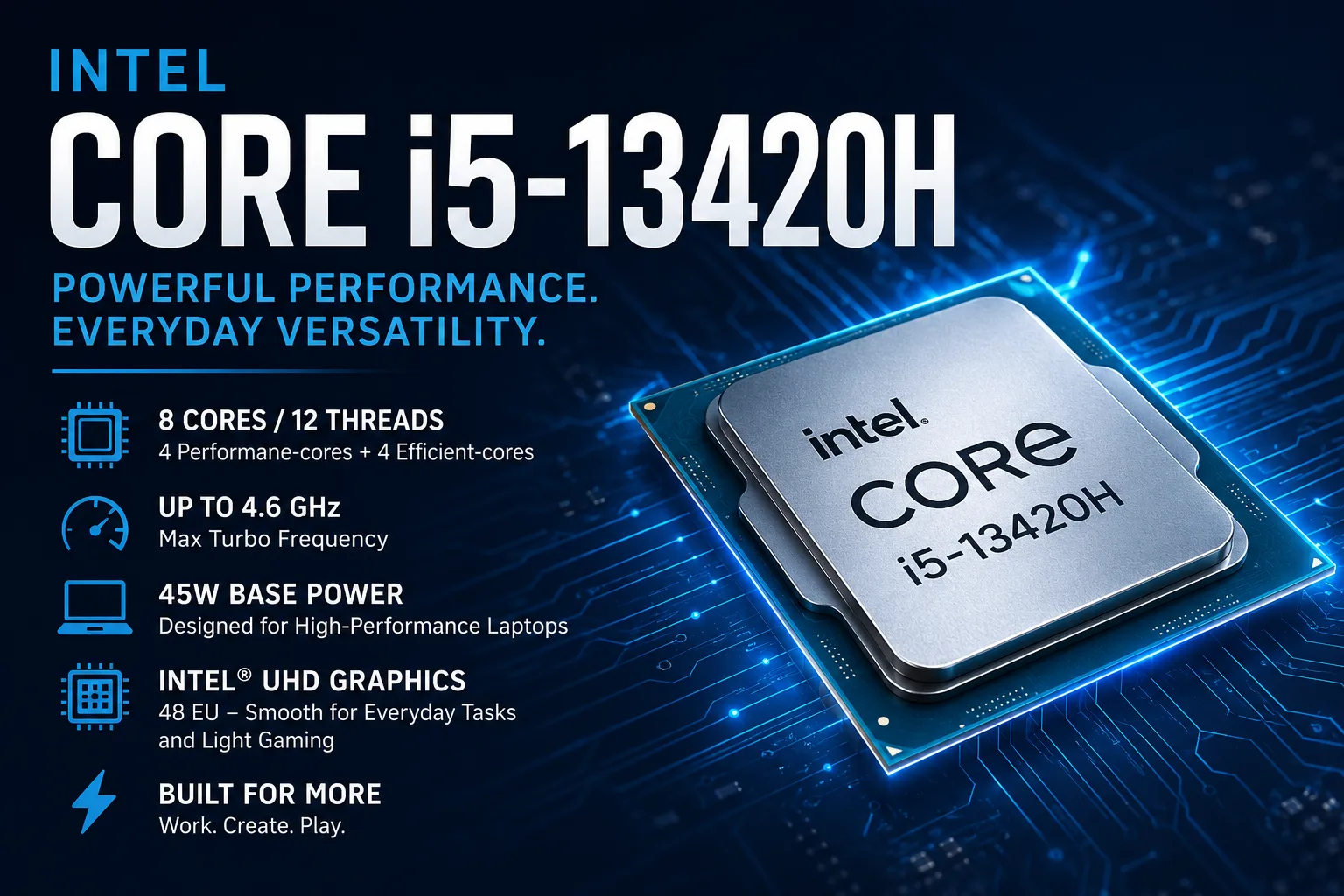
The Core i5-13420H belongs to the 13th generation of Intel Core processors and utilizes the hybrid Raptor Lake architecture. Inside are 4 performance (P) cores and 4 efficiency (E) cores. The P cores support Hyper-Threading, resulting in a total of 8 cores and 12 threads.

The maximum frequency reaches 4.6 GHz, the L3 cache is 12 MB, the base power is rated at 45 W, and the maximum turbo power can reach up to 115 W. However, in laptops, these figures should not be taken literally: actual frequencies, heating, and noise depend on power limits, the chassis, and the cooling system.

Feature What This Means in Practice
4 P-cores + 4 E-cores quick system responsiveness and solid multitasking
12 threads ample reserve for work, study, light editing, and development
45 W base power performs better in laptops with efficient cooling
Up to 115 W in Turbo short-term performance boost, but not a constant mode
Intel UHD Graphics 48 EU basic graphics for video, interface, and simple games

Performance in Real Tasks

In everyday tasks, the Core i5-13420H feels fast. A browser with numerous tabs, office applications, video conferencing, messengers, PDFs, spreadsheets, and educational software are no problem for it. High single-thread performance helps the system respond quickly to user actions.

In multi-threaded tasks, the processor also performs confidently, but without miracles. The 4P + 4E configuration is well-suited for an average laptop; however, higher-end Core i5-13500H, Core i7-H, or Ryzen 7 will be noticeably stronger in prolonged rendering, large projects, and heavy compilation.

For light editing, photo processing, screen recording, programming, and working with multiple applications simultaneously, the i5-13420H is well-suited. For continuous professional workloads, it’s better to look for a processor one class higher.

Integrated Graphics: Only the Basic Level

The Intel UHD Graphics with 48 execution units is the most limited part of this processor. It’s suitable for outputting graphics, watching videos, navigating the Windows interface, older games, and low-demand online projects. However, one should not expect comfortable gaming in modern AAA titles.

In games like Dota 2, League of Legends, Valorant, and similar ones, acceptable results can be achieved at low or medium settings. But for Cyberpunk 2077, Starfield, and other heavy projects, discrete graphics cards become necessary.

Therefore, the most suitable scenario for the Core i5-13420H is a laptop with a dedicated GPU. When paired with an RTX 3050 or RTX 4050, the processor seems particularly appropriate, and in some configurations, it can handle the RTX 4060 as well. In such cases, overall gaming performance will primarily depend on the graphics card and its power limit.

Comparison with Competitors

Processor What’s Interesting What to Consider
Core i5-13420H good balance of price and CPU performance weak integrated graphics
Core i5-12450H similar configuration, often cheaper usually less appealing at the same price
Core i5-13500H more cores and higher multi-threaded performance laptops generally cost more
Ryzen 5 7640HS strong Zen 4 cores and significantly better Radeon 760M especially good without discrete graphics

The comparison with Ryzen 5 7640HS is particularly significant. AMD has fewer cores in total configuration - 6 cores and 12 threads, but these are modern Zen 4 cores, and the integrated Radeon 760M is much stronger than Intel UHD. If the laptop is purchased without a discrete graphics card, Ryzen 5 7640HS often looks more appealing.

However, if the laptop has an RTX 3050, RTX 4050, or RTX 4060, the advantage of AMD’s integrated graphics almost loses significance. Then it’s more important to focus on price, cooling, graphics card power, screen, and memory size.

The Core i5-13420H is particularly advantageous not by itself but in the right configuration. If a laptop with it is significantly cheaper than a similar model with a Core i5-13500H or Ryzen 7, the choice can be very successful. If the price difference is small, it’s better to consider the higher processor.

What to Look for When Choosing a Laptop

The main thing is not to evaluate a laptop solely by the name of the processor. The same Core i5-13420H can behave differently in a thin chassis versus a larger model with two fans.

A minimally reasonable configuration for such a processor is 16 GB of RAM and an NVMe SSD. For gaming, the most critical factor is the discrete graphics card and its TGP: a laptop with an i5-13420H and a powerful RTX 4050 will often perform better than a model with a more expensive processor but weak graphics.

For sustained workloads, it’s essential to pay attention to reviews of the specific laptop: temperature, noise, frequency hold, and power limits. The processor itself is capable of good performance, but not every chassis can unlock its potential.

Pros and Cons of Intel Core i5-13420H

Pros:

  • good performance in everyday tasks;
  • 8 cores and 12 threads;
  • quick system responsiveness thanks to strong P-cores;
  • a suitable foundation for laptops with discrete graphics;
  • support for modern DDR5 and LPDDR5 memory;
  • often found in budget-friendly models.

Cons:

  • integrated graphics are weak by modern standards;
  • performance heavily depends on the cooling of the specific laptop;
  • thin chassis may introduce noise and reduced frequencies;
  • for heavy rendering and professional tasks, it’s better to choose a higher-class CPU.

Conclusion

The Intel Core i5-13420H is a successful mid-range mobile processor for those who need a fast laptop without paying extra for a Core i7. It is well-suited for studying, office work, programming, light editing, photo processing, and gaming when equipped with a discrete graphics card.

This chip looks best in 15-16 inch laptops with good cooling, 16 GB of memory, and a graphics card in the RTX 3050/4050 range. It can also be suitable with an RTX 4060, provided the manufacturer has not compromised on cooling and power limits.

If a laptop is needed without discrete graphics, it makes more sense to consider the Ryzen 5 7640HS or other AMD models with Radeon 760M/780M. If the main task involves heavy rendering, large projects, and prolonged multi-threaded workloads, the Core i5-13420H should be viewed as the baseline level of the H-series rather than a replacement for higher-end Core i7 processors.

Basic

Label Name
Intel
Platform
Mobile
Launch Date
January 2023
Model Name
?
The Intel processor number is just one of several factors - along with processor brand, system configurations, and system-level benchmarks - to be considered when choosing the right processor for your computing needs.
i5-13420H
Code Name
Raptor Lake

CPU Specifications

Total Cores
?
Cores is a hardware term that describes the number of independent central processing units in a single computing component (die or chip).
8
Total Threads
?
Where applicable, Intel® Hyper-Threading Technology is only available on Performance-cores.
12
Performance-cores
4
Efficient-cores
4
Max Turbo Frequency
?
Max Turbo Frequency is the maximum single-core frequency at which the processor is capable of operating using Intel® Turbo Boost Technology and, if present, Intel® Turbo Boost Max Technology 3.0 and Intel® Thermal Velocity Boost. Frequency is typically measured in gigahertz (GHz), or billion cycles per second.
4.60 GHz
Intel Hyper-Threading Technology
?
Intel® Hyper-Threading Technology (Intel® HT Technology) delivers two processing threads per physical core. Highly threaded applications can get more work done in parallel, completing tasks sooner.
Yes
L3 Cache
12 MB
CPU Socket
?
The socket is the component that provides the mechanical and electrical connections between the processor and motherboard.
FCBGA1744
Technology
?
Lithography refers to the semiconductor technology used to manufacture an integrated circuit, and is reported in nanometer (nm), indicative of the size of features built on the semiconductor.
Intel 7
TDP
45 W
Processor Base Power
?
The time-averaged power dissipation that the processor is validated to not exceed during manufacturing while executing an Intel-specified high complexity workload at Base Frequency and at the junction temperature as specified in the Datasheet for the SKU segment and configuration.
45 W
Minimum Assured Power
35 W
Maximum Turbo Power
?
The maximum sustained (>1s) power dissipation of the processor as limited by current and/or temperature controls. Instantaneous power may exceed Maximum Turbo Power for short durations (<=10ms). Note: Maximum Turbo Power is configurable by system vendor and can be system specific.
95 W
Max. Operating Temperature
?
Junction Temperature is the maximum temperature allowed at the processor die.
100°C
Number of PCI Express Lanes
?
A PCI Express (PCIe) lane consists of two differential signaling pairs, one for receiving data, one for transmitting data, and is the basic unit of the PCIe bus. Max # of PCI Express Lanes is the total number of supported lanes.
28
Instruction Set
?
The instruction set is a hard program stored inside the CPU that guides and optimizes CPU operations. With these instruction sets, the CPU can run more efficiently. There are many manufacturers that design CPUs, which results in different instruction sets, such as the 8086 instruction set for the Intel camp and the RISC instruction set for the ARM camp. x86, ARM v8, and MIPS are all codes for instruction sets. Instruction sets can be extended; for example, x86 added 64-bit support to create x86-64. Manufacturers developing CPUs that are compatible with a certain instruction set need authorization from the instruction set patent holder. A typical example is Intel authorizing AMD, enabling the latter to develop CPUs compatible with the x86 instruction set.
64-bit
Microprocessor PCIe Revision
Gen 5

Memory Specifications

Memory Type
?
Intel® processors come in four different types: Single Channel, Dual Channel, Triple Channel, and Flex Mode. Maximum supported memory speed may be lower when populating multiple DIMMs per channel on products that support multiple memory channels.
Up to DDR5 5200 MT/s Up to DDR4 3200 MT/s Up to LPDDR5/x 5200 MT/s Up to LPDDR4x 4267 MT/s
Max Memory Size
?
Max memory size refers to the maximum memory capacity supported by the processor.
96 GB
Memory Channels
?
The number of memory channels refers to the bandwidth operation for real world application.
2
ECC Memory Supported
?
ECC Memory Supported indicates processor support for Error-Correcting Code memory. ECC memory is a type of system memory that can detect and correct common kinds of internal data corruption. Note that ECC memory support requires both processor and chipset support.
No

GPU Specifications

Integrated Graphics Model
?
An integrated GPU refers to the graphics core that is integrated into the CPU processor. Leveraging the processor's powerful computational capabilities and intelligent power efficiency management, it delivers outstanding graphics performance and a smooth application experience at a lower power consumption.
Intel® UHD Graphics for 13th Gen Intel® Processors
Graphics Frequency
?
Graphics max dynamic frequency refers to the maximum opportunistic graphics render clock frequency (in MHz) that can be supported using Intel® HD Graphics with Dynamic Frequency feature.
1.40 GHz
DirectX Support
?
DirectX* Support indicates support for a specific version of Microsoft’s collection of APIs (Application Programming Interfaces) for handling multimedia compute tasks.
12.1
Execution Units
?
The Execution Unit is the foundational building block of Intel’s graphics architecture. Execution Units are compute processors optimized for simultaneous Multi-Threading for high throughput compute power.
48
Max Resolution (DP)
?
Max Resolution (DP) is the maximum resolution supported by the processor via the DP interface (24bits per pixel & 60Hz). System or device display resolution is dependent on multiple system design factors; actual resolution may be lower on your system.
7680 x 4320 @ 60Hz
Max Resolution (eDP - Integrated Flat Panel)
?
Max Resolution (Integrated Flat Panel) is the maximum resolution supported by the processor for a device with an integrated flat panel (24bits per pixel & 60Hz). System or device display resolution is dependent on multiple system design factors; actual resolution may be lower on your device.
4096 x 2304 @ 120Hz
Max Resolution (HDMI)
?
Max Resolution (HDMI) is the maximum resolution supported by the processor via the HDMI interface (24bits per pixel & 60Hz). System or device display resolution is dependent on multiple system design factors; actual resolution may be lower on your system.
4096 x 2304 @ 60Hz
Number of Displays Supported
4
Graphics Output
?
Graphics Output defines the interfaces available to communicate with display devices.
eDP 1.4b | DP 1.4a | HDMI 2.1

Miscellaneous

Intel Deep Learning Boost (Intel DL Boost) on CPU
?
A new set of embedded processor technologies designed to accelerate AI deep learning use cases. It extends Intel AVX-512 with a new Vector Neural Network Instruction (VNNI) that significantly increases deep learning inference performance over previous generations.
Yes
Intel Virtualization Technology for Directed I/O (VT-d)
?
Intel® Virtualization Technology for Directed I/O (VT-d) continues from the existing support for IA-32 (VT-x) and Itanium® processor (VT-i) virtualization adding new support for I/O-device virtualization. Intel VT-d can help end users improve security and reliability of the systems and also improve performance of I/O devices in virtualized environments.
Yes
Intel Virtualization Technology (VT-x)
?
Intel® Virtualization Technology (VT-x) allows one hardware platform to function as multiple “virtual” platforms. It offers improved manageability by limiting downtime and maintaining productivity by isolating computing activities into separate partitions.
Yes
Intel Standard Manageability (ISM)
?
Intel® Standard Manageability is the manageability solution for Intel vPro® Essentials platforms and is a subset of Intel® AMT with out-of-band management over Ethernet and Wi-Fi, but no KVM or new life cycle management features.
Intel® SSE4.1 | Intel® SSE4.2 | Intel® AVX2
Execute Disable Bit
?
Execute Disable Bit is a hardware-based security feature that can reduce exposure to viruses and malicious-code attacks and prevent harmful software from executing and propagating on the server or network.
Yes
Cache
?
CPU Cache is an area of fast memory located on the processor. Intel® Smart Cache refers to the architecture that allows all cores to dynamically share access to the last level cache.
12 MB Intel® Smart Cache
Intel AES New Instructions
?
Intel® AES New Instructions (Intel® AES-NI) are a set of instructions that enable fast and secure data encryption and decryption. AES-NI are valuable for a wide range of cryptographic applications, for example: applications that perform bulk encryption/decryption, authentication, random number generation, and authenticated encryption.
Yes
Intel High Definition Audio
Yes
Intel Volume Management Device (VMD)
?
Intel® Volume Management Device (VMD) provides a common, robust method of hot plug and LED management for NVMe-based solid state drives.
Yes
Intel Boot Guard
?
Intel® Device Protection Technology with Boot Guard helps protect the system’s pre-OS environment from viruses and malicious software attacks.
Yes
Intel VT-x with Extended Page Tables (EPT)
?
Intel® VT-x with Extended Page Tables (EPT), also known as Second Level Address Translation (SLAT), provides acceleration for memory intensive virtualized applications. Extended Page Tables in Intel® Virtualization Technology platforms reduces the memory and power overhead costs and increases battery life through hardware optimization of page table management.
Yes
Intel QuickAssist Software Acceleration
Yes
Intel Control-Flow Enforcement Technology
?
CET - Intel Control-flow Enforcement Technology (CET) helps protect against the misuse of legitimate code snippets through return-oriented programming (ROP) control-flow hijacking attacks.
Yes
Intel Flex Memory Access
Yes
Intel OS Guard
Yes
OpenGL Support
?
OpenGL (Open Graphics Library) is a cross-language, multi-platform API (Application Programming Interface) for rendering 2D and 3D vector graphics.
4.6
OpenCL Support
?
OpenCL (Open Computing Language) is a multi-platform API (Application Programming Interface) for heterogeneous parallel programming.
3.0
Intel Quick Sync Video
?
Intel® Quick Sync Video delivers fast conversion of video for portable media players, online sharing, and video editing and authoring.
Yes

Benchmarks

Geekbench 6
Single Core Score
1987
Geekbench 6
Multi Core Score
7816
Geekbench 5
Single Core Score
1568
Geekbench 5
Multi Core Score
7728
Passmark CPU
Single Core Score
3493
Passmark CPU
Multi Core Score
18964
3DMark CPU Profile
Single Core Score
958
3DMark CPU Profile
Multi Core Score
5321

Compared to Other CPU

Geekbench 6 Single Core
2141 +7.8%
2063 +3.8%
1913 -3.7%
1819 -8.5%
Geekbench 6 Multi Core
8564 +9.6%
8172 +4.6%
7413 -5.2%
6975 -10.8%
Geekbench 5 Single Core
1686 +7.5%
1628 +3.8%
1491 -4.9%
1427 -9%
Geekbench 5 Multi Core
8574 +10.9%
8122 +5.1%
7355 -4.8%
6955 -10%
Passmark CPU Single Core
3653 +4.6%
3556 +1.8%
3430 -1.8%
Passmark CPU Multi Core
20291 +7%
19553 +3.1%
18409 -2.9%
17744 -6.4%
3DMark CPU Profile Single Core
961 +0.3%
960 +0.2%
956 -0.2%
951 -0.7%
3DMark CPU Profile Multi Core
5378 +1.1%
5377 +1.1%
5181 -2.6%
4905 -7.8%