Intel Core Ultra 5 226V

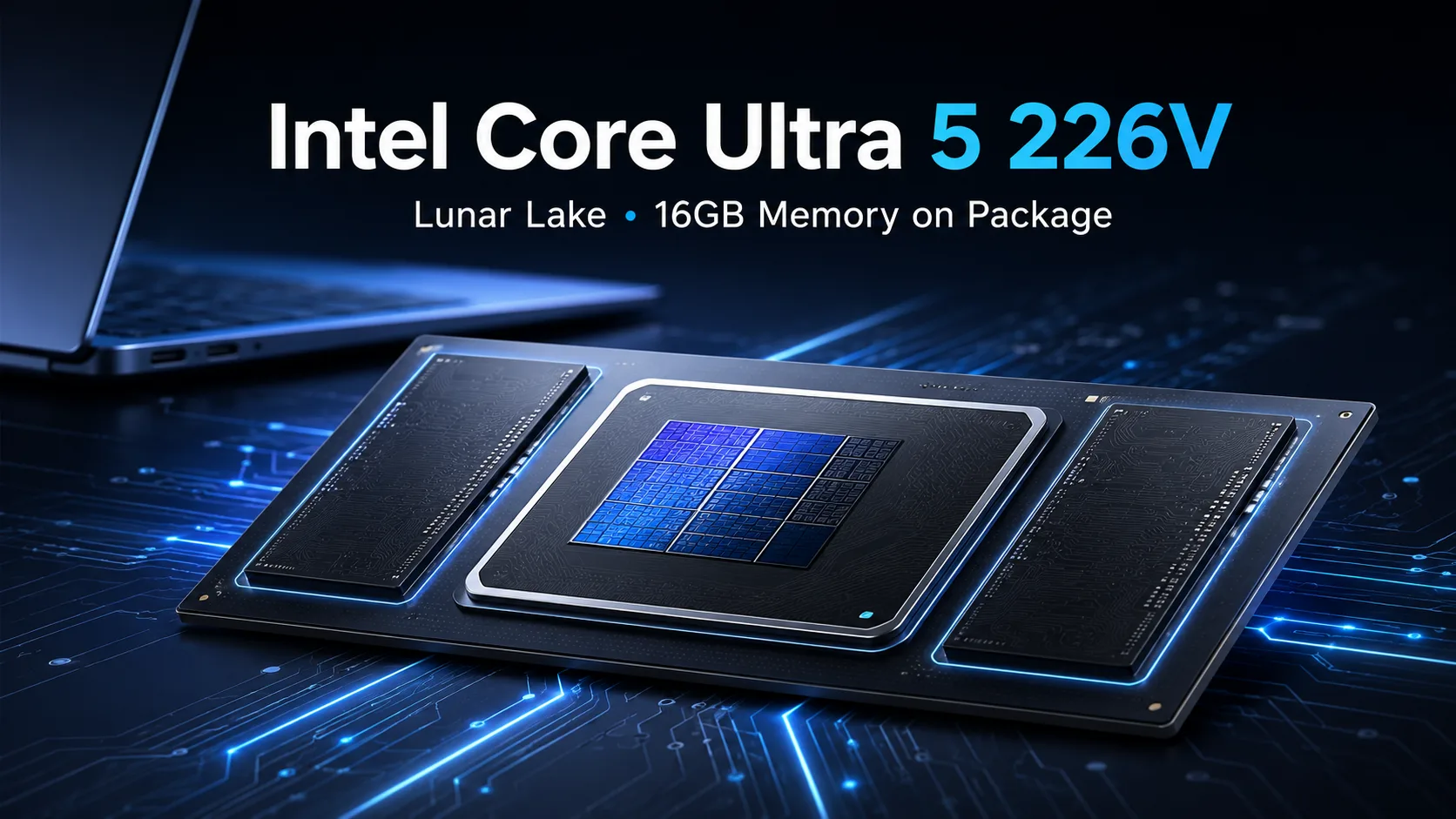
Intel Core Ultra 5 226V: Almost 228V, But Forever with 16 GB of Memory
The Intel Core Ultra 5 226V is hard to call a regular entry-level processor. In terms of cores, frequencies, integrated graphics, and neural processing unit (NPU), it nearly mirrors the Core Ultra 5 228V. The difference between them lies in the memory: the 226V has 16 GB, while the 228V boasts 32 GB.
It’s especially important to note that this isn’t just about soldered memory in an ultrabook. In Lunar Lake, the LPDDR5X chips are placed directly within the CPU package according to the Memory on Package (MOP) scheme. Therefore, the amount of memory essentially becomes part of the CPU model and is independent of the laptop manufacturer.
What the Core Ultra 5 226V Is
The processor belongs to the Lunar Lake family, officially called Core Ultra 200V. It features eight cores: four high-performance Lion Cove cores and four energy-efficient Skymont cores. Hyper-Threading is not supported, so the processor executes eight threads simultaneously. The maximum frequency of the performance cores reaches 4.5 GHz.
The base power consumption is 17 W, while the maximum turbo power is 37 W. The Core Ultra 5 226V is primarily designed for thin laptops, where moderate power consumption, quiet cooling, and extended battery life are prioritized over record-breaking performance under sustained multi-threaded workloads.
For office tasks, web browsing, programming, photo editing, and occasional video editing, its performance is sufficient. Limitations become apparent during long rendering tasks, compiling large projects, and other activities that can keep all cores constantly busy. In this regard, eight threads do not provide as much headroom as mobile processors with 12-16 cores.
MOP: Memory Moves to the CPU Package
In most laptops, the CPU and RAM remain separate components. SO-DIMM modules are installed in slots, while in thin models, LPDDR chips are soldered directly onto the motherboard.
In Lunar Lake, Intel used a different layout-Memory on Package, or MOP. The LPDDR5X chips are not on the motherboard, but rather on a shared substrate with the CPU chiplets.
This does not mean that the memory is integrated into the computing die; it remains as separate chips but is physically located adjacent to the processor in a single package.
Such a design reduces the length of the connections between the controller and memory, frees up space on the motherboard, and decreases energy consumption for data transmission. According to Intel, Memory on Package can reduce the power consumption of the physical memory interface by up to 40%.
For a compact laptop, this is a beneficial trade-off: fewer components on the board, simpler designs, and more available space for the battery or cooling. However, upgrades are entirely excluded. The laptop manufacturer cannot install a different amount of memory, and the owner cannot add it after purchase.
The Core Ultra 5 226V comes with 16 GB of LPDDR5X-8533. This is the final configuration for any laptop using this processor.
Why the 226V Is Almost Indistinguishable from the 228V
The Core Ultra 5 228V features the same four performance cores and four energy-efficient cores, eight threads, a frequency of up to 4.5 GHz, and the same power range. Its integrated graphics and NPU also match those of the 226V.
The main difference lies in the MOP memory:
- Core Ultra 5 226V - 16 GB LPDDR5X-8533;
- Core Ultra 5 228V - 32 GB LPDDR5X-8533.
Thus, upgrading to the 228V does not significantly increase computational performance. The buyer primarily pays for the doubled, non-expandable memory.
This makes the name 226V somewhat misleading. By its index, the model appears to be a considerably weaker processor, though it is, in fact, the same Core Ultra 5, rigidly tied to a smaller memory capacity.
Will 16 GB Be Enough?
For browsing, document editing, video calls, video watching, and basic photo editing, 16 GB remains an adequate amount. The issue arises not so much today, but when purchasing a laptop intended for several years of use.
Memory runs out faster when simultaneously using a browser with dozens of tabs, Photoshop or Lightroom, development environments, containers, virtual machines, and other heavy programs. A portion of the available memory is also used by the integrated graphics, as it lacks dedicated video memory.
The most demanding scenarios for the 226V include:
- High-resolution video editing;
- Large projects in graphic editors;
- Virtual machines and containers;
- Heavy multitasking;
- Running local neural networks;
- Modern games with significant memory consumption.
In these tasks, the processor may still maintain acceptable speed, but the lack of RAM will cause the system to resort to disk storage more frequently. Replacing memory modules will not resolve this issue.
Arc 130V - Not Just Formal Integrated Graphics
The Core Ultra 5 226V is equipped with Intel Arc 130V graphics featuring seven Xe cores and a maximum frequency of 1.85 GHz. It supports DirectX 12.2, hardware encoding and decoding of AV1, H.264 and H.265 processing, as well as VVC decoding.
Arc 130V is suitable not only for desktop applications and video playback. It allows launching competitive games, older large projects, and less demanding new titles without a dedicated graphics card. In demanding games, you will need to lower settings, resolution, or use XeSS scaling.
This is where the limitation of MOP memory becomes particularly noticeable. The graphics use shared RAM, so part of the installed 16 GB is consumed by Windows, applications, and the graphics core simultaneously. For a gaming laptop, this offers a small buffer, even if the performance of the Arc 130V itself is still adequate.
NPU with 40 TOPS
The built-in neural processor, Intel AI Boost, delivers up to 40 TOPS, and the combined advertised performance of the CPU, GPU, and NPU reaches 97 TOPS.
The NPU is intended for local processing of compatible AI tasks: camera effects, noise reduction, speech recognition, image processing, and Windows functionalities. Everyday applications do not automatically become faster due to the presence of a neural processor.
Buying a laptop solely for the number of TOPS is not advisable. Factors such as screen quality, battery life, cooling, and memory capacity have a more significant impact on daily use.
Who Is the Core Ultra 5 226V Suitable For?
A laptop equipped with this processor is suitable for studying, office work, traveling, programming, and moderate graphic tasks. The Core Ultra 5 226V combines modern architecture, powerful integrated graphics, hardware video processing, and a full-fledged NPU.
The key condition is a reasonable price. If a laptop with a Core Ultra 5 228V and 32 GB of memory costs only slightly more, the higher version is preferable. The extra payment is not for a few percentage points of frequency, but for twice the memory capacity, which cannot be added later.
The 226V version is justified when 16 GB is truly sufficient or when the laptop is significantly cheaper than similar configurations with the 228V.
Conclusion
The Intel Core Ultra 5 226V is not a cut-down version of Lunar Lake across the board. It nearly mirrors the Core Ultra 5 228V in terms of processor cores, graphics, frequencies, and NPU capabilities.
Its key feature is the Memory on Package system. The fast LPDDR5X is housed in the same package as the processor, reducing power consumption and simplifying the creation of compact laptops. At the same time, it permanently ties the 226V to 16 GB of RAM.
Therefore, the choice is not between a fast and a slow Core Ultra 5. The decision is between 16 GB and 32 GB of memory, which will remain with the laptop for its entire lifespan.
CPU Comparison
Compare Core Ultra 5 226V with other CPUs
Basic
CPU Specifications
Memory Specifications
GPU Specifications
Benchmarks
Compared to Other CPU
Related CPU Comparisons


Share in social media
Or Link To Us
<a href="https://cputronic.com/en/cpu/intel-core-ultra-5-226v" target="_blank">Intel Core Ultra 5 226V</a>