AMD Ryzen AI 9 HX 475

AMD Ryzen AI 9 HX 475: Performance, Benchmarks, and Comparison with the HX 470
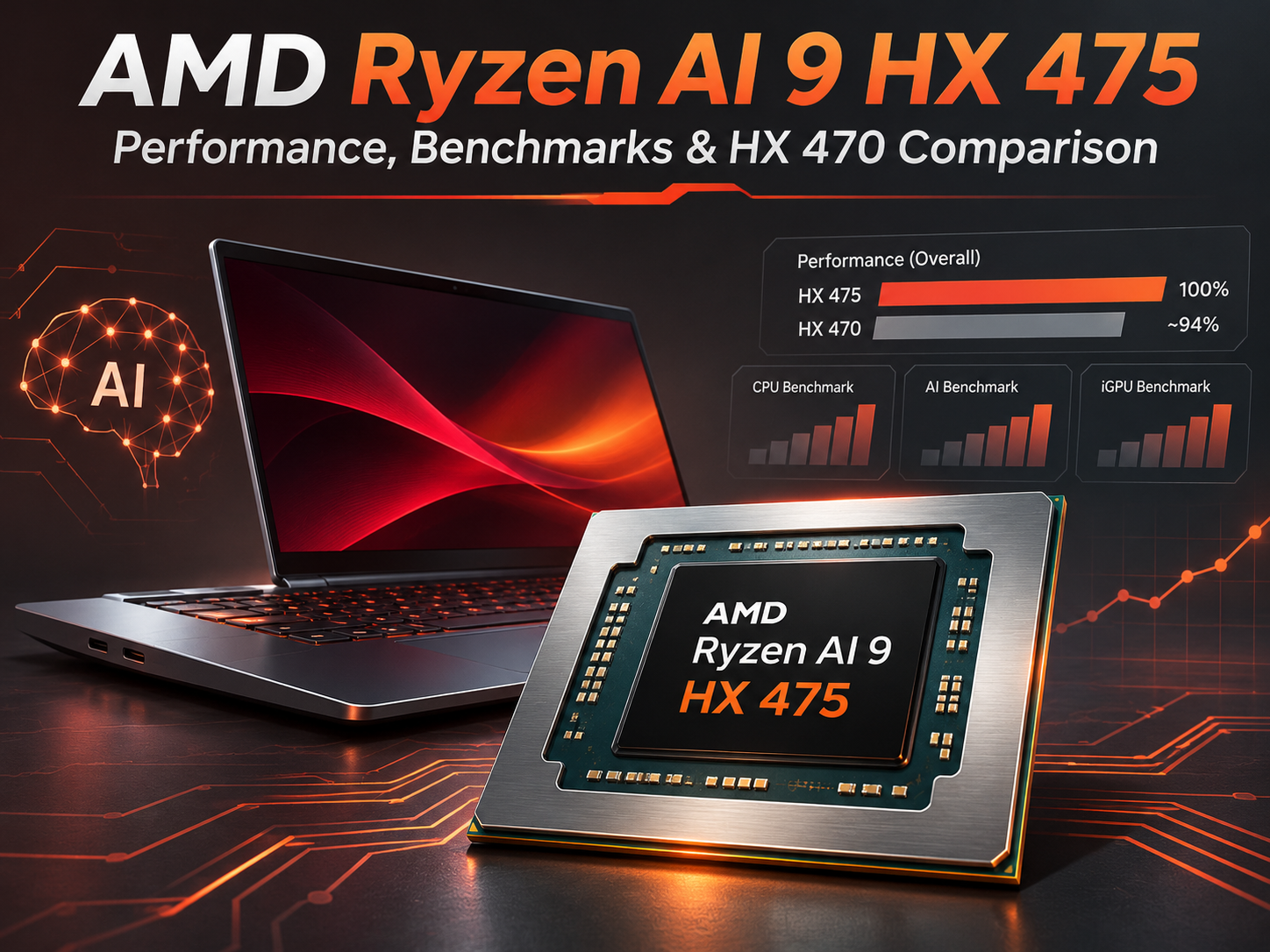
The AMD Ryzen AI 9 HX 475 is a 12-core mobile processor from the Ryzen AI 400 series, introduced in January 2026. It belongs to the Gorgon Point family and uses four high-performance Zen 5 cores and eight compact Zen 5c cores. It supports 24 threads and is equipped with Radeon 890M graphics.
The HX 475 replaces the Ryzen AI 9 HX 375 while retaining its architecture and core configuration. The changes affect operating frequencies, memory support, and the XDNA 2 neural processing unit. In terms of CPU and GPU specifications, the new model is nearly identical to the Ryzen AI 9 HX 470.
| Specification | HX 375 | HX 470 | HX 475 |
|---|---|---|---|
| Maximum CPU frequency | 5.1 GHz | 5.2 GHz | 5.2 GHz |
| Radeon 890M frequency | 2900 MHz | 3100 MHz | 3100 MHz |
| LPDDR5X | 8000 MT/s | 8533 MT/s | 8533 MT/s |
| NPU | 55 TOPS | 55 TOPS | 60 TOPS |
All three processors have 12 cores, 24 threads, and 36 MB of total L2 and L3 cache. Compared with the HX 375, the CPU frequency has increased by approximately 2%, while the maximum frequency of the integrated graphics has increased by 6.9%. These changes do not guarantee a comparable performance increase in applications.
Geekbench 6: Performance in Laptops and Mini PCs
The comparison uses results from specific devices. They show a range of performance but were obtained with different settings and under different testing conditions.
| Device | Processor | Single-Core | Multi-Core |
|---|---|---|---|
| HP OmniBook 7 14-kh0xxx | Ryzen AI 9 HX 475 | 3080 | 16 355 |
| AMD KoratPlus-STX | Ryzen AI 9 HX 475 | 2775 | 14 277 |
| HP OMEN MAX 16-ak0xxx | Ryzen AI 9 HX 375 | 2923 | 15 130 |
| GEEKOM NX16A8 | Ryzen AI 9 HX 470 | 2879 | 13 552 |
| ASUS Zenbook S 16 UM5606WA | Ryzen AI 9 HX 370 | 2813 | 12 411 |
| ASUS Zenbook 14 UX3405CA | Core Ultra 9 285H | 2694 | 14 777 |
The best HX 475 result was obtained on the HP OmniBook 7 running Gentoo Linux with Geekbench 6.7.1. The AMD KoratPlus-STX engineering platform was tested under Windows with Geekbench 6.6.0. The other measurements were also performed under Windows.
The KoratPlus-STX entry lists 16 GB of DDR5-5600 memory and a maximum frequency of 3864 MHz instead of the specified 5200 MHz. A single entry cannot establish the reason for the frequency discrepancy or determine how the processor behaved throughout the test.
The difference between the two HX 475 results is approximately 11% in Single-Core and 15% in Multi-Core. The variation is affected by the operating system, test version, hardware configuration, and power settings. These measurements cannot be used to determine the typical advantage of the HX 475 over other processors.
The GEEKOM NX16A8 with the HX 470 scored 13 552 points in Multi-Core-less than the previous-generation HP OMEN MAX with the HX 375 and the laptop with the Core Ultra 9 285H. This does not prove that the older processors are superior: the results relate to different devices.
The Intel Core Ultra 9 285H scored 14 777 points in Multi-Core, placing it between the two HX 475 measurements. A proper comparison of the architectures requires testing with comparable power limits and software environments.
An additional HX 475 result was obtained on the retail HP HyperX OMEN MAX 16-ak1xxx running Windows 11: 2426 points in Single-Core and 17 860 in Multi-Core. Geekbench 7.1.0 was used, so these values cannot be directly compared with Geekbench 6 results.
In PassMark CPU Mark, the processor scores approximately 39 000 points. This is another reference point for multithreaded performance, although the number of available measurements is still limited.
Performance in Workloads
The four Zen 5 cores operate at up to 5.2 GHz, while the eight Zen 5c cores reach up to 3.3 GHz. All cores support SMT. The compact Zen 5c cores occupy less die area, allowing AMD to place 12 compute cores in a mobile processor with a nominal TDP of 28 W.
Large project compilation, rendering, and video processing can use all 24 threads. The execution speed of extended workloads depends on power limits and cooling efficiency.
AMD specifies a configurable TDP range of 15 to 54 W. As a result, a compact laptop with a sustained limit of around 25 W may be slower than a larger system with the same HX 475.
For software development, Docker workloads, and virtual machines, the processor provides sufficient computing headroom. In these scenarios, the amount of system memory is often more important than the small difference in frequencies between the HX 375 and HX 475.
Radeon 890M: Gaming Results
The integrated Radeon 890M is based on the RDNA 3.5 architecture and contains 16 compute units, or 1024 stream processors. Its maximum frequency reaches 3100 MHz.
There are not yet enough direct gaming measurements of the HX 475 with integrated graphics. The comparison therefore uses Radeon 890M results from the HX 470 and HX 370, as well as the Intel Arc 140T.
| Device | 3DMark Time Spy Graphics | Cyberpunk 2077 | Dota 2 |
|---|---|---|---|
| BOSGAME VTA-439, HX 470, Radeon 890M | 3750 | 41.9 FPS | 103 FPS |
| GMK EVO-X1, HX 370, Radeon 890M | 3634 | 38.2 FPS | 93.4 FPS |
| ASUS NUC 15 Pro+, Core Ultra 9 285H, Arc 140T | 3940 | 33.7 FPS | 87.6 FPS |
The games were tested at a resolution of 1920 × 1080: Cyberpunk 2077 at Medium without FSR, and Dota 2 at High.
The BOSGAME VTA-439 used 32 GB of DDR5-5600 memory in dual-channel mode. The processor was configured with power limits of 65 W under sustained load and 75 W for short-term loads, above AMD’s standard configurable range.
In Cyberpunk 2077, the HX 470 system was approximately 10% faster than the GMK EVO-X1 with the HX 370. Its advantage in Dota 2 was also around 10%. The difference depends not only on the graphics core frequency but also on memory and power settings.
The Intel Arc 140T in the ASUS NUC 15 Pro+ achieved a higher Time Spy Graphics score but lost to the Radeon 890M in both games. A synthetic test does not always reflect the FPS relationship in specific titles.
The HX 475’s integrated graphics are suitable for Full HD gaming at moderate settings in demanding titles. Results from mini PCs with high power limits cannot automatically be applied to thin laptops.
XDNA 2 NPU and Local AI
The Ryzen AI 9 HX 475 is equipped with an XDNA 2 NPU rated at up to 60 TOPS. This is approximately 9% more than the 55 TOPS offered by the HX 470.
For Copilot+ PC features, Microsoft sets a minimum NPU requirement of 40 TOPS. Both processors exceed it, so the additional 5 TOPS do not unlock a separate category of Windows capabilities.
The difference may appear in applications that directly use the NPU. Running large language models also depends on the amount of available memory, CPU and GPU performance, and support for the relevant software.
Laptops with the Ryzen AI 9 HX 475 and Prices
The processor is installed in both compact work laptops and gaming models with discrete graphics.
| Device | Configuration |
|---|---|
| HP OmniBook 7 14-kh | HX 475, Radeon 890M, up to 64 GB RAM |
| HP HyperX OMEN MAX 16-ak1xxx | HX 475, GeForce RTX 5080 Laptop, 32 GB RAM |
| HP OMEN MAX 16-ak0xxx | HX 375, GeForce RTX 5080 Laptop, 32 GB RAM |
The last two models belong to different generations of HP gaming laptops.
As a reference point, the HP HyperX OMEN MAX 16-ak1942nr with the HX 475, GeForce RTX 5080 Laptop, 32 GB of RAM, and a 2 TB SSD is offered for approximately $3250. In this configuration, a significant portion of the price is associated with the discrete graphics card and the laptop’s equipment.
It is incorrect to compare this gaming laptop with the HP OmniBook 7 based solely on the processor. When choosing between the HX 475, HX 470, and HX 375, it is more reasonable to compare models from the same class with similar memory, graphics, and cooling specifications.
In most cases, paying extra specifically for the HX 475 instead of the HX 470 is not worthwhile: their stated CPU and GPU specifications are identical.
Conclusion
The AMD Ryzen AI 9 HX 475 is a powerful mobile processor with 12 Zen 5/Zen 5c cores, Radeon 890M graphics, and a 60 TOPS NPU. It is suitable for development, multitasking, and content processing, while its integrated graphics can run many games in Full HD.
The available Geekbench results show significant variation between devices using the same processor. When choosing a laptop, it is therefore important to consider not only the CPU model but also the cooling system, power limits, and memory configuration.
Compared with the HX 375, the update brings a small increase in frequencies and support for faster memory. The Ryzen AI 9 HX 470 is practically equal to the new model in CPU and GPU capabilities. The additional 5 TOPS of NPU performance remain the main difference of the HX 475, but they will not be a decisive advantage for most users.
CPU Comparison
Compare Ryzen AI 9 HX 475 with other CPUs
Basic
CPU Specifications
Memory Specifications
GPU Specifications
Miscellaneous
Benchmarks
Compared to Other CPU
Related CPU Comparisons






Share in social media
Or Link To Us
<a href="https://cputronic.com/en/cpu/amd-ryzen-ai-9-hx-475" target="_blank">AMD Ryzen AI 9 HX 475</a>