Qualcomm Snapdragon X X1-26-100

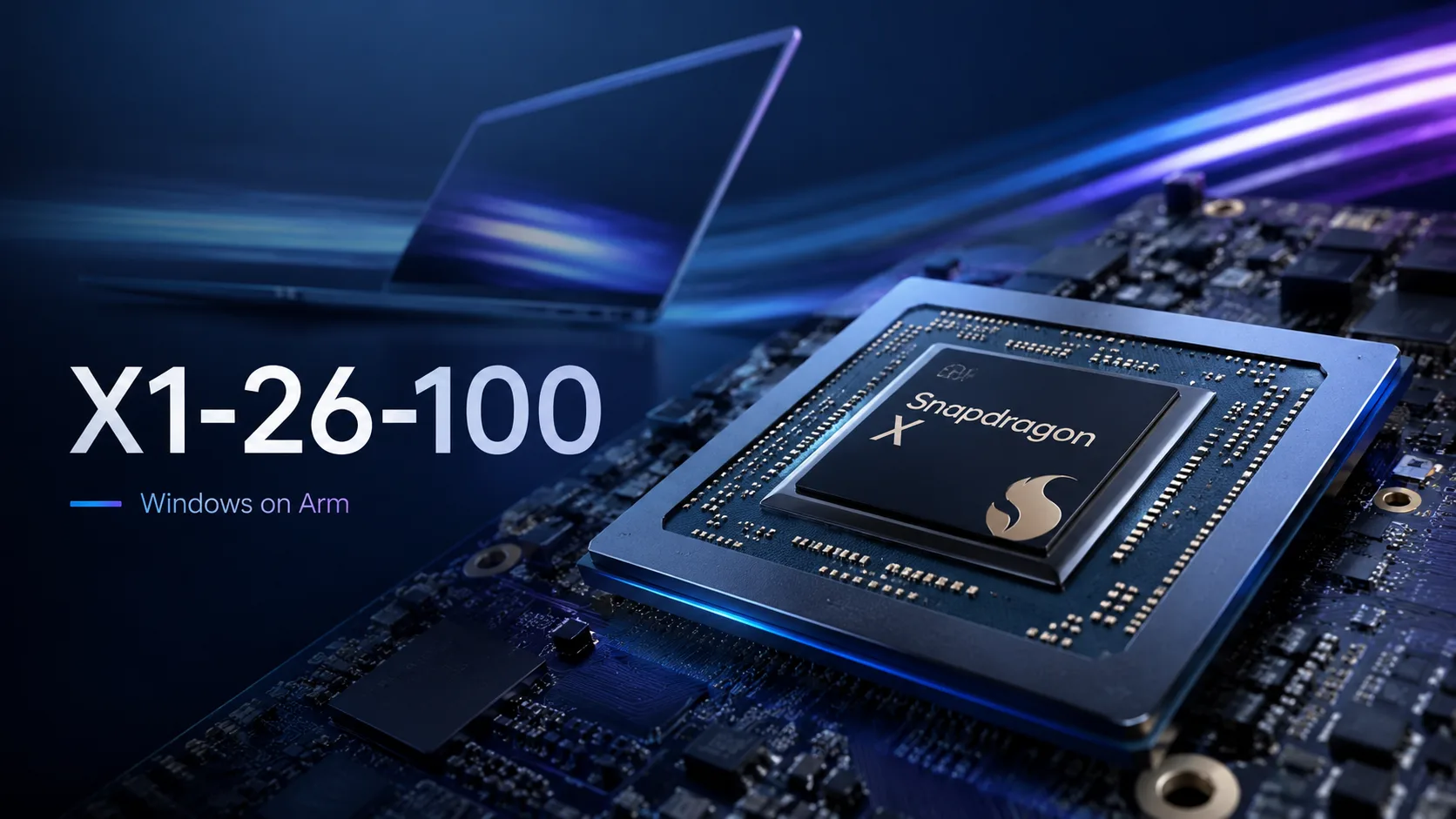
Qualcomm Snapdragon X X1-26-100: The Entry-Level Chip of the New Windows on Arm Platform
For a long time, nearly all Windows laptops relied on the x86 platform from Intel and AMD. This ensured wide compatibility with legacy software, drivers, peripherals, and games, but it also came with a considerable legacy burden: a complex architecture, higher power requirements, and frequent dependence on active cooling.
ARM has taken a different approach. This architecture grew out of mobile devices, where not only peak speed is important, but also efficiency: how much work the chip does per watt of energy. Smartphones have long demonstrated that ARM can be both fast and economical, but for a long time, this idea did not perform well in the world of full-fledged laptops.
Apple has shown on the mass market that ARM can serve as the foundation not only for phones but also for serious laptops. The transition of Macs to Apple Silicon made a simple point clear: a thin computer can be fast, quiet, and have a long battery life without the classic x86 approach.
Qualcomm, alongside Microsoft, is attempting to make a similar transition in the world of Windows. Snapdragon X is not just another line of processors; it is an effort to bring the ARM philosophy to Windows laptops: low power consumption, good battery life, quick wake-from-sleep, built-in NPU, and performance sufficient not just for browsing.
In this context, Snapdragon X X1-26-100 becomes interesting. It is not the flagship or the fastest chip from Qualcomm. It is the entry-level model of the Snapdragon X platform. It clearly shows what is left of the Windows on Arm idea when you remove the reserve of the higher X Plus and X Elite: 8 Oryon cores, an NPU of up to 45 TOPS, good speed for everyday tasks, but less powerful graphics and lower performance headroom for the future.
What's Inside Snapdragon X X1-26-100
Snapdragon X X1-26-100 features 8 Qualcomm Oryon cores. Unlike many modern Intel and AMD processors, it does not have the familiar hybrid scheme with performance and efficiency cores. All cores belong to one architectural line, making the CPU's behavior simpler: it does not distribute tasks among different types of cores but uses eight identical ARM cores.
For a thin laptop, this is a suitable foundation-without flagship ambitions, but with good responsiveness in browsers, office applications, video calls, and everyday multitasking.
The chip supports LPDDR5X memory, comes with built-in graphics X1-45, and a separate NPU of up to 45 TOPS. This is important: X1-26-100 is not a processor “without iGPU.” There is integrated graphics here, but it is an entry-level version, so one should not expect it to compete with fast integrated Radeon or discrete graphics cards.
The NPU is one of the key reasons for this platform’s existence. In a typical browser or Excel, it will not make the laptop noticeably faster, but for local AI functions in Windows, camera processing, noise cancellation, background in video calls, and similar tasks, a dedicated NPU here truly makes sense.
Position of Snapdragon X X1-26-100 Within the Lineup
| Processor | Cores | CPU Frequency | Cache | GPU | NPU | Positioning |
|---|---|---|---|---|---|---|
| Snapdragon X X1-26-100 | 8 | up to 3.0 GHz | 30 MB | X1-45 | up to 45 TOPS | Base Snapdragon X |
| Snapdragon X Plus X1P-42-100 | 8 | up to 3.4 GHz | 30 MB | X1-45 | up to 45 TOPS | Entry-level X Plus |
| Snapdragon X Plus X1P-46-100 | 8 | up to 4.0 GHz in boost | 30 MB | X1-45 | up to 45 TOPS | Fast 8-core X Plus |
| Snapdragon X Plus X1P-64-100 | 10 | up to 3.4 GHz | 42 MB | X1-85 | up to 45 TOPS | Stronger CPU and GPU |
| Snapdragon X Elite X1E-78-100 | 12 | up to 3.4 GHz | 42 MB | X1-85 | up to 45 TOPS | Higher class Snapdragon X |
The table shows the key point: the X1-26-100 does not have a cut-down NPU-the AI block remains at the platform level. The savings are visible in other areas: lower CPU frequency, only 8 cores, and entry-level graphics X1-45. Thus, it is more logical to perceive X1-26-100 as the most basic Snapdragon X rather than as "almost X Elite."
Performance: Quick for a Thin Laptop, but No Headroom for Higher Models
In Geekbench 6, Snapdragon X X1-26-100 scores about 2120 points in the single-core test and around 10339 points in the multi-core test. For a thin laptop, this is an acceptable level: browsing, office work, messaging, video calls, document handling, academic tasks, and light photo editing should not be a problem.
However, the result is only important in context. Snapdragon X is interesting not because it is necessarily faster than all x86 chips, but because it aims to provide comparable everyday speed in a more mobile format: a thin chassis, low consumption, quiet operation, and long battery life. That is the platform's primary purpose.
| Processor | Class | Geekbench 6 Single | Geekbench 6 Multi | Comparison Details |
|---|---|---|---|---|
| Snapdragon X X1-26-100 | Base Snapdragon X | 2120 | 10339 | Good level for everyday ARM laptop |
| Snapdragon X Plus X1P-42-100 | Entry-level X Plus | 2377 | 11147 | Faster due to higher frequency |
| Snapdragon X Plus X1P-46-100 | Fast 8-core X Plus | 2375 | 11571 | Noticeably better in multi-core |
| Snapdragon X Plus X1P-64-100 | 10-core X Plus | 2348 | 12663 | Already a different level of multi-threading |
| Snapdragon X Elite X1E-78-100 | 12-core X Elite | 2279 | 11607 | More cores, but result depends on laptop |
| Intel Core Ultra 5 125H | x86 Windows Competitor | 2256 | 10239 | Close multi-core, higher single-core |
| AMD Ryzen 7 8840U | Strong x86 ultrabook chip | 2497 | 11558 | Faster CPU and noticeably stronger graphics |
| Apple M3 | ARM macOS competitor | 2855 | 10621 | Much stronger single-core, close multi-core |
In CPU performance, Snapdragon X X1-26-100 does not appear weak. In the multi-core test, it stays close to the Core Ultra 5 125H and Apple M3, which is quite decent for an entry-level Snapdragon X model. However, in single-core performance, it falls short compared to Apple M3, Ryzen 7 8840U, and higher-end Snapdragon X Plus models. So, one shouldn’t expect the feeling of a flagship ARM chip from it.
The main takeaway: X1-26-100 is not a record-breaker but a balanced entry-level processor. It provides adequate everyday speed without the headroom of X1P-64-100, X Elite, strong Ryzens, or Apple M-series.
Integrated Graphics Available, but Not for Gaming
Snapdragon X X1-26-100 has integrated graphics X1-45. It is sufficient for Windows, video playback, external monitors, web applications, casual games, and older projects. However, for modern gaming, this GPU is unsuitable.
The problem is not just in graphics power. Windows on Arm can introduce issues with compatibility, emulation, drivers, anti-cheats, and gaming launchers. Thus, among laptops without discrete graphics, AMD's platforms with Radeon 780M or newer integrated graphics appear to be more predictable choices for gaming: they run in a familiar x86 environment with less risk that a game may simply not launch.
If gaming is a priority, integrated graphics should not be considered a primary option at all. In this class, discrete graphics cards make the difference, and models with NVIDIA GeForce RTX will perform significantly better.
For everyday use, the entry-level iGPU X1-45 is not critical. For gaming, it is one of the main limitations of Snapdragon X X1-26-100.
Windows on Arm: The Main Nuance in Choosing
Snapdragon X X1-26-100 cannot be assessed solely based on benchmarks. This is an ARM processor for Windows, and compatibility may be more important than a 10-15% CPU performance difference.
Modern Windows on Arm has improved significantly compared to a few years ago. Browsers, office applications, messaging apps, video calls, and many popular software now work fine-either natively or through emulation. For a user who primarily uses Chrome, Edge, Office, Google Docs, Telegram, Zoom, and web services, there may be no issues at all.
The weak points are older utilities, specific professional software, drivers, plugins, some VPN clients, peripherals, and games. Before purchasing a laptop with Snapdragon X, it is better to check not the abstract “performance of ARM” but your actual set of software. If all necessary programs work correctly, the platform can be very pleasant. If there is a reliance on old x86 software, Intel or AMD remains the safer choice.
The crucial question when choosing a laptop with X1-26-100 is not “Will it run the browser?” but “Does my software set work on Windows on Arm?”
Who Should Consider Snapdragon X X1-26-100
Snapdragon X X1-26-100 is worth considering if you need a lightweight laptop for studying, office work, browsing, email, documents, video calls, watching movies, and working on the go.
Best scenarios include:
- A laptop for study and office use;
- A mobile work machine for browsing, documents, and video calls;
- A thin Copilot+ PC without gaming claims;
- A travel device where battery life is more critical than maximum power.
Do not choose X1-26-100 for heavy video editing, 3D modeling, modern gaming, engineering software, or tasks where maximum compatibility with x86 applications and drivers is critical.
Conclusion
Qualcomm Snapdragon X X1-26-100 is the entry-level model of the Snapdragon X platform. It features 8 Oryon cores, integrated graphics, and an NPU of up to 45 TOPS, but within the lineup, it is clearly positioned lower than X Plus and X Elite: lower frequencies, fewer cores, weaker GPU, and less performance headroom for the future. This processor is built for modern laptops with Windows on Arm, rather than a universal platform for all tasks.
But therein lies its essence. X1-26-100 illustrates the entry-level version of the new Windows laptop idea: less focus on raw power, more on battery life, quiet operation, mobility, and AI features. If you need a laptop for browsing, documents, study, video calls, and battery operation, such a chip looks reasonable.
If you require a universal computer “for everything,” including gaming, older professional software, and non-standard peripherals, the familiar x86 platforms from AMD and Intel are still the safer bet. Snapdragon X X1-26-100 is interesting not as a replacement for all laptops at once but as the most accessible way to try the new Windows on Arm platform without switching to Mac.
CPU Comparison
Compare Snapdragon X X1-26-100 with other CPUs
Basic
CPU Specifications
Memory Specifications
GPU Specifications
AI Specifications
Connectivity
Interfaces and Ports
Miscellaneous
Benchmarks
Compared to Other CPU
Related CPU Comparisons




Share in social media
Or Link To Us
<a href="https://cputronic.com/en/cpu/qualcomm-snapdragon-x-x1-26-100" target="_blank">Qualcomm Snapdragon X X1-26-100</a>