Intel Core i7-1355U
Intel Core i7-1355U: Why Performance Depends on the Laptop
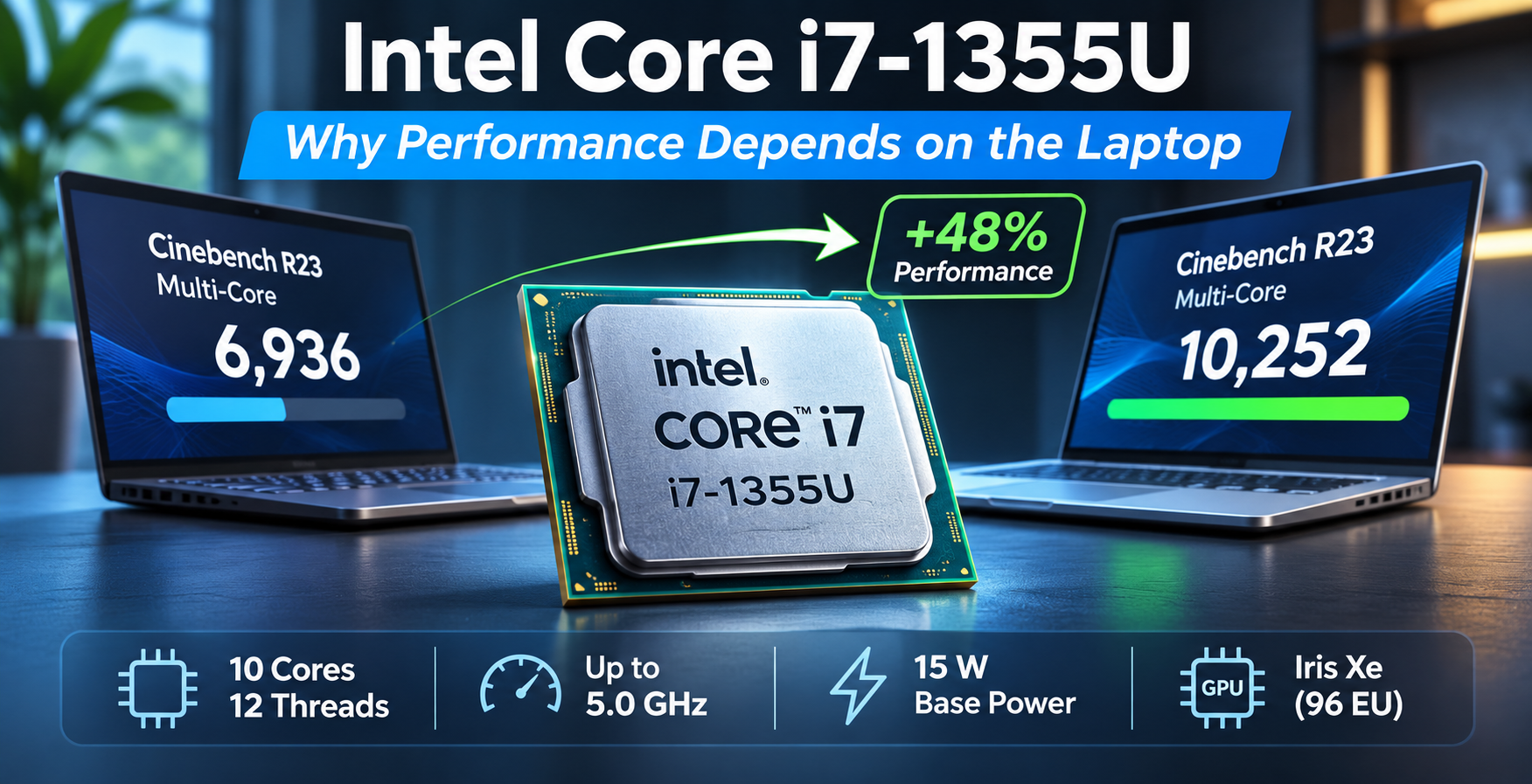
The Intel Core i7-1355U is a mobile processor from the Raptor Lake family, introduced in early 2023. It has 10 cores and 12 threads, a maximum clock speed of 5.0 GHz, and a base power of 15 W. In six tested laptops, Cinebench R23 Multi scores range from 6,936 to 10,252 points-a difference of up to 48%. This spread shows how strongly performance depends on how the processor is implemented in a particular device.
How the Core i7-1355U Differs from Similar Models
The Core i7-1355U has the same core configuration as the Core i5-1335U and the previous-generation Core i7-1255U: two performance P-cores, eight efficient E-cores, and 12 threads. The main differences concern clock speeds, integrated graphics, and memory support.
| Specification | Core i7-1355U | Core i5-1335U | Core i7-1255U |
|---|---|---|---|
| Maximum P-core clock | 5.0 GHz | 4.6 GHz | 4.7 GHz |
| Maximum E-core clock | 3.7 GHz | 3.4 GHz | 3.5 GHz |
| GPU execution units | 96 EU | 80 EU | 96 EU |
| Maximum GPU clock | 1.30 GHz | 1.25 GHz | 1.25 GHz |
| LPDDR5/x support | 6400 MT/s | 6400 MT/s | 5200 MT/s |
| Maximum RAM capacity according to CPU specifications | 96 GB | 96 GB | 64 GB |
The Core i7-1355U and Core i5-1335U have the same 12 MB of L3 cache and a base power of 15 W. The higher-end model differs through its higher clock speeds and graphics with 96 EU versus 80 EU in the Core i5.
Compared with the Core i7-1255U, the changes are also modest: CPU and GPU clock speeds are higher, and support for faster LPDDR5/x memory has been added. The number of cores and threads remains unchanged.
Cores and Power Consumption
The Core i7-1355U is manufactured using the Intel 7 process. Its two P-cores support Hyper-Threading and handle four threads, while the eight E-cores handle one thread each.
The processor is intended for thin and light laptops. Intel specifies the following parameters:
- Processor Base Power - 15 W.
- Maximum Turbo Power - 55 W.
- Minimum Assured Power - 12 W.
- Maximum junction temperature - 100 °C.
Under short-term loads, the processor's power consumption can significantly exceed the base 15 W. Laptop manufacturers set their own limits: PL1 is the sustained power limit, while PL2 is the short-term limit.
However, actual performance cannot be determined from PL1 and PL2 alone. It is also affected by thermal limits, BIOS settings, and Turbo Boost behavior.
Performance in Real-World Laptops
For comparison, Cinebench R23 results were taken from six devices with the Core i7-1355U. The test measures single-core performance and the performance of all available compute threads.
| Laptop | PL1 / PL2 | R23 Single | R23 Multi |
|---|---|---|---|
| HP Pavilion Plus 14-ew0153TU | 25 / 41 W | 1,740 | 6,936 |
| ASUS Zenbook S13 OLED UX5304 | 17 / 44 W | 1,730 | 7,015 |
| Lenovo ThinkPad E14 Gen 5 | 25 / 53 W | 1,851 | 7,912 |
| HP Envy x360 15-fe0072ng | 30 / 46 W | 1,819 | 8,816 |
| Lenovo ThinkPad T14s Gen 4 | 24 / 50 W | 1,851 | 10,251 |
| Lenovo Yoga 7 16IRL8 | 25 / 50 W | 1,825 | 10,252 |
In the single-threaded test, the difference between the devices is about 7%. In the multithreaded test, the Lenovo Yoga 7 scores 47.8% more than the HP Pavilion Plus 14.
At the same time, both laptops have the same specified PL1 of 25 W. The HP Envy x360, with its higher 30 W limit, also trails the Lenovo Yoga 7.
Therefore, increasing PL1 by itself does not guarantee higher results. The stated limits describe the settings of the tested laptops but do not show the processor's actual power consumption throughout the entire test.
The difference may be explained by thermal limits, how long the processor operates at elevated clock speeds, and power-management characteristics. Determining why a particular model falls behind requires measuring clock speeds, temperatures, and power consumption under load.
Geekbench 6
In Geekbench 6.0, the spread between results is noticeably smaller. This test differs from Cinebench R23 in its set of tasks and load characteristics.
| Laptop | Geekbench 6.0 Single | Geekbench 6.0 Multi |
|---|---|---|
| ASUS Zenbook S13 OLED UX5304 | 2,393 | 8,793 |
| HP ProBook 450 G10 | 2,453 | 8,713 |
| Lenovo ThinkPad T16 Gen 2 | 2,454 | 8,053 |
| Acer Aspire 5 A515-58GM-76S8 | 2,556 | 8,200 |
The difference between the highest and lowest Geekbench 6 Multi-Core results is about 9%.
Notably, the ASUS Zenbook S13, which posted one of the lowest Cinebench R23 Multi results, ranks first in Geekbench 6 Multi-Core among these four devices. This confirms that results from different benchmarks cannot be considered interchangeable: they place different types of load on the processor.
Integrated Iris Xe Graphics
The Core i7-1355U is equipped with integrated Intel Iris Xe graphics featuring 96 EU and a maximum clock speed of 1.3 GHz. It supports DirectX 12.1, hardware video acceleration through Quick Sync, and multiple displays.
Dual-channel RAM is required for the Iris Xe configuration to operate. With single-channel memory, Intel uses the UHD Graphics designation, although the processor's graphics block itself does not change. The resulting reduction in RAM bandwidth may limit GPU performance.
The following results were obtained on the Lenovo Yoga 7 16IRL8 with 16 GB of dual-channel LPDDR5 memory:
| Test | Score |
|---|---|
| 3DMark Time Spy, overall score | 1,851 |
| 3DMark Time Spy, Graphics | 1,628 |
| 3DMark Fire Strike, overall score | 5,103 |
For comparison, the Lenovo Yoga 7 with a Ryzen 7 6800U and Radeon 680M scored 2,449 points in Time Spy Graphics-approximately 50% more. AMD's advantage applies specifically to graphics performance, not CPU speed.
Gaming at 1920 × 1080
Results for the Lenovo Yoga 7 16IRL8 with the Core i7-1355U and Iris Xe:
| Game | Settings | Average FPS |
|---|---|---|
| Dota 2 Reborn | High | 66.5 |
| F1 22 | Low | 47.6 |
| GTA V | High, 2x MSAA + FXAA | 24.7 |
| Cyberpunk 2077, version 1.6 | Low | 21.3 |
Dota 2 averages 66.5 FPS at high settings, while F1 22 reaches 47.6 FPS at low settings. In GTA V, the frame rate drops below 25 FPS at the high preset. Cyberpunk 2077 runs too slowly for comfortable gameplay at this resolution even at the lowest preset.
The tests show that Iris Xe is primarily suitable for undemanding and older games. In more demanding titles, resolution and graphics quality must be reduced.
The listed FPS figures apply to the specific laptop and the stated game versions. Other memory configurations and power settings may produce different results.
Is the Core i7-1355U Worth the Premium?
The closest competitor within Intel's lineup is the Core i5-1335U. It has the same 10 cores and 12 threads, while its maximum P-core clock is 400 MHz lower.
In average Cinebench R23 Multi results, the Core i7-1355U scores about 8,637 points versus 8,383 for the Core i5-1335U. The advantage is approximately 3%. These results come from different laptops, so the comparison does not reflect the difference between the processors under identical conditions.
Several factors should be considered when choosing:
- RAM. 16 GB is sufficient for most everyday tasks. For development, virtual machines, and working with large files, 32 GB is preferable.
- Cooling. It determines how well the processor can maintain high clock speeds under sustained load.
- Integrated graphics. The Core i7 has more EU execution units, but Iris Xe performance also depends on RAM bandwidth.
- Configuration price. A laptop with a Core i5, sufficient memory, and a good display may offer better value than a more expensive Core i7 version.
The Core i7-1355U is suitable for office applications, programming, photo processing, and multitasking. For sustained CPU rendering, it is better to choose laptops with effective cooling and processors designed for higher sustained power.
Conclusion
The Intel Core i7-1355U provides sufficient performance for most work tasks, but the same processor does not guarantee the same speed in different laptops. Even similar power limits do not rule out substantial differences in sustained computing tests.
Its advantage over the Core i5-1335U is small, so paying extra for the higher-end model is not always justified. When choosing a laptop, it is more important to consider the amount of RAM, cooling, and the test results of the specific configuration-especially if sustained CPU loads are expected.
CPU Comparison
Compare Core i7-1355U with other CPUs
Basic
CPU Specifications
Memory Specifications
GPU Specifications
AI Specifications
Interfaces and Ports
Miscellaneous
Benchmarks
Compared to Other CPU
Related CPU Comparisons





Share in social media
Or Link To Us
<a href="https://cputronic.com/en/cpu/intel-core-i7-1355u" target="_blank">Intel Core i7-1355U</a>