Intel Core 5 120U
Intel Core 5 120U: New Name, Familiar Essence
Intel Core 5 120U is a mobile processor for thin laptops, office models, and home work machines. By name, it appears to be part of a new line of Intel Core processors without the familiar "i," but technically, it is not a revolution. We are looking at an evolution of the familiar Raptor Lake-U platform: 10 cores, 12 threads, moderate power consumption, and a focus on everyday responsiveness.
The main point is simple: Core 5 120U makes sense in an affordable and well-built laptop. It is not worth overpaying for it just because of its new name.
What Kind of Processor Is This
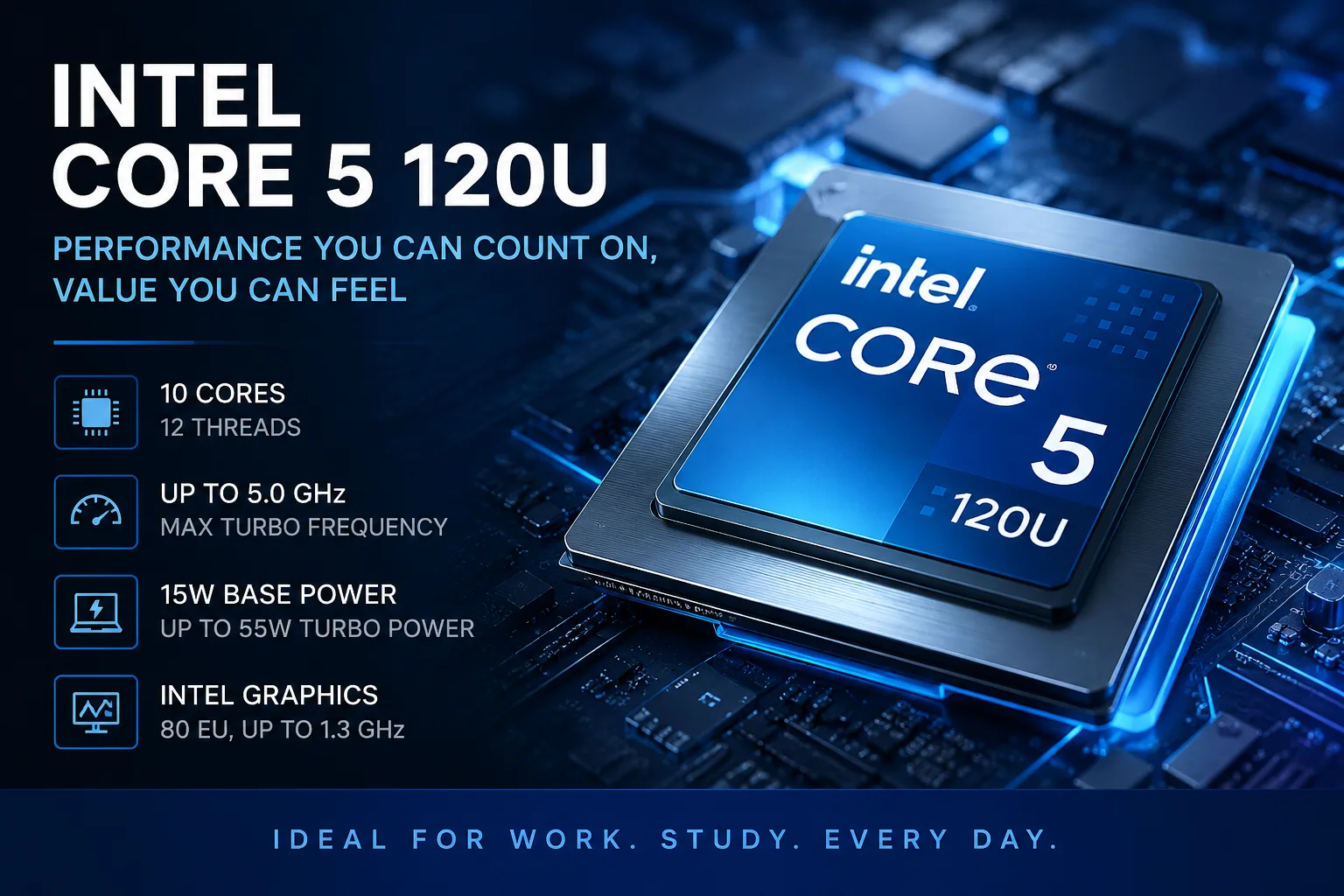
Intel Core 5 120U uses a hybrid architecture with 2 performance P-cores and 8 energy-efficient E-cores. In total, there are 10 cores and 12 threads. The P-cores are responsible for the system's fast responses, running programs, and active tasks, while the E-cores assist with background processes and multitasking.
The maximum frequency of the P-cores reaches 5.0 GHz, while the E-cores can go up to 3.8 GHz. The third-level cache is 12 MB. The processor's base power is 15W, while its maximum turbo power can go up to 55W.
On paper, the specifications look robust, but the class of the processor is more important. This is a U-series, not an H-series. Core 5 120U performs well under short and medium workloads but is not designed for prolonged heavy work under full load. In a thin laptop, it can respond quickly for the first seconds or minutes, but thereafter everything will depend on cooling and power limits.
Not Core Ultra or a New Generation
It is essential not to confuse Core 5 120U with Core Ultra. There is no Meteor Lake architecture, no separate NPU for AI tasks, and no more advanced graphics than those found in the new Core Ultra models. This is not a new Intel platform; it is a carefully updated mass-market chip based on an old foundation.
For a typical laptop, this is not an issue. In browsing, documents, CMS, video calls, spreadsheets, and study tasks, the processor does not need to be a technological breakthrough. It only needs to be fast, efficient, and reasonably priced in the finished device.
The problem arises when a laptop with Core 5 120U is sold for nearly the price of models with Core Ultra or more powerful Ryzen chips. In such cases, the new name does not help: inside, it is still an ordinary energy-efficient mid-range processor.
Performance in Real Work
In everyday tasks, Core 5 120U is expected to feel fast. The high frequency of the P-cores helps the system not to lag when opening programs, switching between windows, working with browsers, and office applications. For most users, this is more important than impressive numbers in multi-threaded tests.
| Task | Rating |
|---|---|
| Browser, documents, email | Excellent |
| Study and office work | Excellent |
| Video calls and multimedia | Good |
| Light photo editing | Average |
| Web development, admin tasks, school projects | Average |
| Video editing | Basic level only |
| 3D rendering and heavy compilation | Not the best choice |
| Games | Only simple or old ones |
The main limitation is only 2 performance cores. For regular work, this is sufficient because the E-cores assist with background and parallel tasks. However, in heavy scenarios, Core 5 120U quickly shows its class. It is not a processor for continuous rendering, large code compilations, complex editing, or tasks where all cores are heavily loaded for an extended period.
Integrated Graphics
Core 5 120U features integrated Intel Graphics with 80 execution units and a frequency of up to 1.3 GHz. This is adequate for video output, YouTube, movies, Windows interface, and simple graphical tasks.
Gaming capabilities are more modest. Older titles, simple online games, and undemanding games are possible, generally at low settings and without much future-proofing. It is not advisable to buy a laptop with Core 5 120U specifically as a gaming device.
An important nuance is memory. Integrated graphics heavily depend on RAM bandwidth. A laptop with dual-channel memory will perform significantly better than a model with reduced or slow configurations.
Memory and Platform
Core 5 120U supports DDR5-5200, DDR4-3200, LPDDR5/LPDDR5X-5200, and LPDDR4X-4267, with a maximum of 96 GB of memory. This is convenient for manufacturers: the same processor can be installed in more modern laptops with LPDDR5 and in affordable models with DDR4.
PCIe 4.0 and Thunderbolt 4 are also announced, but this does not mean that every laptop with Core 5 120U will automatically come with a good set of ports. The manufacturer may choose not to include Thunderbolt, install a low-quality display, a slow SSD, or limited memory.
Therefore, Core 5 120U cannot be assessed in isolation from the laptop. In a good implementation, it is a pleasant versatile chip. In a poor one, it is just a new name in the specifications that covers a compromised build.
Comparison with Neighboring Processors
| Processor | Cores / Threads | Class | Comparison relevance |
|---|---|---|---|
| Core i5-1335U | 10 / 12 | Raptor Lake-U | Very close predecessor |
| Core 5 120U | 10 / 12 | Core Series 1, U-series | Similar base, new name, and frequency up to 5.0 GHz |
| Core 7 150U | 10 / 12 | Core Series 1, U-series | Same class, but higher frequencies |
| Core Ultra 5 125U | 12 / 14 | Meteor Lake-U | Newer platform with NPU and different architecture |
The difference with Core i5-1335U does not appear to be significant. Core 5 120U may be slightly more attractive regarding frequencies and name, but this is not a case where one should change laptops or pay significantly more.
Core 7 150U is more interesting if the price difference is small. However, both processors remain in the same class of thin, energy-efficient laptops, so any premium should be reasonable.
Core Ultra 5 125U is already a different option. It is more appealing as a platform: more recent architecture, presence of an NPU, and a different approach to efficiency and graphics. However, such laptops are often more expensive, so Core 5 120U remains meaningful in more budget-friendly models.
Who Is Core 5 120U For
Core 5 120U should be considered for work, study, browsing, documents, video calls, travel, and typical home tasks. The optimal configuration would be 16 GB of RAM, a fast SSD, a decent display, and a reasonable price.
In this format, a laptop with Core 5 120U can be quiet, lightweight, and adequately fast for daily use. It is not a processor bought for record-breaking performance. It is purchased when a practical laptop is needed without a premium for a flagship platform.
It is not the best choice for heavy editing, 3D graphics, modern gaming, continuous compilation of large projects, and other tasks where the processor is under full load for extended periods. The frequency of up to 5.0 GHz here should not be misleading: this is a mobile 15-watt class, not a workstation.
Conclusion
Intel Core 5 120U is a decent mobile processor without any magic. It is fast in everyday tasks, efficient, and sufficiently modern for thin laptops, but it is not a new generation compared to Core Ultra.
Buying a laptop with Core 5 120U makes sense due to a well-thought-out configuration and pricing, not because of the processor's name. If a similar model with Core i5-1335U is available significantly cheaper, the difference may be insignificant. If a slightly more expensive Core Ultra offers a better platform, it is also worth considering.
In a successful budget laptop, Core 5 120U looks honest. In an expensive model, it becomes more of a marketing point rather than an advantage.
CPU Comparison
Compare Core 5 120U with other CPUs
Basic
CPU Specifications
Memory Specifications
GPU Specifications
AI Specifications
Benchmarks
Compared to Other CPU
Related CPU Comparisons


Share in social media
Or Link To Us
<a href="https://cputronic.com/en/cpu/intel-core-5-120u" target="_blank">Intel Core 5 120U</a>