Intel Core Ultra 5 332

Intel Core Ultra 5 332: Review of the Panther Lake Processor for Business Laptops
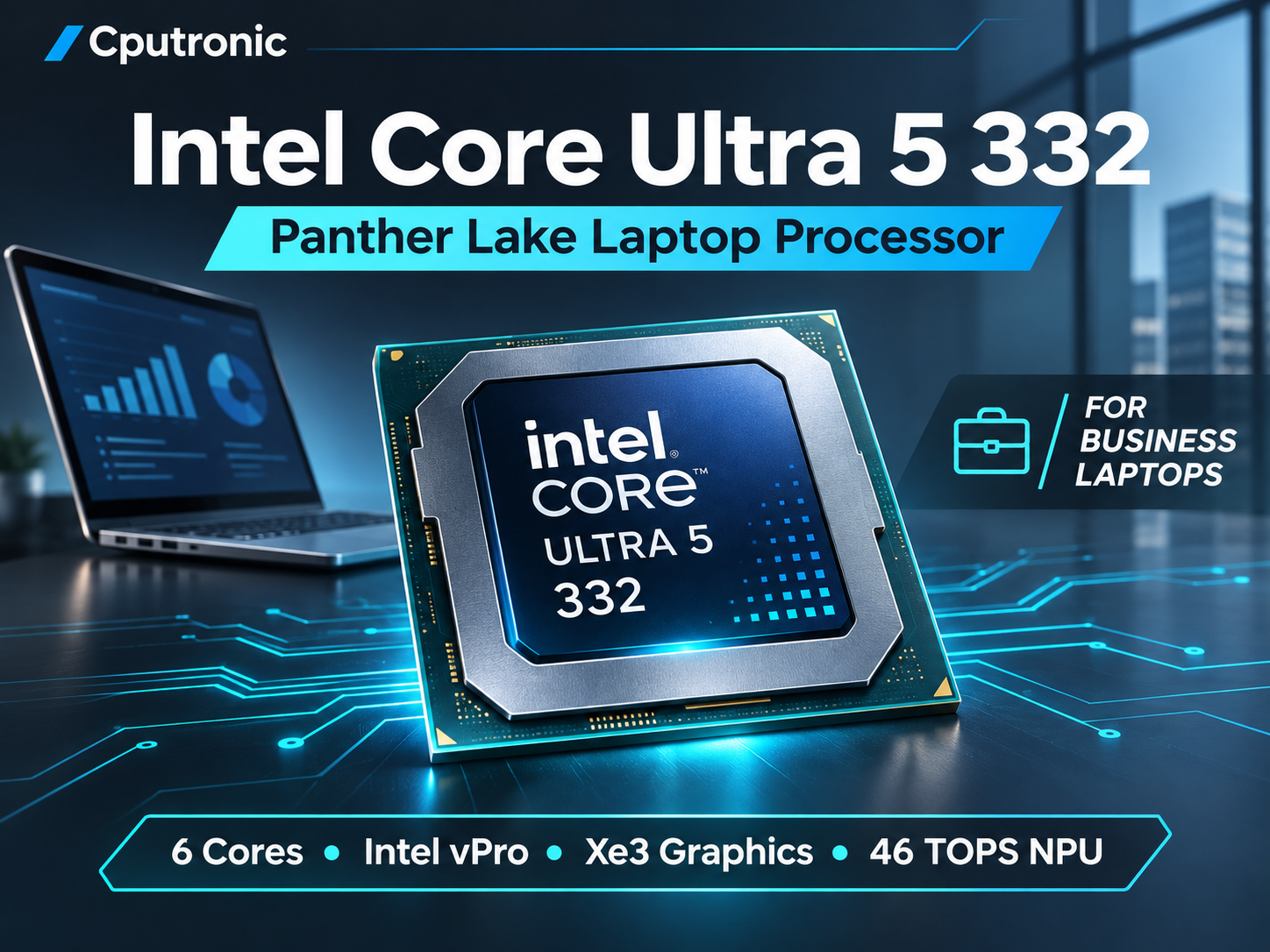
The Intel Core Ultra 5 332 is a mobile processor from the Panther Lake family, introduced in the first quarter of 2026. It has six cores, integrated Intel Graphics with two Xe3 cores, and an NPU with performance of up to 46 TOPS. The model is primarily aimed at business laptops where remote-management capabilities and a base power of 25 W are important.
In terms of computing specifications, the Core Ultra 5 332 is practically identical to the Core Ultra 5 322, but it supports the Intel vPro platform. The eight-core Core Ultra 5 325 offers higher multithreaded performance and graphics with four Xe3 cores.
Differences from the Core Ultra 5 322 and 325
| Specification | Ultra 5 322 | Ultra 5 332 | Ultra 5 325 |
|---|---|---|---|
| P-cores | 2 | 2 | 4 |
| Total cores / threads | 6 / 6 | 6 / 6 | 8 / 8 |
| Maximum P-core frequency | 4.4 GHz | 4.4 GHz | 4.5 GHz |
| Xe3 graphics cores | 2 | 2 | 4 |
| NPU | 46 TOPS | 46 TOPS | 47 TOPS |
| Intel vPro | No | Yes | No |
The Core Ultra 5 332’s enterprise features include Intel Active Management Technology, Remote Platform Erase, and One-Click Recovery. They allow system administrators to service and recover computers remotely. The availability of individual features depends on the laptop’s hardware and software.
For home users, these features are usually not particularly important. If remote management is not required, the Core Ultra 5 322 delivers practically the same computing performance.
Architecture and Power Consumption
The Core Ultra 5 332 combines two performance Cougar Cove cores with four power-efficient Darkmont Low Power E-cores. There are no regular E-cores in this configuration. Hyper-Threading is also absent, so its six physical cores process six threads.
The processor die is manufactured using the Intel 18A process. P-core frequencies range from 2.5 to 4.4 GHz, while LP E-core frequencies range from 1.9 to 3.3 GHz. The shared L3 cache totals 12 MB.
Base power is 25 W, while maximum turbo power is 55 W. Under sustained load, clock speeds depend on the laptop’s cooling system and power settings.
The memory controller supports DDR5-6400 and LPDDR5X-7467. Maximum capacity is 128 GB for DDR5 and 96 GB for LPDDR5X.
Performance in Geekbench 6
The comparison uses measurements from three specific laptops tested in Geekbench 6.7.1.
| Laptop | Processor | Single | Multi |
|---|---|---|---|
| Lenovo 21YASIT015 (ThinkPad L14p Gen 7) | Core Ultra 5 332 | 2549 | 8193 |
| Lenovo IdeaPad Slim 3 15IPH11 (83UR) | Core Ultra 5 322 | 2515 | 8142 |
| Lenovo ThinkBook 14 G9 IPL (21UX005PGE) | Core Ultra 5 325 | 2571 | 10907 |
The Core Ultra 5 332 outperforms the 322 by 1.4% in the single-threaded test and by 0.6% in the multithreaded test. Such a small difference does not indicate a significant advantage for either processor.
The eight-core Core Ultra 5 325 achieves a 33.1% higher Multi-Core score. Its advantage in Single-Core is just 0.9%. The difference in the multithreaded test is consistent with the presence of four P-cores instead of two.
However, the results were obtained on different laptops. Their cooling systems, memory, and power limits differ, so the stated percentages apply to these specific test configurations.
For everyday work, the Core Ultra 5 332 is suitable for:
- Office applications, web browsing, and video conferencing.
- Programming, working with IDEs, and building small projects.
- Photo editing and light video editing.
Eight-core models are faster in tasks that use multiple cores, including lengthy compilation of large projects and rendering.
Integrated Graphics and Gaming
The processor includes Intel Graphics based on the Xe3 architecture, with two graphics cores and a maximum frequency of 2.3 GHz. The GPU is manufactured using the Intel 3 process and supports DirectX 12 Ultimate, including hardware-accelerated ray tracing.
The results from the Lenovo IdeaPad 5i 2-in-1 14IPH11 with a Core Ultra 5 322 can be used to estimate gaming performance. Its graphics unit has the same configuration and maximum frequency as the Core Ultra 5 332.
| Device | Test | Result |
|---|---|---|
| IdeaPad 5i, Ultra 5 322 | 3DMark Time Spy Graphics | 1362 |
| IdeaPad 5i, Ultra 5 322 | Dota 2 Reborn, 1920 × 1080, High | 52.2 FPS |
| IdeaPad 5i, Ultra 5 322 | Cyberpunk 2077, 1920 × 1080, Low, FSR Off | 18.8 FPS |
These are measurements for the Core Ultra 5 322, not direct tests of the 332. The matching GPU specifications make it possible to use the results as a reference, but the actual frame rate depends on the device’s memory and power limits.
In Dota 2, the graphics provide around 52 FPS at High settings and 1920 × 1080. For more consistent performance, it is better to lower the image quality. Cyberpunk 2077 produces less than 20 FPS even at the lowest preset without FSR, which is insufficient for comfortable gaming.
The two-core Xe3 GPU is primarily suitable for multimedia, productivity applications, and less demanding games.
NPU and Multimedia Capabilities
The Core Ultra 5 332 is equipped with Intel AI Boost, offering peak performance of 46 TOPS for INT8 calculations. The NPU is intended for local execution of supported AI workloads, including camera-image processing, noise reduction, and recognition.
The media engine supports hardware encoding and decoding of H.264, HEVC, and AV1, as well as VVC decoding. Intel Quick Sync Video is also supported.
The processor supports Thunderbolt 4, PCIe 5.0, and connection of up to four displays. The actual selection of ports depends on the laptop model.
Laptops and Prices
The Core Ultra 5 332 is found primarily in the Lenovo ThinkPad and HP EliteBook business lines.
Among specific configurations, the Lenovo ThinkPad X13 Gen 7 (21YH0019US) stands out, with 16 GB of memory and a 512 GB SSD. Its approximate price on the US market is around $1,900.
The larger ThinkPad T16 Gen 5 (21WT006EUS), with 32 GB of RAM and a 512 GB SSD, costs around $2,470. Both models use the Core Ultra 5 332 but differ in size, memory capacity, and design.
Other laptops featuring this processor include the ThinkPad L14 Gen 7, ThinkPad T14 Gen 7, and HP EliteBook 6 G2i.
When choosing a specific model, it is worth considering the memory capacity and upgrade options, cooling system, display, and available enterprise features. These factors can affect ease of use more significantly than the small difference between closely matched processors.
Conclusion
The Intel Core Ultra 5 332 is a six-core Panther Lake processor for business laptops. Its computing performance is practically identical to that of the Core Ultra 5 322, with Intel vPro support being its main advantage.
The two performance cores provide sufficient speed for office applications and everyday tasks but limit the processor’s capabilities under sustained multithreaded workloads. The integrated graphics with two Xe3 cores is suitable for multimedia and less demanding games.
The Core Ultra 5 332 is suitable for business laptops that require centralized management. If Intel vPro is not needed, the Core Ultra 5 322 offers comparable performance, while the Core Ultra 5 325 is better suited to tasks that can use a larger number of cores.
CPU Comparison
Compare Core Ultra 5 332 with other CPUs
Basic
CPU Specifications
Memory Specifications
GPU Specifications
Interfaces and Ports
Benchmarks
Compared to Other CPU
Related CPU Comparisons


Share in social media
Or Link To Us
<a href="https://cputronic.com/en/cpu/intel-core-ultra-5-332" target="_blank">Intel Core Ultra 5 332</a>