AMD Ryzen 5 5600GT
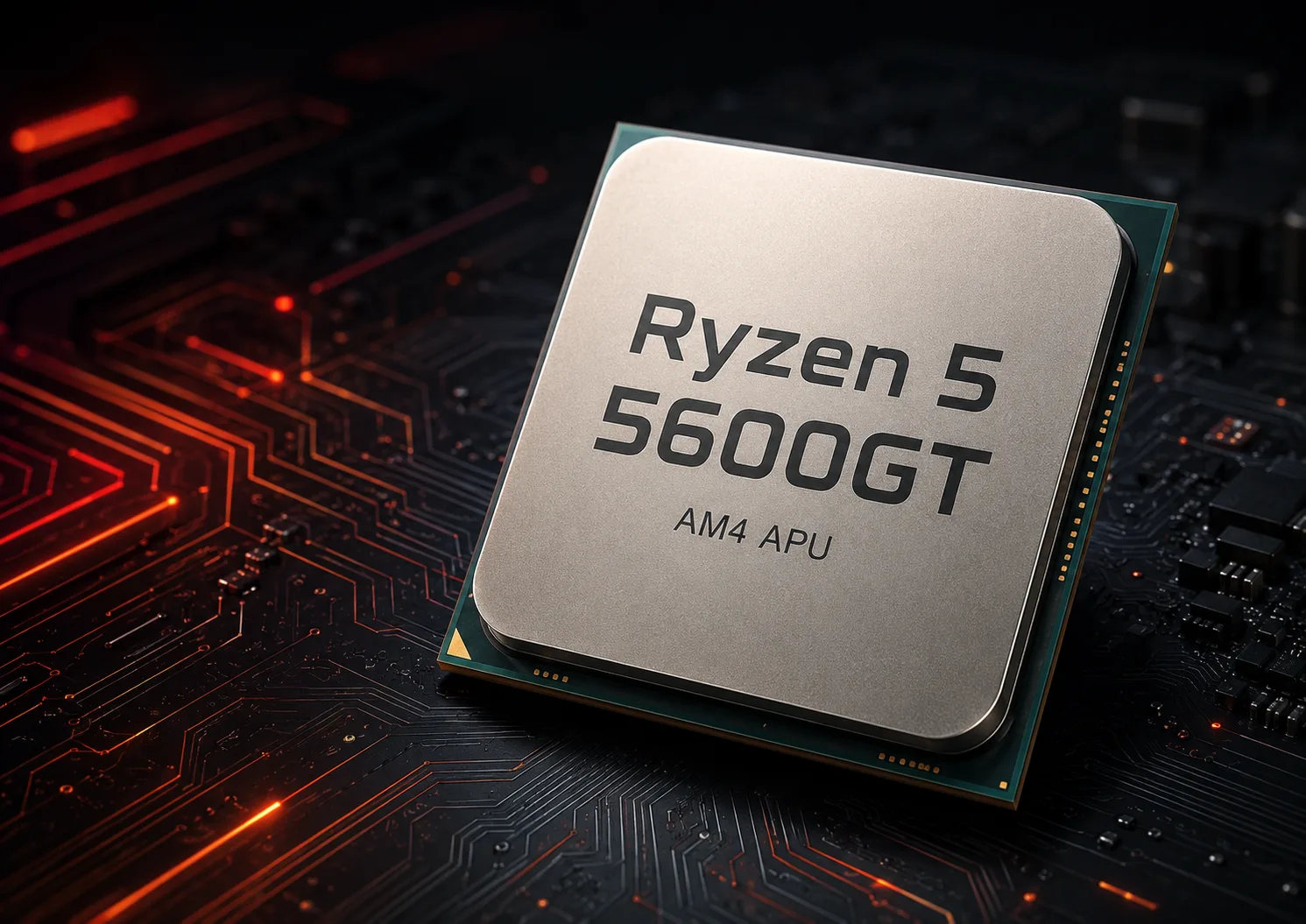
AMD Ryzen 5 5600GT: Not a Ryzen 5 5600 with Graphics, but a Late APU for AM4
AMD Ryzen 5 5600GT can easily be misunderstood by its name. It seems like a regular Ryzen 5 5600, just with integrated graphics. In reality, the 5600GT is closer to the Ryzen 5 5600G and 5500GT than to the Ryzen 5 5600.
This is a late 6-core APU for the AM4 platform. It was released after AMD's transition to AM5, DDR5, and the new generations of Ryzen, but its purpose is different. Its value lies not in novelty, but in the ability to build an affordable AM4 computer without a dedicated graphics card.
The Ryzen 5 5600GT features 6 cores and 12 threads, Zen 3 architecture, a base clock speed of 3.6 GHz, boost up to 4.6 GHz, 16 MB of L3 cache, a TDP of 65W, and integrated Radeon Graphics with 7 graphics cores. It works with DDR4 memory, uses the AM4 socket, and is limited to PCIe 3.0.
Main Difference from Ryzen 5 5600
The Ryzen 5 5600GT is based on Cezanne rather than Vermeer. The regular Ryzen 5 5600 has more L3 cache - 32 MB vs. 16 MB - support for PCIe 4.0, but lacks integrated graphics. In contrast, the Ryzen 5 5600GT has less cache, PCIe 3.0, but allows for a computer build without a discrete graphics card.
Thus, the 5600GT cannot be considered a direct replacement for the Ryzen 5 5600. If a graphics card is already available, the regular Ryzen 5 5600 often appears stronger. If there's no graphics card or one will be purchased later, the 5600GT becomes more convenient.
The main takeaway is simple: the Ryzen 5 5600GT is not the fastest Ryzen 5 for AM4, but a processor that allows for building a working PC without a separate graphics card.
Ryzen 5 5600GT vs. 5500GT, 5600G, and 5600
| Parameter | Ryzen 5 5500GT | Ryzen 5 5600G | Ryzen 5 5600GT | Ryzen 5 5600 |
|---|---|---|---|---|
| Architecture | Zen 3 / Cezanne | Zen 3 / Cezanne | Zen 3 / Cezanne | Zen 3 / Vermeer |
| Cores / Threads | 6 / 12 | 6 / 12 | 6 / 12 | 6 / 12 |
| Base Clock | 3.6 GHz | 3.9 GHz | 3.6 GHz | 3.5 GHz |
| Boost | up to 4.4 GHz | up to 4.4 GHz | up to 4.6 GHz | up to 4.4 GHz |
| L3 Cache | 16 MB | 16 MB | 16 MB | 32 MB |
| Integrated Graphics | Yes | Yes | Yes | No |
| PCIe | 3.0 | 3.0 | 3.0 | 4.0 |
| TDP | 65 W | 65 W | 65 W | 65 W |
| Main Purpose | Cheap AM4 APU | Classic AM4 APU | Faster AM4 APU | Better for systems with GPU |
Against the Ryzen 5 5600G, the new 5600GT does not appear as a new generation but rather as a slight frequency update. It has a lower base clock but higher boost: 3.6/4.6 GHz versus 3.9/4.4 GHz. In short tasks, this might give a small advantage, but switching from the 5600G to the 5600GT is almost pointless.
The difference from the Ryzen 5 5500GT is even smaller: the 5600GT has a boost 200 MHz higher. If the prices are nearly the same, it's better to choose the 5600GT. If the 5500GT is significantly cheaper, the extra cost for the higher model is not always justified.
Performance
The Ryzen 5 5600GT remains a decent 6-core processor for home and office PCs. Six cores and twelve threads are sufficient for browsing, documents, studying, light photo editing, simple video editing, older games, and everyday multitasking.
In synthetic tests, the Ryzen 5 5600GT typically outperforms the Ryzen 5 5600G slightly due to the higher boost. In PassMark, it holds around 20,000 CPU Mark points, while in Geekbench 6, it scores around 2000 points in single-core and about 7900-8000 points in multi-core. For an affordable AM4 processor with integrated graphics, this is a good level.
However, don't expect a massive leap. The Ryzen 5 5600GT is neither a new architecture nor a competitor to modern Ryzen 7000/8000/9000. Its advantage lies elsewhere: sufficient CPU performance, an affordable platform, and integrated graphics.
In gaming with a discrete graphics card, the processor handles budget and mid-range GPUs well, but it’s not the best option for maximum FPS. The 16 MB L3 cache and PCIe 3.0 make it less appealing compared to the Ryzen 5 5600 if integrated graphics are not required.
PCIe 3.0 and Integrated Graphics
PCIe 3.0 does not make the Ryzen 5 5600GT a bad processor. For office PCs, home systems, and budget builds, this is an acceptable limitation. However, if a fast NVMe SSD or a modern graphics card with a limited number of PCIe lanes is planned, the Ryzen 5 5600 with PCIe 4.0 looks more preferable.
The main advantage of the 5600GT is the integrated Radeon Graphics. It is suitable for work, video, browsing, documents, older games, and undemanding online projects. In terms of performance, it is akin to older Vega graphics, though AMD simply refers to it as Radeon Graphics in the specifications. It lags significantly behind modern Radeon 740M, 760M, and 780M.
Memory is particularly crucial for the iGPU. Using a single stick of DDR4 severely limits bandwidth, so it is advisable to use a dual-channel kit with, for example, 2×8 GB or 2×16 GB DDR4-3200 for the Ryzen 5 5600GT.
Who Should Consider the Ryzen 5 5600GT
The Ryzen 5 5600GT is worth considering if you need:
- An affordable home or office PC without a graphics card;
- An upgrade for an old AM4 system without switching to AM5;
- A temporary computer where a graphics card will be purchased later;
- A compact build for browsing, documents, video, and light gaming;
- A budget DDR4 system with a capable 6-core processor.
For an upgrade from the Ryzen 5 5600G, this processor is almost unnecessary. For a gaming build with a dedicated graphics card, it is often more sensible to choose the Ryzen 5 5600. For a new system with a buffer for years, it is better to look towards AM5, if the budget allows.
Conclusion
The AMD Ryzen 5 5600GT should be bought not for its novelty but for its practicality. This late Cezanne processor for AM4 fills a specific niche: an affordable computer with integrated graphics, DDR4 memory, and the option to add a discrete graphics card later.
It has clear advantages: 6 cores, 12 threads, low platform cost, and integrated Radeon Graphics. However, it also has limitations: PCIe 3.0, 16 MB L3 cache, and outdated graphic architecture.
If a graphics card is already available, the Ryzen 5 5600 will generally perform better. If there is no graphics card and an inexpensive functional PC on AM4 is needed, the Ryzen 5 5600GT fits its niche very precisely.
CPU Comparison
Compare Ryzen 5 5600GT with other CPUs
Basic
CPU Specifications
Memory Specifications
GPU Specifications
Benchmarks
Compared to Other CPU
Related CPU Comparisons


Share in social media
Or Link To Us
<a href="https://cputronic.com/en/cpu/amd-ryzen-5-5600gt" target="_blank">AMD Ryzen 5 5600GT</a>