MediaTek Dimensity 9500s
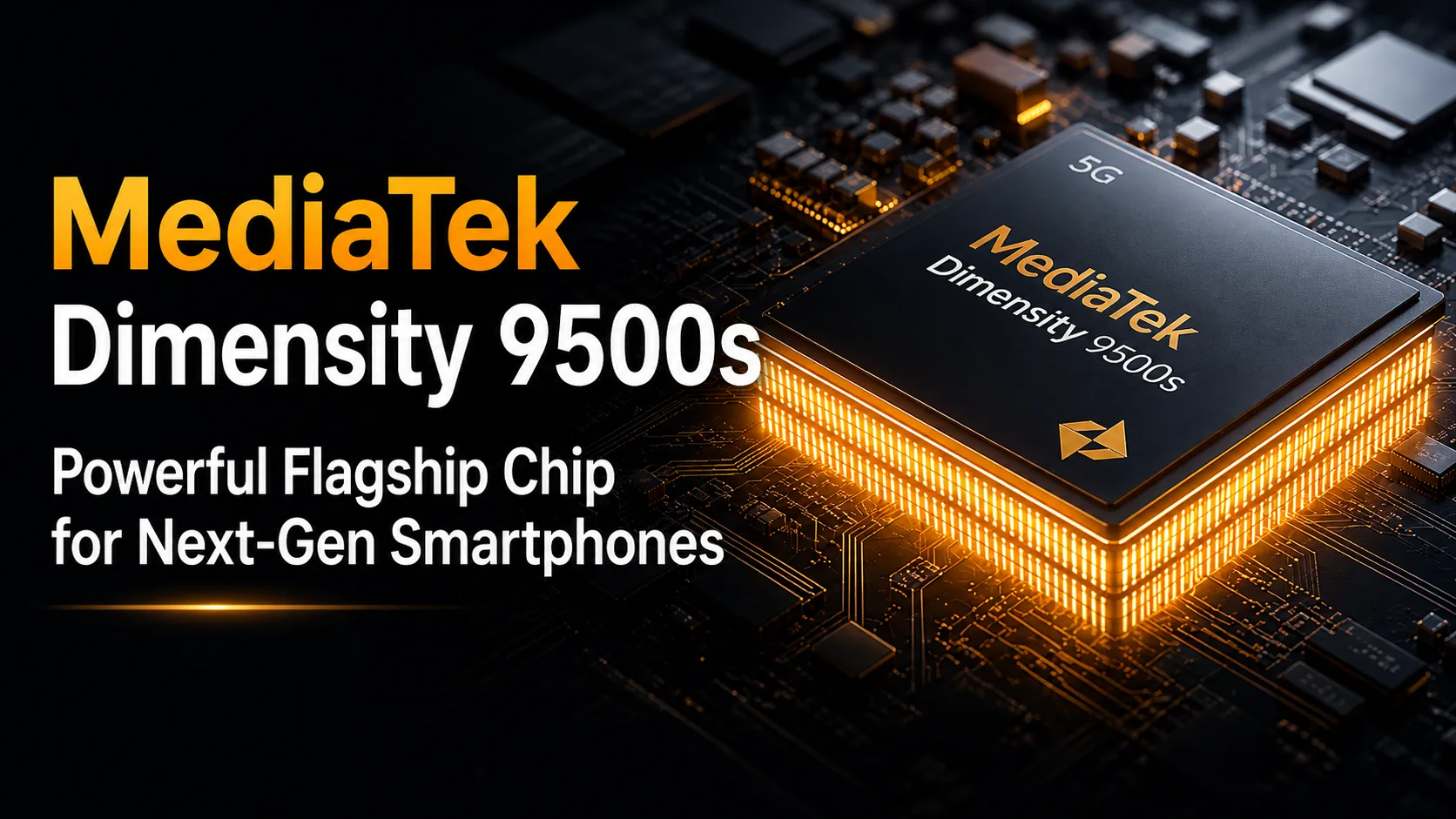
MediaTek Dimensity 9500s: A Powerful Flagship Chip with Practical Character
The MediaTek Dimensity 9500s is a high-end mobile platform designed for smartphones in 2026. It is targeted at devices that require high performance, strong graphics, modern AI features, fast photo and video processing, up-to-date connectivity, and good energy efficiency.
In essence, the Dimensity 9500s is not just a chip for impressive benchmark numbers. It serves as the foundation for powerful Android smartphones, where stability under load, battery life, cooling quality, and the price of the final device are crucial. This processor is appealing to those who want flagship-level speed without necessarily paying a premium for the most expensive chip of the generation.
The main feature of the Dimensity 9500s is its All Big Core architecture. Unlike traditional big.LITTLE designs, this processor does not have small energy-efficient cores. Instead, it uses eight high-performance Arm cores of various power levels. This configuration is well-suited for modern scenarios: app launches, camera use, gaming, navigation, photo processing, AI functions, and multitasking.
Architecture and Performance
The Dimensity 9500s is manufactured using a 3nm process and features an octa-core CPU. The most powerful core, the Cortex-X925, operates at speeds of up to 3.73 GHz. Additionally, it includes three Cortex-X4 cores and four Cortex-A720 cores. To enhance data exchange speeds, MediaTek specifies a large cache: 12 MB of L3 cache and 10 MB of SLC system cache.
More important than just the core set is the platform’s logic. The single most powerful core is responsible for peak tasks and rapid interface response, while the three Cortex-X4 cores assist in handling heavy multithreaded loads, with the four Cortex-A720 cores managing less extreme but still performance-oriented scenarios. This approach makes the Dimensity 9500s particularly strong in tasks where the smartphone needs to respond quickly: app launches, camera usage, gaming, photo processing, AI functions, and switching between programs.
The large cache helps reduce data exchange delays, while support for fast LPDDR5X memory and UFS 4 storage makes the platform relevant for high-end smartphones. In everyday use, smartphones powered by the Dimensity 9500s should handle heavy Android skins, active browsing, social media, short video shooting and editing, gaming, and multitasking effectively.
However, having the same processor name does not guarantee identical speeds across all smartphones. Manufacturers might set different power limits, cooling systems, and performance modes. As a result, one device with the Dimensity 9500s can maintain high performance in gaming for a long time, while another might reduce performance more quickly due to overheating.
Graphics and Gaming
The graphics are powered by the Arm Immortalis-G925. This high-level GPU supports hardware ray tracing. The Dimensity 9500s is designed for demanding mobile games, high frame rates, and advanced visual effects.
A specific aspect to note is that the GPU configuration may vary depending on the specific smartphone model. For instance, one device may use a version with 11 cores, while another may feature a more powerful configuration. Therefore, when comparing smartphones, it is essential to look not only at the SoC name but also at the specific graphics version, cooling systems, gaming mode settings, and display refresh rates.
| Feature | What It Offers |
|---|---|
| Immortalis-G925 | High performance in modern 3D games |
| Ray tracing | More realistic lighting and reflections in supported games |
| MAGT 3.0 | Energy consumption optimization in gaming scenarios |
| MFRC 3.0 | Increased smoothness of graphics in compatible games |
| Support for high-refresh displays | A good foundation for smartphones with 120 Hz, 144 Hz, and higher |
For gaming, the Dimensity 9500s appears to be a strong option. It is suitable for titles like Genshin Impact, Honkai: Star Rail, PUBG Mobile, Call of Duty Mobile, and other demanding games. However, the key question will not only be the chip itself but also the smartphone's build: a large battery, adequate cooling, and smart power limits are no less important than the GPU.
AI and NPU
The Dimensity 9500s has a MediaTek NPU that supports generative and agent-based AI. In practice, this serves as a base for features that are increasingly common in modern smartphones: photo enhancement, object removal, image upscaling, speech recognition, translation, summarization, intelligent search, and content processing directly on the device.
One should not expect every smartphone with the Dimensity 9500s to have identical AI capabilities. The hardware provides a foundation, but the available features depend on the firmware, region, interface language, manufacturer applications, and cloud service support. Therefore, when purchasing, it’s wise to look not only at the NPU but also at which AI tools are actually available in a given model.
Cameras and Video
The Dimensity 9500s utilizes the advanced MediaTek Imagiq ISP. The platform supports high-resolution cameras, 18-bit RAW, focus tracking at 30 frames per second, operation with multiple sensors, and video capture up to 8K60. It is also claimed to support 8K Dolby Vision video capture.
| Camera Feature | Practical Importance |
|---|---|
| Up to 320 MP | Support for high-resolution sensors |
| 18-bit RAW | More data for post-processing images |
| 3 x 36 MP at 30 FPS | Ability to work with multiple cameras |
| Motion tracking focus | More reliable focus on moving objects |
| 8K60 capture | Potential for ultra-high-resolution video |
| 8K Dolby Vision | Enhanced HDR video capabilities |
It’s important not to confuse the platform's capabilities with the actual modes of a specific smartphone. The Dimensity 9500s may support 8K60 at the SoC level, but the device manufacturer may limit video recording to a lower resolution or frame rate. The reasons for this can vary: sensor limitations, cooling, power consumption, stabilization, camera firmware, and marketing segmentation of models.
Photo quality also relies not just on the processor. The sensor, optics, stabilization, processing algorithms, autofocus speed, and HDR settings can significantly influence the result, potentially more so than the ISP itself. The Dimensity 9500s provides a solid technical base but does not automatically make any device a camera phone.
Memory, Storage, and System Speed
The Dimensity 9500s supports LPDDR5X memory at speeds up to 10667 Mbps and UFS 4 + MCQ storage. This is a crucial part of overall performance since fast CPUs and GPUs only perform to their full potential when paired with sufficiently fast memory and storage.
Fast RAM benefits gaming, camera ops, AI features, and multitasking. A quick storage medium speeds up app launches, game installations, loading levels, handling large files, and data loading in demanding applications.
Configurations in specific smartphones may vary. For example, the POCO X8 Pro Max uses LPDDR5X at 9600 Mbps and UFS 4.1. This is a good set for a high-end device, but when selecting another smartphone featuring the Dimensity 9500s, checking the type of memory is advisable.
Connectivity and Wireless Options
The Dimensity 9500s supports 5G Release 17, Sub-6GHz, 4CC carrier aggregation, Dual SIM Dual Active, Wi-Fi 7, and Bluetooth 5.4. The maximum claimed download speed in 5G reaches 7 Gbps, and the peak speed for Wi-Fi 7 is up to 6.5 Gbps.
| Wireless Feature | What’s Important |
|---|---|
| 5G Release 17 | A modern foundation for 5G networks |
| 4CC-CA | Frequency aggregation for high speeds |
| Dual SIM Dual Active | More flexible use of two SIM cards |
| Wi-Fi 7 | High speeds and low latency in compatible networks |
| Bluetooth 5.4 | Current base characteristic of the platform |
| Navigation | GPS, BeiDou, Galileo, GLONASS, QZSS, NavIC |
In real life, the speed and stability of connectivity depend not just on the SoC. Important factors include the smartphone's antennas, supported frequency bands, carrier, region, and modem firmware. Additionally, certain models may claim wireless capabilities that differ from the platform's base specifications. Therefore, it is advisable to check Bluetooth, Wi-Fi, 5G bands, and navigation functions on the specific smartphone’s page.
Dimensity 9500s vs. Dimensity 9500 and Dimensity 8500
The Dimensity 9500s occupies an intermediate position between the highest flagship and the upper mid-range. It is noticeably more powerful than mainstream chips but should not be seen as a complete equivalent of the higher-end Dimensity 9500.
| Chip | Positioning | What to Choose |
|---|---|---|
| Dimensity 9500 | Maximum flagship from MediaTek | For those who want the highest level of CPU, GPU, and NPU |
| Dimensity 9500s | Practical flagship-level performance | For gaming, cameras, AI, and powerful smartphones without overpaying for maximum performance |
| Dimensity 8500 | Upper mid-range | For users who prioritize a balance of price, battery life, and speed |
If maximum performance and the strongest versions of the CPU, GPU, and NPU are required, it makes more sense to look at the Dimensity 9500. If a powerful smartphone for gaming, photography, video, AI functions, and active everyday tasks is needed, the Dimensity 9500s seems to be the more rational choice. Meanwhile, the Dimensity 8500 is suitable for those seeking good speed without needing flagship-level specifications.
Smartphones Featuring MediaTek Dimensity 9500s
Among notable models featuring the Dimensity 9500s, the POCO X8 Pro Max stands out. It serves as a good example of the types of devices that use this chip: a large battery, fast display, powerful platform, rapid charging, and a focus on gaming, multimedia, and battery life.
| Smartphone | Features |
|---|---|
| POCO X8 Pro Max | Dimensity 9500s, LPDDR5X 9600 Mbps, UFS 4.1, 8500 mAh battery, 100W charging, 120Hz AMOLED display |
This example illustrates why it is crucial to look at the specifications of the entire smartphone, not just the processor. A device may utilize the Dimensity 9500s but differ in GPU configuration, memory, cameras, battery, cooling, and available AI functionalities.
Pros and Cons of the Dimensity 9500s
| Pros | Cons |
|---|---|
| Powerful All Big Core architecture | Not the highest chip in the lineup |
| 3nm manufacturing process | Results depend on the smartphone’s cooling |
| Strong Immortalis-G925 graphics | GPU version may vary by model |
| Support for ray tracing | Gaming stability depends on the chassis and power limits |
| Modern NPU for AI | AI functions depend on firmware and region |
| Good ISP for photos and videos | Camera performance relies on more than just the processor |
| LPDDR5X and UFS 4 + MCQ | Memory configurations can vary in specific devices |
| 5G Release 17 and Wi-Fi 7 | Real speeds depend on network and antennas |
Who Should Consider a Smartphone with Dimensity 9500s
A smartphone with the Dimensity 9500s is worth considering for those who want a powerful Android device for gaming, photography, social media, short video editing, AI functions, navigation, and active multitasking. This chip performs especially well in devices with a large battery, fast storage, a good display, and smart cooling systems.
It suits users who need flagship-level performance but do not necessarily prioritize the most expensive processor of the generation. This is a good choice for those who focus on more than just AnTuTu or Geekbench scores but also consider how a smartphone performs: heat management, FPS stability, camera speed, interface smoothness, and battery life.
Conclusion
The MediaTek Dimensity 9500s is a robust high-end platform with a practical flagship character. It boasts a powerful CPU, modern Immortalis-G925 graphics, ray tracing support, an advanced NPU, an excellent ISP, 5G Release 17, Wi-Fi 7, and fast LPDDR5X memory.
The key advantage of the Dimensity 9500s is its balance. It is not merely a chip for short peaks in tests but a foundation for smartphones that need to be fast every day: in gaming, photography, browsing, interface operation, AI features, and multimedia.
When choosing a smartphone with the Dimensity 9500s, it’s important to consider the cooling system, memory, cameras, battery, and software features. If the manufacturer has not cut corners on these components, such a device can be a successful purchase for those looking for a powerful, modern, and long-lasting Android smartphone without the obligatory surcharge for the costliest flagship chip.
SOC Comparison
Compare Dimensity 9500s with other SOCs
Basic
3x 3.3 GHz – Cortex-X4
4x 2.4 GHz – Cortex-A720
GPU Specifications
Connectivity
Memory Specifications
Miscellaneous
- FLAC
- HE-AACv1
- HE-AACv2
- MP3
- H.265
- AV1
- VP9
Benchmarks
Phones with Dimensity 9500s


Comparison of Devices with Dimensity 9500s
Compared to Other SoC
Related SoC Comparisons





Share in social media
Or Link To Us
<a href="https://cputronic.com/index.php/soc/mediatek-dimensity-9500s" target="_blank">MediaTek Dimensity 9500s</a>