Qualcomm Snapdragon 8 Gen 5

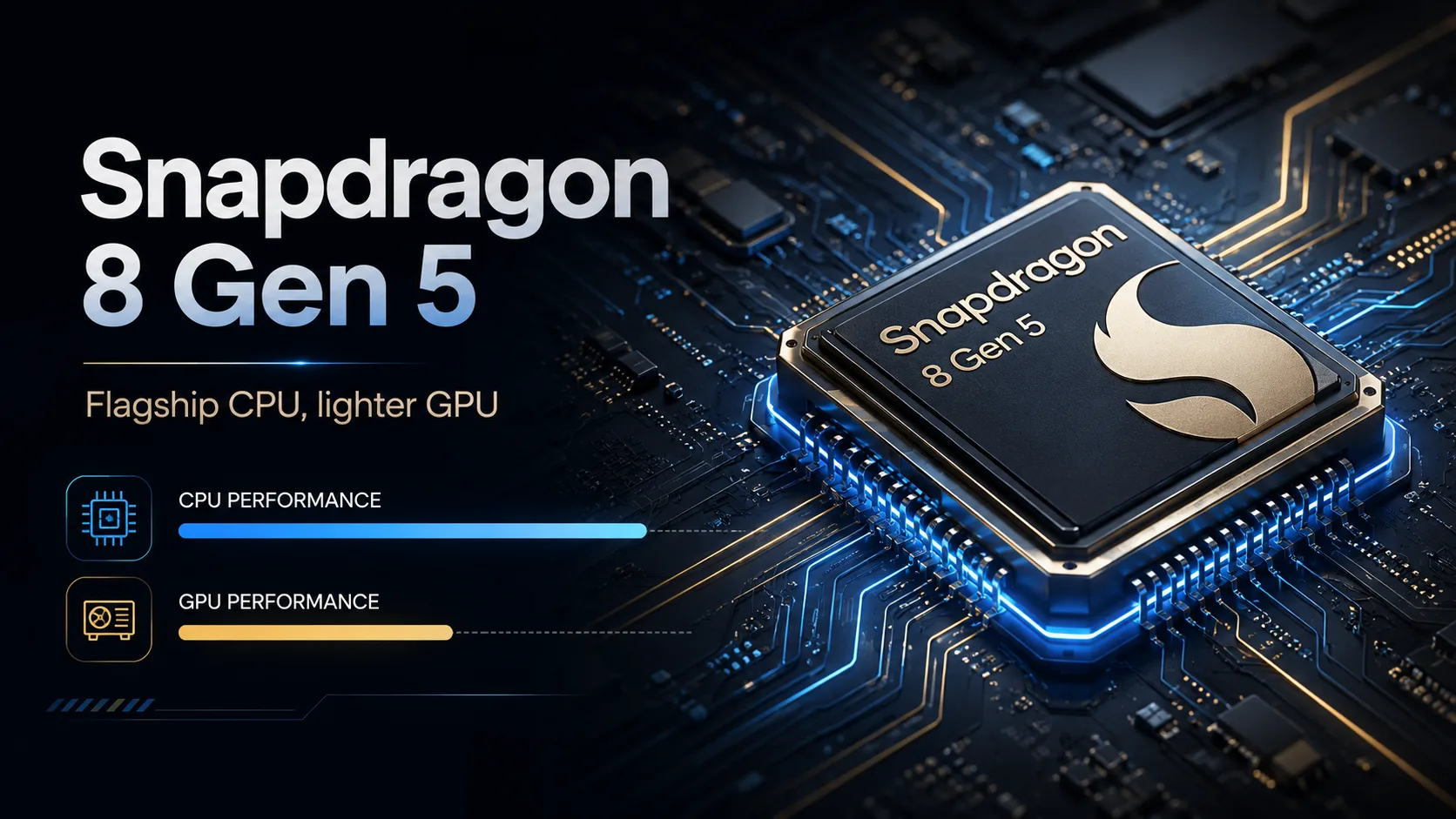
Snapdragon 8 Gen 5: Almost Elite in CPU, But Not in Graphics
The Snapdragon 8 Gen 5 occupies a new tier in Qualcomm's lineup: below Elite but above the simplified 8s models. It utilizes Oryon cores and a 3nm manufacturing process; however, CPU frequencies and graphics performance are lower than that of the Snapdragon 8 Elite Gen 5.
The chip is aimed at high-end smartphones for manufacturers that do not require the maximum performance of the Elite version. Savings on the platform may leave a larger budget for the battery, screen, cameras, or cooling.
Below Elite, But Above the 8s Series
Qualcomm's higher mobile platforms now form three tiers:
- Snapdragon 8 Elite Gen 5 - Maximum performance;
- Snapdragon 8 Gen 5 - Junior flagship platform with reduced CPU frequencies and less powerful graphics;
- Snapdragon 8s - More affordable chips with significant limitations compared to higher models.
Qualcomm compares the Snapdragon 8 Gen 5 with the Snapdragon 8 Gen 3. According to the company, CPU performance has increased by 36%, GPU by 11%, and NPU by 46%. At the same time, it claims a reduction in power consumption for the CPU by 42%, graphics by 28%, and the entire system by 13%.
These are manufacturer's data, not results from independent testing. In finished smartphones, performance indicators will depend on cooling, firmware, and power limits.
In terms of architecture and energy efficiency, the Snapdragon 8 Gen 5 surpasses the Snapdragon 8 Gen 3, but Qualcomm reserved maximum performance for the Elite version.
Oryon Without Little Cores
The CPU includes eight Qualcomm Oryon cores:
- Two Prime cores with frequencies up to 3.8 GHz;
- Six Performance cores with frequencies up to 3.32 GHz.
There are no separate energy-efficient cores. Under light load, the same cores reduce frequencies and power consumption. The total L2 cache size is 16 MB: 4 MB is allocated to the two Prime cores and 12 MB to the six Performance cores.
The same scheme is used in the Snapdragon 8 Elite series, but the frequencies of the Snapdragon 8 Gen 5 are lower. In the Elite Gen 5, the main cores can boost up to 4.6-4.74 GHz, making it faster in short single-threaded tasks.
In app launching, browsing, and switching between programs, the Elite’s advantage will be minimal. The Snapdragon 8 Gen 5 has sufficient performance for complex web applications, photo processing, video editing, and active multitasking. The higher model performs noticeably better in prolonged calculations, heavy emulation, and other tasks with high sustained loads.
CPU at the Level of the Last Elite, Weaker Graphics
The first smartphones with the Snapdragon 8 Gen 5 score about 2900 points in single-core mode and 9500-9600 in multi-core in Geekbench 6. In terms of CPU, the new chip is close to the first-generation Snapdragon 8 Elite, although the performance of a specific device depends on cooling and power settings.
| Test | Approximate Result of Snapdragon 8 Gen 5 |
|---|---|
| Geekbench 6 Single-Core | about 2900 |
| Geekbench 6 Multi-Core | 9500-9600 |
| 3DMark Steel Nomad Light | 1800-2000 |
| 3DMark Wild Life Extreme | about 5000 |
The CPU is near the first-generation Snapdragon 8 Elite, whereas the GPU lags significantly behind. In heavy graphic tests, the difference can reach approximately 20%.
The Adreno graphics supports hardware ray tracing, Mesh Shading, and Variable Rate Shading, as well as outputting images at up to 165 Hz. Most mobile games run on high or maximum settings, but a previous-generation model with the Snapdragon 8 Elite may perform faster at a comparable price.
Much Depends on Cooling in Games
The platform supports image scaling, frame generation, and selective shading quality reduction to improve performance. However, having these technologies does not guarantee a stable frame rate.
In a thin body with a small heatsink, performance may drop within a few minutes of load. A smartphone with a large vapor chamber and less aggressive throttling can maintain high frequencies longer than a model with a more powerful chip.
When choosing a gaming smartphone, it's not enough to compare only processors. Important factors include:
- Stability of results in prolonged tests;
- Body temperature;
- Frequency drops after heating;
- Size of the cooling system;
- Firmware behavior under sustained load.
The Elite makes sense for heavy emulation, long gaming sessions, and maximum frame rates at high settings. For most mobile games, the Snapdragon 8 Gen 5’s capabilities are sufficient.
ISP Retains Most Flagship Capabilities
In terms of image processing capabilities, the Snapdragon 8 Gen 5 is close to the higher platform. It features three 20-bit Spectra ISPs capable of processing data from multiple cameras simultaneously.
The following modes are claimed:
- Three 48 MP cameras with zero shutter lag;
- One camera up to 108 MP with zero lag;
- Photos with a resolution of up to 320 MP;
- 4K recording at 120 frames per second;
- 1080p slow motion at 480 frames per second;
- 8K HDR playback at 30 frames per second.
The platform's algorithms can adjust skin and sky tones, as well as fine-tuning autofocus, exposure, and white balance depending on the scene. Separate audio blocks handle wind noise suppression during video recording.
However, the platform's capabilities alone do not guarantee high-quality shooting. The result depends on the sensors, optics, stabilization, and manufacturer algorithms. Two smartphones with the same processor may significantly differ in detail, color reproduction, and quality of night photography.
NPU Has Become Faster, But Its Usefulness Depends on Firmware
According to Qualcomm, the performance of the Hexagon NPU has grown by 46% compared to the Snapdragon 8 Gen 3. It supports calculations with varying precision, and the Oryon cores received hardware acceleration for matrix operations.
The low-power Sensing Hub processes data from microphones, cameras, and sensors without constantly taxing the main cores. This block is intended for background voice recognition, sensor data analysis, and triggering contextual scenarios.
The practical value of the NPU depends on the firmware. A fast accelerator by itself does not add new features and does not guarantee their support after the smartphone's release.
It’s worth evaluating the specific capabilities of the device: offline translation, speech transcription, photo processing, and operation of local AI models. The update cycle should also be checked separately.
Few Differences in Memory and Connectivity Compared to Elite
The Snapdragon 8 Gen 5 supports up to 24 GB of LPDDR5X memory at frequencies up to 4800 MHz and UFS 4.1 storage.
Wireless connectivity is handled by FastConnect 7900, which supports Wi-Fi 7, Bluetooth 6.0, and UWB. The maximum claimed Wi-Fi speed reaches 5.8 Gbps.
The Snapdragon X80 modem supports 5G Advanced, satellite messaging NB-NTN, and data download speeds of up to 10 Gbps. The Snapdragon 8 Elite Gen 5 uses the newer X85; however, its advantage in peak speed rarely manifests in real-world networks.
The smartphone manufacturer may not utilize all the platform's capabilities. Therefore, it’s essential to verify features like Wi-Fi 7, UWB, and video output via USB separately for each model.
When Snapdragon 8 Gen 5 Makes Sense
Opting for the Snapdragon 8 Gen 5 is justified when there is a significant price difference from models with the Elite. Such a smartphone appears more appealing if the buyer also gets:
- A large battery;
- A quality screen;
- A telephoto lens;
- Effective cooling;
- More RAM or storage.
At a similar price, the advantage of the Snapdragon 8 Gen 5 disappears, and comparisons must be made regarding cameras, displays, battery life, and cooling.
With noticeable savings, the chip offers CPU performance on par with the first Elite, Wi-Fi 7, UFS 4.1, and a modern 5G modem. The main losses occur in GPU performance and maximum CPU core frequencies.
Conclusion
The Snapdragon 8 Gen 5 occupies the junior tier of Qualcomm's flagship lineup. CPU performance is close to that of the first-generation Snapdragon 8 Elite, but graphics are noticeably weaker.
It is adequate for most games at high settings; however, the first-generation Snapdragon 8 Elite and Elite Gen 5 perform faster under prolonged graphical loads. Therefore, the new chip is more logically used in models where the manufacturer prioritizes lowering costs, increasing battery capacity, or enhancing cameras over achieving maximum gaming performance.
In the case of a significant price difference, this is a justified compromise: the CPU remains flagship, while the main limitations are associated with graphics.
SOC Comparison
Compare Snapdragon 8 Gen 5 with other SOCs
Basic
GPU Specifications
Connectivity
Memory Specifications
Miscellaneous
Benchmarks
Phones with Snapdragon 8 Gen 5









Tablets with Snapdragon 8 Gen 5



Comparison of Devices with Snapdragon 8 Gen 5
Compared to Other SoC
Related SoC Comparisons


Share in social media
Or Link To Us
<a href="https://cputronic.com/index.php/soc/qualcomm-snapdragon-8-gen-5" target="_blank">Qualcomm Snapdragon 8 Gen 5</a>