Unisoc T9100

Unisoc T9100 in Real Smartphones: Performance, Gaming, and Its Place Among Competitors
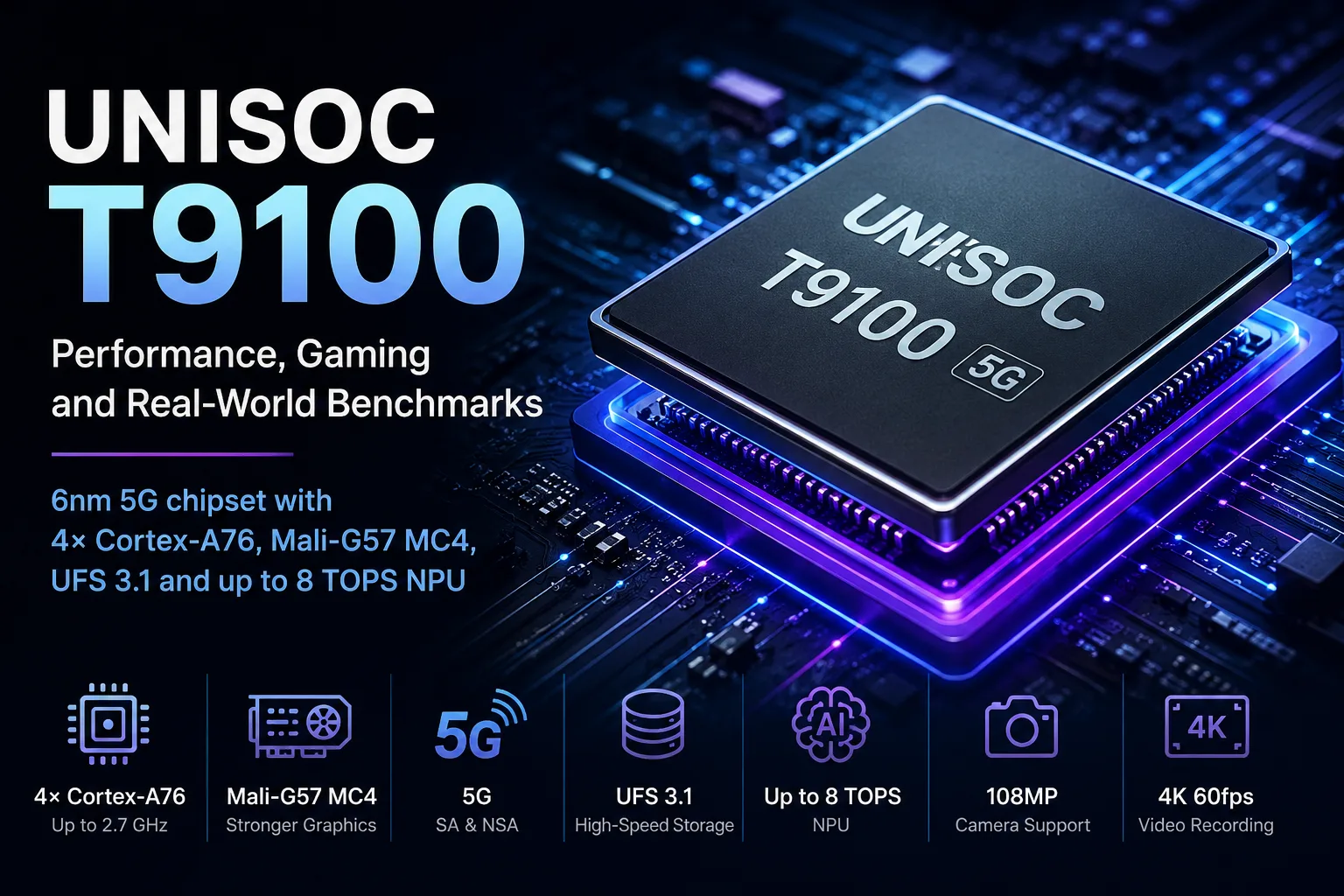
The Unisoc T9100 is a 6nm 5G platform featuring four Cortex-A76 cores and a Mali-G57 MC4 GPU, which differs significantly from most budget SoCs that typically have two performance cores. Despite the age of the Cortex-A76, the four fast cores give the T9100 an advantage over many solutions with the usual 2+6 core configuration. The setup is complemented by UFS 3.1 storage, 4K recording at 60 frames per second, and a dedicated NPU with a performance of up to 8 TOPS.
The most notable smartphone featuring the T9100 is the nubia Neo 3 GT 5G. Its results clearly demonstrate the chip’s position between budget-level solutions like the Helio G200 and faster platforms like the Dimensity 7300.
Unisoc T9100 vs. T8300, Dimensity 7300, and Helio G200
| Specification | Unisoc T9100 | Unisoc T8300 | Dimensity 7300 | Helio G200 |
|---|---|---|---|---|
| Process Technology | 6nm | 6nm | 4nm | 6nm |
| Performance Cores | 1× A76 2.7 GHz + 3× A76 2.3 GHz | 2× A78 2.2 GHz | 4× A78 up to 2.5 GHz | 2× A76 2.2 GHz |
| Efficiency Cores | 4× A55 2.1 GHz | 6× A55 2.0 GHz | 4× A55 | 6× A55 2.0 GHz |
| GPU | Mali-G57 MC4 | Mali-G57, 2 cores | Mali-G615 | Mali-G57 MC2 |
| 5G | Yes | Yes | Yes | No |
| Positioning | Budget / Lower Mid-range 5G | Budget 5G | Mid-range 5G | Budget 4G |
Instead of the usual two performance core configuration found in budget SoCs, the T9100 features four Cortex-A76 cores. One operates at a frequency of up to 2.7 GHz, while the other three operate at up to 2.3 GHz. This configuration enhances multicore performance compared to typical 2+6 configurations.
The Helio G200 has only two Cortex-A76 cores and a Mali-G57 MC2 GPU, which means it lags behind the T9100 in both CPU and GPU performance. Additionally, the T9100 supports 5G, while the Helio G200 is limited to 4G networks.
The Cortex-A78 cores in the T8300 allow it to slightly outperform the T9100 in single-threaded tests. However, its two performance cores limit its multicore performance, where the T9100 takes the lead.
The Dimensity 7300 represents the next level of performance. Four Cortex-A78 cores, a 4nm process, and a Mali-G615 GPU give it an advantage in both CPU and GPU performance.
T9100 in Real Devices: Geekbench 6
Cooling, memory, and firmware can impact SoC results, so below are scores from specific smartphones.
| Smartphone | Processor | Geekbench 6 Single | Geekbench 6 Multi |
|---|---|---|---|
| nubia Neo 3 GT 5G | Unisoc T9100 | ~873 | ~2447 |
| nubia Neo 3 5G | Unisoc T8300 | ~888 | ~2074 |
| vivo T4x 5G | Dimensity 7300 | ~992 | ~2781 |
| RugOne Xever 8 | Helio G200 | ~728 | ~1952 |
In Geekbench 6, the T9100 and T8300 are close in Single-Core scores, but in Multi-Core, the T9100 is significantly ahead due to its four Cortex-A76 cores. The Helio G200 falls short in both tests, while the Dimensity 7300 remains the leader of this group.
Results from specific devices may vary due to firmware, cooling, and power modes. The nubia Neo 3 GT also scores around 740,000 points in AnTuTu v11, but this result cannot be directly compared to AnTuTu v10 results.
Mali-G57 MC4: A Significant Step Up from Mali-G57 MC2
The T9100 utilizes Mali-G57 MC4, while the Helio G200 is limited to Mali-G57 MC2.
| Smartphone | Processor | GPU | 3DMark Steel Nomad Light |
|---|---|---|---|
| nubia Neo 3 GT 5G | Unisoc T9100 | Mali-G57 MC4 | 233 |
| vivo T4x 5G | Dimensity 7300 | Mali-G615 | ~331 |
| RugOne Xever 8 | Helio G200 | Mali-G57 MC2 | ~162 |
In terms of GPU performance, the T9100 occupies a middle position between the Helio G200 and Dimensity 7300. The doubling of the Mali-G57 cores compared to the G200 is evident in 3DMark scores, but there remains a significant gap to the Mali-G615 of the Dimensity 7300.
Gaming: What to Expect from the T9100
The T9100 supports FHD+ displays with refresh rates of up to 120 Hz and QHD+ at 60 Hz. However, a 120 Hz screen does not guarantee that the Mali-G57 MC4 can deliver 120 fps in heavy games.
In the nubia Neo 3 GT, performance heavily depends on the specific game. Free Fire can run at about 60 fps on high settings, Call of Duty Mobile around 40 fps on medium settings, and Diablo Immortal around 30 fps. In Genshin Impact, you can expect approximately 40-55 fps at moderate settings, although the frame rate varies with the scene and duration of load.
In competitive and relatively light games, the T9100 can maintain an acceptable frame rate, but heavy titles require reduced settings.
UFS 3.1 - A Key Advantage of the T9100
The support for UFS 3.1 is a notable distinction of the T9100 from many cheaper SoCs that still rely on eMMC. Fast storage speeds up app launches, game installations, and working with large files.
The memory controller works with LPDDR4X up to 2133 MHz and supports up to 32 GB of RAM. In addition to UFS 3.1, eMMC 5.1 is available. UFS 2.2 is not specified in the official specifications of the T9100.
Cameras and Video
The Vivimagic 6.0 ISP supports cameras with resolutions up to 108 MP. The SoC can encode and decode 4K video at 60 fps and also supports HDR10+, AI noise reduction, and AI-HDR.
The presence of a feature in the SoC does not mean that the smartphone manufacturer will necessarily implement it. For example, the nubia Neo 3 GT is built on the T9100, but it only records 4K video at a maximum of 30 fps.
5G, Wi-Fi, and Bluetooth
The modem supports 5G Sub-6 GHz in both SA and NSA modes, dual SIM functionality, and 5G standby. For LTE, it offers Cat.15 for download and Cat.18 for uploads.
Wi-Fi 5 and Bluetooth 5.0 are already outdated compared to the capabilities of more modern mid-range SoCs. The Dimensity 7300 provides a more up-to-date set of wireless features, while the T9100's advantage over the Helio G200 is full 5G support.
NPU and Hardware Security
The T9100 includes a dedicated NPU with a claimed performance of up to 8 TOPS. It also features iSE, Trusted Execution Environment (TEE), and a hardware encryption mechanism.
The actual set of AI and security features depends on the smartphone manufacturer and firmware.
Where the T9100 Stands Among Competitors
In overall performance, the T9100 ranks above the Helio G200 and is more interesting than the T8300 in heavy multicore and graphical workloads, but it is below the Dimensity 7300. The Helio G200 lags behind in both CPU and GPU performance and does not support 5G. The T8300 is closer in classification: the Cortex-A78 performs better in single-threaded tasks, while the combination of four Cortex-A76 cores and the Mali-G57 MC4 gives the T9100 an advantage in multicore tasks and graphics.
The Dimensity 7300 is noticeably faster in both areas, making it the upper limit for the T9100. As a result, the chip occupies a clear niche between budget platforms and full-fledged mid-range options.
For smartphones like the nubia Neo 3 GT, the T9100's strengths are its high multicore performance for this segment, the Mali-G57 MC4, UFS 3.1, and 5G support. Overall, it is significantly more attractive than the Helio G200, stronger than the T8300 in many workloads, but it falls short of the Dimensity 7300 level.
SOC Comparison
Compare T9100 with other SOCs
Basic
GPU Specifications
Connectivity
Memory Specifications
Miscellaneous
- AIFF
- CAF
- MP3
- MP4
- WAV
- H.265
- VP9
Benchmarks
Phones with T9100

Comparison of Devices with T9100
Compared to Other SoC
Related SoC Comparisons


Share in social media
Or Link To Us
<a href="https://cputronic.com/index.php/soc/unisoc-t9100" target="_blank">Unisoc T9100</a>