Qualcomm Snapdragon 6 Gen 1

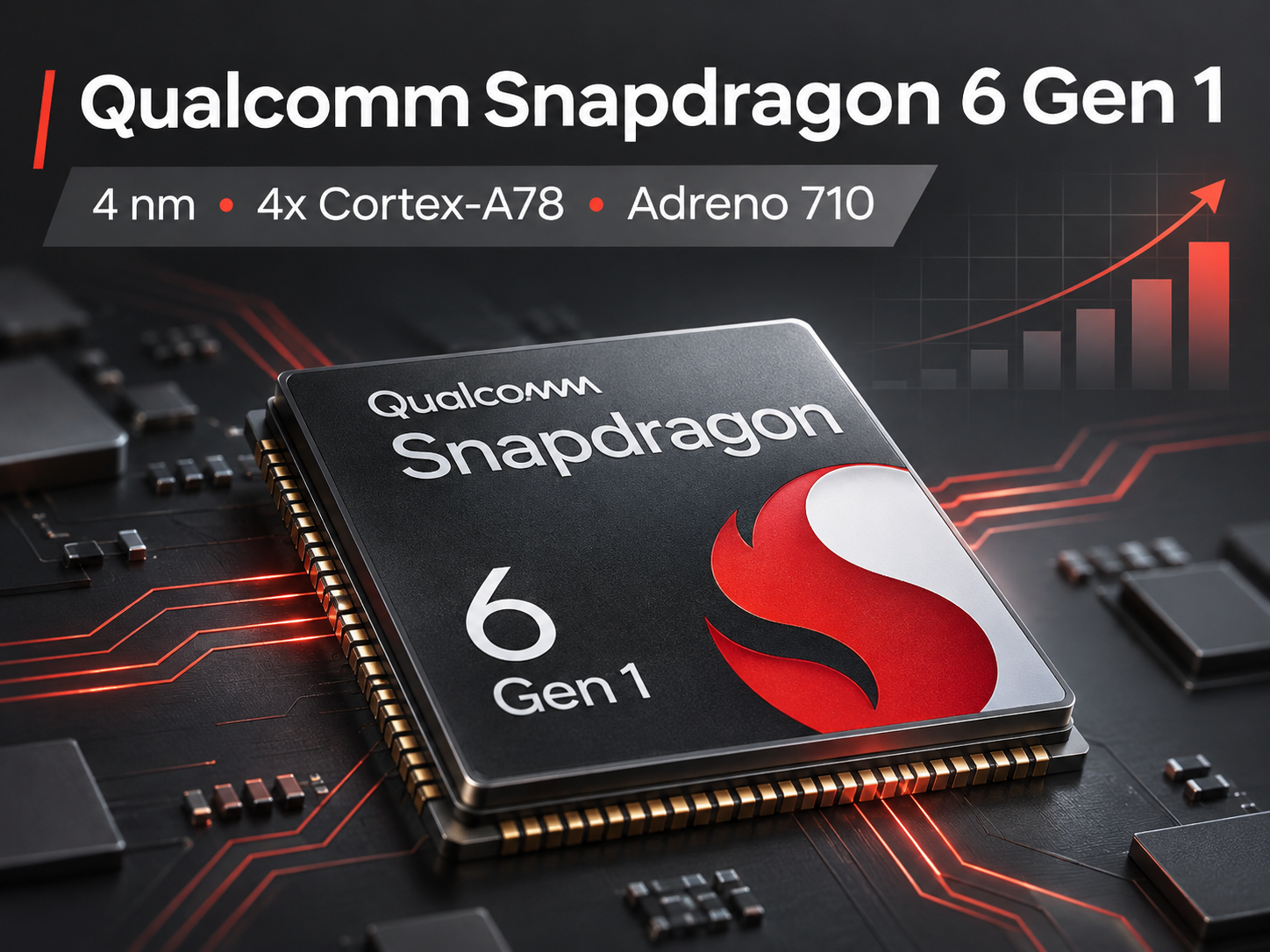
Qualcomm Snapdragon 6 Gen 1: Specifications, Performance, and Smartphone Benchmarks
Qualcomm Snapdragon 6 Gen 1 is an octa-core mid-range mobile processor introduced in September 2022. It is manufactured using a 4 nm process and combines four high-performance Cortex-A78 cores, four power-efficient Cortex-A55 cores, and an Adreno 710 graphics accelerator.
The chip is used in the Sony Xperia 10 VI, Honor Magic6 Lite, Honor Magic7 Lite, Realme 12 Pro, and other devices. Snapdragon 6 Gen 1 is noticeably faster than Snapdragon 695 in multi-threaded workloads and graphics tests, but it falls behind more powerful mid-range solutions.
Architecture and Specifications
Snapdragon 6 Gen 1 uses two CPU core clusters:
- 4 × Cortex-A78 up to 2.2 GHz - handle resource-intensive tasks and provide most of the computing performance.
- 4 × Cortex-A55 up to 1.8 GHz - handle background processes and lightly loaded tasks.
The Snapdragon 695 has only two high-performance Cortex-A78 cores. Increasing their number to four allows Snapdragon 6 Gen 1 to handle multi-threaded workloads more efficiently. At the same time, the two chips differ only slightly in single-core performance.
Graphics are handled by the Adreno 710, with support for Vulkan 1.1 and OpenGL ES 3.2. The memory controller supports LPDDR5, while the storage subsystem supports UFS 2.2 and UFS 3.1. The specific memory and storage types depend on the device manufacturer.
The processor is manufactured using a 4 nm process. Its actual power consumption and frequency stability under sustained loads depend on the smartphone's power settings and cooling system.
Benchmark Performance
In Geekbench 6, Snapdragon 6 Gen 1 scores around 930-950 points in the single-core test and 2700-2900 points in the multi-core test. AnTuTu 10 results vary more significantly because the test measures CPU, GPU, memory, and user interface performance.
The table shows measurements from four devices with 8 GB of RAM. Geekbench version 6.7.1 was used.
| Device | Geekbench 6 Single | Geekbench 6 Multi | AnTuTu 10 |
|---|---|---|---|
| Sony Xperia 10 VI | 948 | 2896 | 564 247 |
| Honor Magic6 Lite | 940 | 2776 | 504 020 |
| Honor Magic7 Lite | 940 | 2772 | 579 582 |
| Honor Pad 9 | 944 | 2773 | 490 448 |
Single-core performance is virtually identical across all four devices: the difference between the lowest and highest results is less than 1%.
In the Geekbench 6 multi-core test, the Sony Xperia 10 VI is approximately 4.5% faster than the Honor Magic7 Lite. The differences may be related to power-consumption settings, thermal conditions, and software.
The spread is more noticeable in AnTuTu 10: the Honor Magic7 Lite scores almost 580,000 points, while the Honor Pad 9 scores around 490,000. The difference is 18%. This reflects device performance in a comprehensive test rather than the speed of the processor cores alone.
Comparison with Snapdragon 695 and Exynos 1480
The comparison uses results from smartphones powered by Snapdragon 695 and Exynos 1480. The second table is based on a different series of measurements, so the Sony Xperia 10 VI and Honor Magic7 Lite results differ slightly from those shown above.
| Smartphone | Processor | Geekbench 6 Single | Geekbench 6 Multi | 3DMark Wild Life Extreme |
|---|---|---|---|---|
| Sony Xperia 10 VI | Snapdragon 6 Gen 1 | 939 | 2827 | 615 |
| Honor Magic7 Lite | Snapdragon 6 Gen 1 | 931 | 2763 | 613 |
| OnePlus Nord CE 4 Lite | Snapdragon 695 | 903 | 1977 | 397 |
| Samsung Galaxy A55 5G | Exynos 1480 | 1138 | 3444 | 991 |
Compared with the OnePlus Nord CE 4 Lite powered by Snapdragon 695, the Sony Xperia 10 VI delivers:
- A 4% higher result in Geekbench 6 Single-Core.
- A 43% higher result in Geekbench 6 Multi-Core.
- A 55% higher result in 3DMark Wild Life Extreme.
Both processors use high-performance Cortex-A78 cores, which is why their single-core results are close. In the multi-threaded test, Snapdragon 6 Gen 1 has a significantly larger advantage thanks to its four high-performance cores instead of two. The Adreno 710 graphics accelerator is also noticeably faster than the Adreno 619 used in Snapdragon 695.
The Exynos 1480 in the Samsung Galaxy A55 5G is faster than Snapdragon 6 Gen 1. Compared with the Xperia 10 VI, its advantage is approximately 21% in Geekbench 6 Single-Core, 22% in Multi-Core, and 61% in Wild Life Extreme.
Thus, Snapdragon 6 Gen 1 occupies an intermediate position between Snapdragon 695 and more powerful mid-range platforms.
Adreno 710 Graphics and Gaming
The Adreno 710 provides sufficient graphics performance for less demanding mobile games. In titles with complex 3D graphics, the accelerator's capabilities limit the choice of image-quality settings.
In 3DMark Wild Life Extreme, the Sony Xperia 10 VI scores 615 points, while the Honor Magic7 Lite scores 613. The difference of less than 1% indicates virtually identical GPU performance in this test.
In demanding games, lowering the graphics settings may be necessary to improve FPS stability. However, 3DMark results do not make it possible to determine FPS precisely in specific games: it is affected by rendering resolution, the graphics preset, and application optimization.
Sustained gaming workloads also differ from short benchmark runs. As the device heats up, CPU and GPU frequencies may decrease, so two smartphones with the same processor do not necessarily provide the same FPS stability.
Cameras, Displays, and Multimedia
Snapdragon 6 Gen 1 is equipped with a triple 12-bit Qualcomm Spectra image signal processor (ISP). The platform supports cameras with resolutions of up to 200 MP and 4K video recording at 30 frames per second.
The ISP can process data from multiple cameras simultaneously and perform hardware-accelerated operations related to HDR. AI workloads are handled by the Qualcomm AI Engine with a Hexagon processor, which can be used for image processing and object recognition.
The maximum camera resolution and video-recording capabilities are not necessarily implemented in every smartphone. Final photo quality depends on the sensor, optics, and processing algorithms.
The platform supports Full HD+ displays with refresh rates of up to 120 Hz. However, the actual display refresh rate and available display modes are determined by the specifications of the particular device.
Connectivity and Power Consumption
Snapdragon 6 Gen 1 is equipped with a Snapdragon X62 5G modem with a maximum advertised download speed of up to 2.9 Gbit/s. The platform supports sub-6 GHz and mmWave bands, but their availability depends on the modem implementation, antennas, and the regional version of the smartphone.
The FastConnect 6700 wireless subsystem supports Wi-Fi 6E and Bluetooth 5.2. Navigation support includes GPS, Galileo, GLONASS, BeiDou, and other satellite systems, including dual-frequency L1/L5 reception.
Qualcomm Quick Charge 4+ is also supported, but the charging power and technology used in the finished device may differ.
Under light loads, tasks are handled primarily by the power-efficient Cortex-A55 cores. More demanding applications use the Cortex-A78 cores, which provide additional computing power.
The battery life of smartphones with Snapdragon 6 Gen 1 depends on battery capacity, the display, cellular signal quality, and software settings. Comparing device battery life based solely on the processor model is not accurate.
Conclusion
Qualcomm Snapdragon 6 Gen 1 is suitable for everyday tasks such as web browsing, navigation, video calls, video playback, and multitasking.
Compared with Snapdragon 695, it delivers significantly higher multi-threaded and graphics performance. In the tested smartphones, the advantage is approximately 43% in Geekbench 6 Multi-Core and 55% in 3DMark Wild Life Extreme.
The main limitation is the Adreno 710's performance in demanding games. More powerful platforms, including Exynos 1480, deliver noticeably better graphics benchmark results.
Snapdragon 6 Gen 1 is suitable for smartphones focused on everyday tasks, but at a similar price, devices with a more powerful GPU will be preferable for gaming.
SOC Comparison
Compare Snapdragon 6 Gen 1 with other SOCs
Basic
4x 1.8 GHz – Cortex-A55
GPU Specifications
Connectivity
Memory Specifications
Miscellaneous
Benchmarks
Phones with Snapdragon 6 Gen 1




















Tablets with Snapdragon 6 Gen 1


Comparison of Devices with Snapdragon 6 Gen 1
Compared to Other SoC
Related SoC Comparisons





Share in social media
Or Link To Us
<a href="https://cputronic.com/index.php/soc/qualcomm-snapdragon-6-gen-1" target="_blank">Qualcomm Snapdragon 6 Gen 1</a>