MediaTek Helio G100

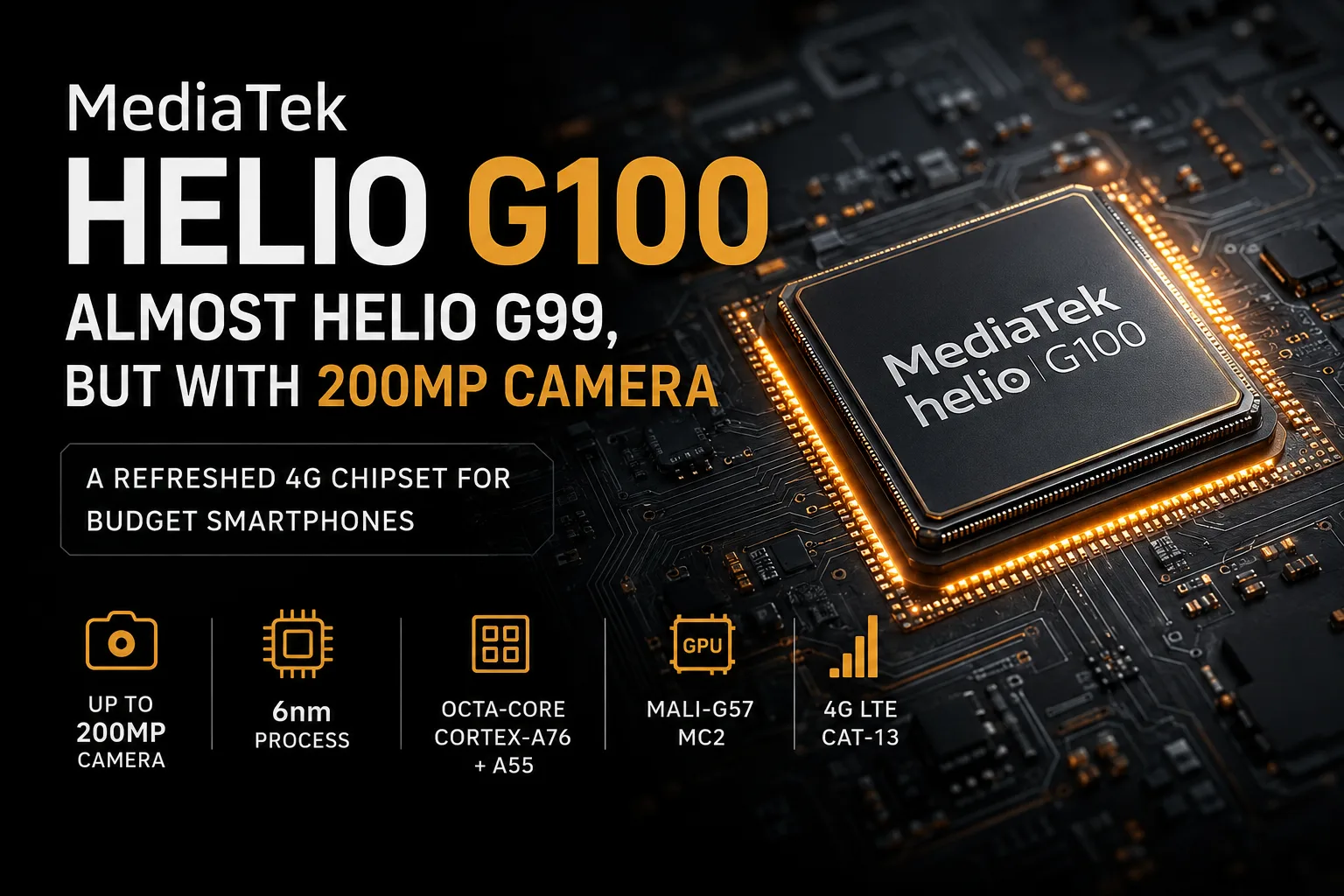
MediaTek Helio G100: almost Helio G99, but with a camera up to 200 MP
The Helio G100 appears to be a new chip in MediaTek's lineup, but the intrigue quickly fades: in terms of hardware, it is almost identical to the Helio G99. This is not a new generation or a performance upgrade, but an improved 4G platform for budget smartphones and tablets.
The main difference is support for cameras up to 200 MP instead of 108 MP with the Helio G99. The CPU, GPU, process technology, and memory remain nearly the same. Therefore, the Helio G100 should be seen as an updated version of the G99 rather than a step into another class.
What's inside the Helio G100
The Helio G100 is manufactured using TSMC's 6nm process. For the budget 4G segment, this is still a successful base: the chip is more efficient than the older 12nm Helio G80/G85 and generally does not create serious heating issues in normal tasks.
The CPU consists of eight cores:
- 2x Cortex-A76 up to 2.2 GHz
- 6x Cortex-A55 up to 2.0 GHz
The graphics are handled by a Mali-G57 MC2. It is sufficient for interfaces, browsers, YouTube, messengers, and simple games. However, it is a weak point for heavy 3D games.
It also supports LPDDR4X up to 4266 Mbps, UFS 2.2, Full HD+ displays up to 120 Hz, Wi-Fi 5, Bluetooth 5.2, and LTE Cat-13.
How Helio G100 differs from Helio G99
When comparing the Helio G100 with the Helio G99, the difference is minimal. It belongs to the same class of chip, has the same CPU configuration, the same GPU, and the same 6nm process technology.
| Chip | Process Tech | CPU | GPU | Camera |
|---|---|---|---|---|
| Helio G96 | 12nm | 2x Cortex-A76 + 6x Cortex-A55 | Mali-G57 MC2 | up to 108 MP |
| Helio G99 | 6nm | 2x Cortex-A76 + 6x Cortex-A55 | Mali-G57 MC2 | up to 108 MP |
| Helio G100 | 6nm | 2x Cortex-A76 + 6x Cortex-A55 | Mali-G57 MC2 | up to 200 MP |
The main hardware difference is the ISP, which allows for cameras up to 200 MP. For manufacturers, this is a convenient way to launch a budget smartphone with an impressive camera specification without transitioning to a more expensive 5G platform.
Another distinction is the Elevator Mode. This feature helps to reconnect faster after exiting an elevator, tunnel, underground passage, or other areas with poor reception. Users may not see increased speeds, but a network that returns faster after an elevator or tunnel is a tangible everyday improvement.
Thus, the Helio G100 is more accurately referred to as Helio G99 with an updated ISP and minor software improvements. For owners of smartphones with Helio G99, transitioning to Helio G100 for speed does not make much sense.
Performance
For browsing, social media, messengers, YouTube, maps, and banking applications, the performance of the Helio G100 is sufficient. The two Cortex-A76 cores still provide acceptable responsiveness, especially if the manufacturer has not skimped on memory and storage.
In Geekbench 6, the results are approximately as follows:
| Chip | Single-Core | Multi-Core |
|---|---|---|
| Helio G100 | around 730 | around 2000 |
| Helio G99 | around 730 | around 2000 |
| Snapdragon 680 | around 410 | around 1450 |
Compared to the Snapdragon 680, the Helio G100 is noticeably faster. However, alongside contemporary mid-range 5G chips, it does not appear strong anymore. This is a normal level for a budget 4G smartphone, with no reserve for heavy tasks.
In AnTuTu v10, devices featuring Helio G100 typically score around 420-440 thousand points. The variation depends on memory, cooling, firmware, and specific device models. The difference from Helio G99 is minimal and nearly imperceptible in real-world usage.
Gaming
The Helio G100 is suitable for light to moderate gaming. PUBG Mobile, Call of Duty Mobile, Mobile Legends, Asphalt 9, and similar titles will run well if maximum graphics settings are not used.
Heavy games, such as Genshin Impact or Once Human, should be regarded as formally runnable on the Helio G100 rather than comfortable. Even at low settings, frame drops may occur, especially after several minutes of taxing gameplay. The cooling of a specific smartphone can slightly influence stability, but it does not change the overall class of the chip.
The Helio G100 is designed for casual gaming and popular online projects, not for purchasing a smartphone "for gaming."
Battery Life
The main advantage of the Helio G100 over the old 12nm Helio chips is not speed but lower heat generation and more stable battery life. In typical scenarios such as messaging, browsing, video, music, and navigation, the 6nm process helps keep energy consumption under control.
In smartphones with a battery around 5000 mAh, one can expect a full day of active use. With moderate load, one and a half to two days is achievable. However, precise results depend not only on the chip: the screen, firmware, battery capacity, and manufacturer settings are crucial.
No significant gains are anticipated compared to the Helio G99. These chips are too similar in hardware.
Devices with Helio G100
The Helio G100 is being placed in budget smartphones and tablets. Some examples include:
- Tecno Camon 30S Pro
- Infinix Hot 50
- Tecno Spark 30 Pro
- Tecno Spark 40 Pro
- OPPO A6 Pro
- Blackview Mega 3
- Redmi Pad 2 in the Helio G100-Ultra version
The names Ultimate and Ultra should not be interpreted as separate new chips. There are no publicly noticeable major hardware differences from the standard Helio G100. These are often OEM markings for specific devices, configurations, or markets.
Conclusion
The MediaTek Helio G100 is basically a Helio G99 with support for 200 MP cameras and minor software improvements. The CPU and GPU remain at the same level, so no speed increase should be expected.
For owners of smartphones with Helio G99, there is no reason to upgrade. For a new budget smartphone or tablet, the Helio G100 may be a reasonable choice if the device's price is appropriate.
The Helio G100 should be chosen not for performance but as a reliable 6nm foundation for a simple 4G smartphone. For gaming, 5G, and future-proofing, it is better to look at more recent Dimensity or Snapdragon chips one class higher.
SOC Comparison
Compare Helio G100 with other SOCs
Basic
GPU Specifications
Connectivity
Memory Specifications
Miscellaneous
Benchmarks
Phones with Helio G100





Tablets with Helio G100

Comparison of Devices with Helio G100
Compared to Other SoC
Related SoC Comparisons




Share in social media
Or Link To Us
<a href="https://cputronic.com/index.php/soc/mediatek-helio-g100" target="_blank">MediaTek Helio G100</a>