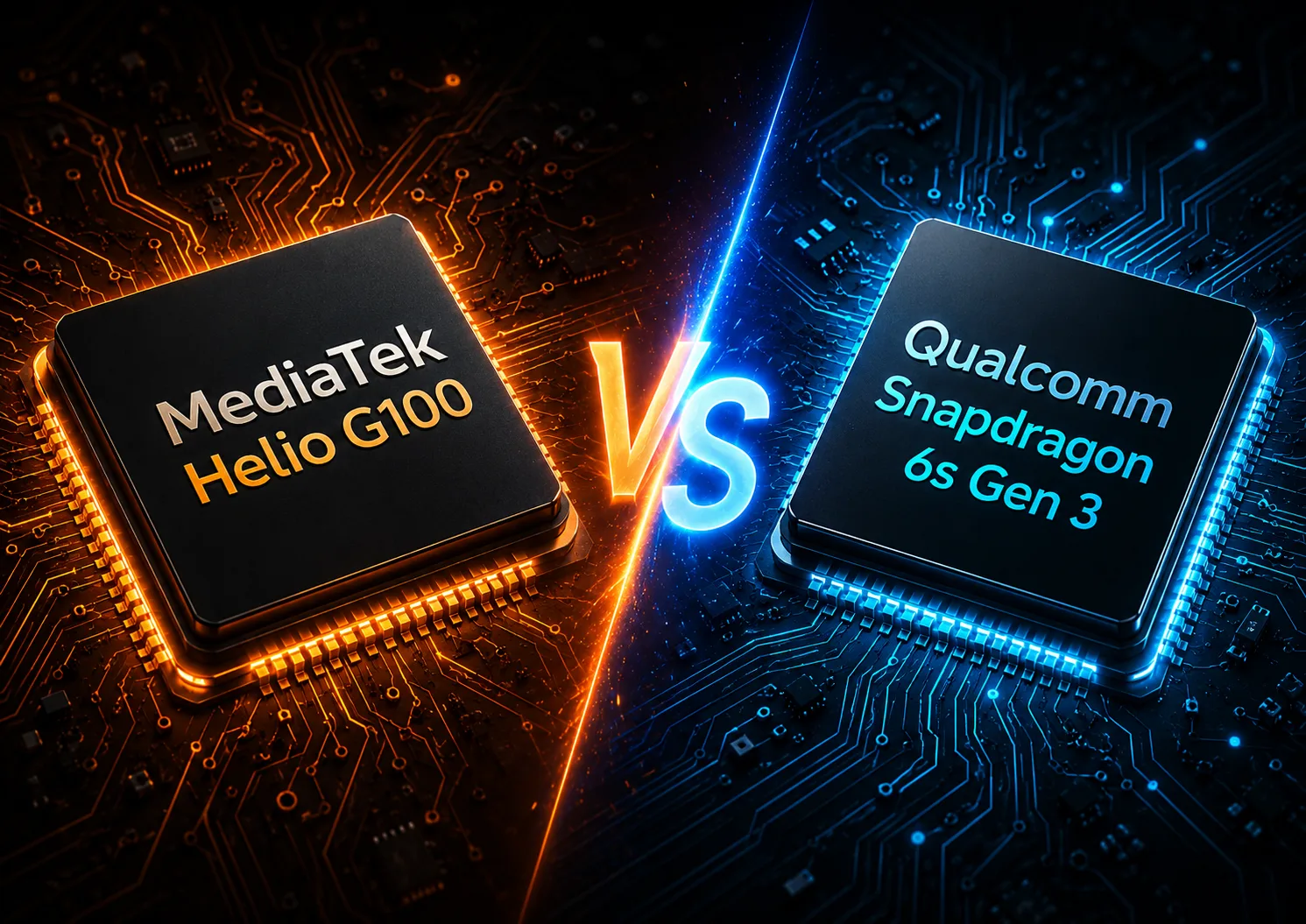
MediaTek Helio G100
vs
Qualcomm Snapdragon 6s Gen 3
SoC Comparison Result
MediaTek Helio G100 vs Qualcomm Snapdragon 6s Gen 3: 4G practicality vs budget 5G
MediaTek Helio G100 and Qualcomm Snapdragon 6s Gen 3 are closely matched platforms for budget smartphones, but with different focuses. The Helio G100 is designed for affordable 4G models with good battery life, screens up to 120 Hz, and camera support of up to 200 MP. The Snapdragon 6s Gen 3 bets on 5G, newer Cortex-A78 performance cores, and Adreno 619 graphics, but overall power is not a huge leap forward, rather a moderate advantage.
Key Difference
| Characteristic | MediaTek Helio G100 | Qualcomm Snapdragon 6s Gen 3 |
|---|---|---|
| Class | affordable 4G smartphones | affordable 5G smartphones |
| Process Technology | 6 nm TSMC | 6 nm |
| CPU | 2x Cortex-A76 + 6x Cortex-A55 | 2x Cortex-A78 + 6x Cortex-A55 |
| Maximum Frequency | up to 2.2 GHz | up to 2.3 GHz |
| GPU | Mali-G57 MC2 | Adreno 619 |
| Memory | LPDDR4X | LPDDR4X |
| Storage | UFS 2.2 | UFS 2.2 |
| Connectivity | 4G LTE Cat-13 | 5G, Snapdragon X51 |
| Wi-Fi | Wi-Fi 5 | FastConnect 6200; in real models often Wi-Fi 5 |
| Camera | up to 200 MP | up to 108 MP |
| Video | up to 2K 30 FPS | up to 1080p 60 FPS |
| Screen | FHD+ up to 120 Hz | FHD+ up to 120 Hz |
The main difference is not in the process technology, memory, or storage: these platforms are very similar here. The Snapdragon 6s Gen 3 wins due to 5G, newer Cortex-A78 cores, and slightly stronger graphics. The Helio G100 looks better in terms of declared camera and video recording capabilities: up to 200 MP and 2K 30 FPS versus 108 MP and 1080p 60 FPS on the Snapdragon.
Smartphone Examples
For MediaTek Helio G100, examples include Tecno Spark 30 Pro and Infinix Hot 50 Pro+. This clearly shows the positioning of the chip: affordable 4G smartphones focused on display, battery life, camera, and price. Infinix officially lists Helio G100 for the Hot 50 Pro+, and third-party databases also indicate Helio G100 for the Tecno Spark 30 Pro.
Snapdragon 6s Gen 3 is found in models like Motorola Moto G85 5G, Motorola Moto G45 5G, and Redmi 15 5G. This follows a different logic: to provide a budget smartphone with 5G support without transitioning to the more expensive Snapdragon 6 Gen 3 or Snapdragon 7 series. Motorola officially lists Snapdragon 6s Gen 3 for Moto G85 5G and Moto G45 5G, while Xiaomi lists it for Redmi 15 5G.
CPU Performance
Snapdragon 6s Gen 3 features two performance Cortex-A78 cores up to 2.3 GHz and six Cortex-A55 cores up to 2.0 GHz. The Helio G100 has two Cortex-A76 cores up to 2.2 GHz and six Cortex-A55 cores up to 2.0 GHz. Therefore, the Snapdragon generally excels in single-thread performance: Cortex-A78 is newer and faster than Cortex-A76. However, in multi-threaded workloads, the gap is small since both chips have only two performance cores and six energy-efficient cores.
For a more concrete comparison, we can take real devices: Tecno Spark 30 Pro with Helio G100 and Motorola Moto G85 5G with Snapdragon 6s Gen 3.
| Benchmark | Tecno Spark 30 Pro / Helio G100 | Motorola Moto G85 5G / Snapdragon 6s Gen 3 | Difference |
|---|---|---|---|
| Geekbench 6 Single-Core | 733 | 938 | Snapdragon is about 28% faster |
| Geekbench 6 Multi-Core | 2028 | 2013 | almost the same |
| AnTuTu 11 | 542331 | 622608 | Snapdragon is about 15% faster |
| AnTuTu 11 GPU | 47983 | 60025 | Snapdragon is about 25% faster |
These figures should not be taken as absolute differences between all smartphones using these processors. One should be especially cautious when comparing AnTuTu: the final score highly depends on memory, cooling, firmware, and version of the test. However, the overall conclusion is clear: Snapdragon 6s Gen 3 is noticeably better in single-core performance and slightly faster in overall system performance, while the multi-core advantage may be almost negligible.
Graphics and Gaming
In graphics, Snapdragon 6s Gen 3 generally leads. Adreno 619 is more powerful than Mali-G57 MC2 in Helio G100, although the difference is not as significant as comparing Helio G100 with the regular Snapdragon 6 Gen 3. Based on AnTuTu GPU, the advantage of Snapdragon 6s Gen 3 over Tecno Spark 30 Pro and Moto G85 5G amounts to about a quarter.
In practice, Helio G100 is well-suited for casual games, MOBA, simple shooters, and less demanding projects. Snapdragon 6s Gen 3 will provide a bit more headroom and stability, but it is also not a high-end gaming chip. In demanding games, both processors are more likely to require low or medium settings.
Connectivity and Wireless Features
The most obvious advantage of Snapdragon 6s Gen 3 is its 5G support. The platform utilizes the Snapdragon X51 modem with a claimed download speed of up to 2.5 Gbps in 5G, while Helio G100 is limited to 4G LTE Cat-13.
The situation with Wi-Fi is more nuanced. Snapdragon 6s Gen 3 has FastConnect 6200, but in real smartphones on this platform, Wi-Fi 802.11ac, i.e., Wi-Fi 5, is often cited. For instance, both Moto G85 5G and Moto G45 5G are officially stated to support Wi-Fi 802.11 a/b/g/n/ac. Therefore, it’s better not to present Wi-Fi as a major advantage for Snapdragon 6s Gen 3: the main difference here lies in 5G, rather than in home wireless networks.
Cameras and Multimedia
In terms of cameras, Helio G100 appears more interesting at the platform limitations level. It supports cameras up to 200 MP and video recording up to 2K 30 FPS, FHD 60 FPS, and HD 120 FPS. Snapdragon 6s Gen 3 supports photography up to 108 MP and video recording up to 1080p 60 FPS.
This does not mean that any smartphone with Helio G100 will take better photos. The quality of the photos depends on the sensor, optics, stabilization, and algorithms from the manufacturer. However, when comparing the capabilities of the platforms, Helio G100 looks stronger here: it has a higher ceiling in camera resolution and video recording.
Battery Life and Heating
Both processors are manufactured using a 6 nm process, both use six energy-efficient Cortex-A55 cores, and are both aimed at budget smartphones. Therefore, it’s hard to name a clear winner in battery life: the outcome will depend on the battery, display, firmware, and settings of the specific device.
Helio G100 may appear advantageous in 4G smartphones, where there is no additional load from the 5G modem. Snapdragon 6s Gen 3 could be faster in short tasks due to Cortex-A78, but during active 5G use, energy consumption will depend on network quality and signal strength.
What to Choose
Choose MediaTek Helio G100 if you need an affordable 4G smartphone with good battery life, 120 Hz display, decent speed for everyday tasks, and potentially more interesting camera capabilities. It is sufficient for messaging, browsing, YouTube, navigation, and casual gaming.
Choose Qualcomm Snapdragon 6s Gen 3 if 5G is important, and you need slightly higher overall performance, better graphics, and faster single-core. However, do not confuse it with the regular Snapdragon 6 Gen 3: the 6s Gen 3 version is noticeably simpler and closer to the budget 5G segment.
Conclusion
MediaTek Helio G100 and Qualcomm Snapdragon 6s Gen 3 are closely matched platforms but with different priorities. Helio G100 is better suited for affordable 4G smartphones, where price, battery life, camera, and everyday stability are important. Snapdragon 6s Gen 3 is more interesting if you need a budget smartphone with 5G, slightly better graphics, and faster responses in single-threaded tasks.
If 5G is not critical, paying extra for Snapdragon 6s Gen 3 is not always justified: performance gains are moderate, and in multi-core scenarios the difference may be almost imperceptible. But if the smartphone will be purchased for several years and 5G is already in use in your area, Snapdragon 6s Gen 3 would be the more future-proof choice.
Advantages
- Newer Launch Date: August 2024 (August 2024 vs June 2024)
- Higher Frequency: 2300 MHz (2200 MHz vs 2300 MHz)
Basic
6x 2 GHz – Cortex-A55
GPU Specifications
Connectivity
Memory Specifications
Miscellaneous
Benchmarks
Related SoC Comparisons


Share in social media
Or Link To Us
<a href="https://cputronic.com/index.php/soc/compare/mediatek-helio-g100-vs-qualcomm-snapdragon-6s-gen-3" target="_blank">MediaTek Helio G100 vs Qualcomm Snapdragon 6s Gen 3</a>