Qualcomm Snapdragon 8 Gen 4

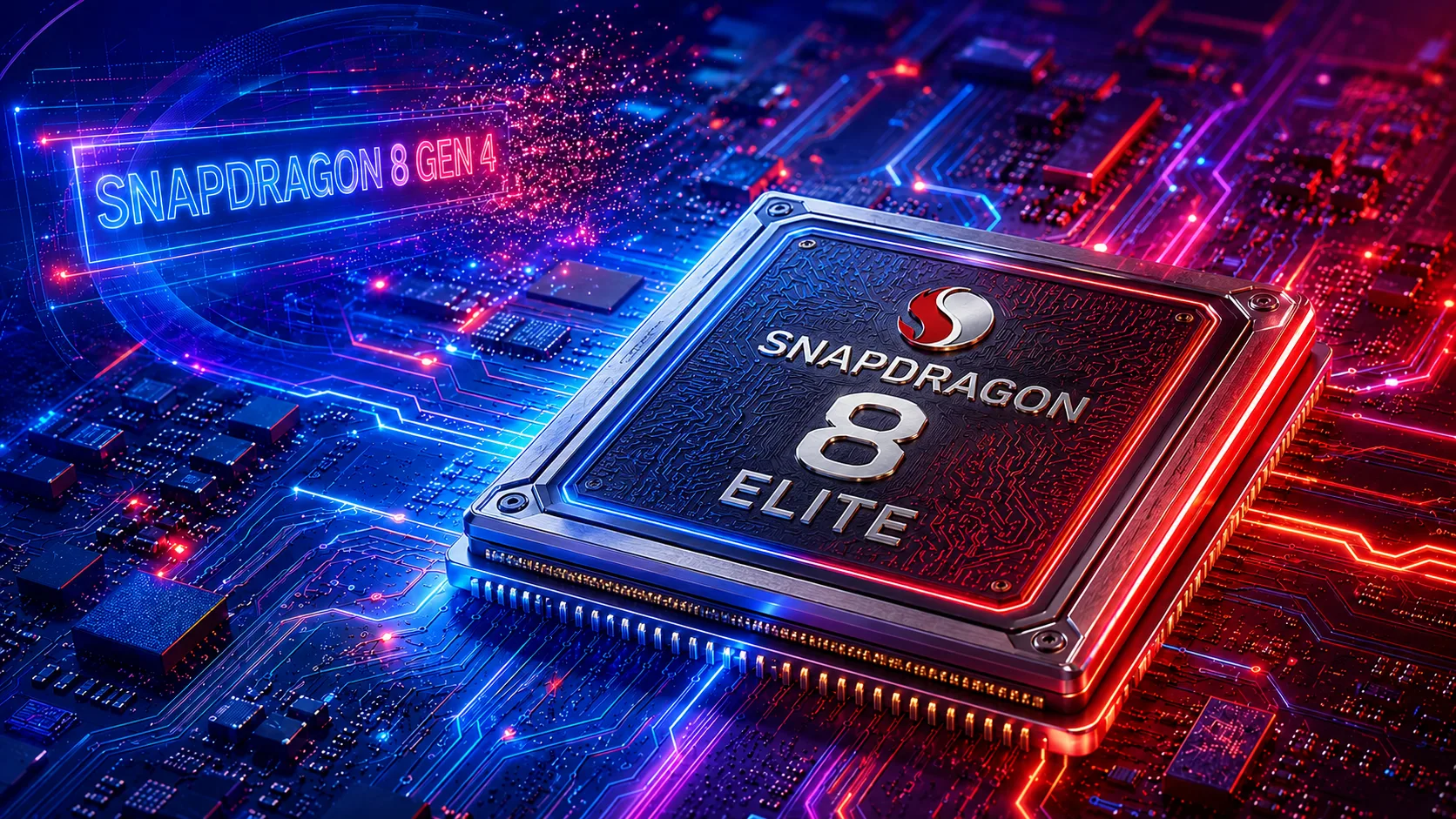
Snapdragon 8 Gen 4 Didn't Launch: How Snapdragon 8 Elite Replaced Cortex with Oryon
Prior to the official announcement, leaks and industry media referred to Qualcomm's upcoming flagship as Snapdragon 8 Gen 4. However, on October 21, 2024, the company unveiled it as Snapdragon 8 Elite. Both names refer to the SM8750 - Qualcomm's first smartphone chip with Oryon cores.
The renaming coincided with an architectural shift: instead of Cortex, the chip features its own Oryon cores. Oryon has increased peak CPU performance, but sustained speeds still depend on the power and cooling limits of the smartphone.
Why the Snapdragon 8 Gen 4 Name Disappeared
The Elite designation linked the mobile chip to the notebook line of Snapdragon X Elite, emphasizing the transition to proprietary CPU architecture.
Configurations with Cortex-X5 and Cortex-A730, seen in earlier descriptions, do not apply to the production chip. Snapdragon 8 Elite has harnessed the second generation of Qualcomm Oryon and became the first mobile platform from the company with this architecture.
Hidden Context of the Lineup
| Platform | Year | Processor Cores | What Changed |
|---|---|---|---|
| Snapdragon 8 Gen 1 | 2021 | Kryo based on Arm Cortex | Beginning of the Gen naming scheme |
| Snapdragon 8 Gen 2 | 2022 | Kryo based on Arm Cortex | New cluster configuration |
| Snapdragon 8 Gen 3 | 2023 | Kryo based on Arm Cortex | Last flagship series with Cortex |
| Snapdragon 8 Elite | 2024 | Qualcomm Oryon, 2nd generation | Initially referred to as 8 Gen 4 |
| Snapdragon 8 Elite (7 cores) | 2025 | 2 Oryon Prime cores + 5 performance cores | Later version SM8750-3-AB |
| Snapdragon 8 Elite Gen 5 | 2025 | Qualcomm Oryon, 3rd generation | Evolution of the Elite branch |
Oryon Without Separate Small-Core Cluster
The octa-core version of Snapdragon 8 Elite combines two Prime cores up to 4.32 GHz with six performance cores up to 3.53 GHz. There is no separate cluster of compact energy-efficient cores. Under light load, the scheduler lowers frequencies and offloads suitable tasks to specialized SoC blocks.
The Snapdragon 8 Elite for Galaxy in Samsung phones boosts the two Prime cores' frequency to 4.47 GHz. This is a separate version of the chip, thus the 4.47 GHz frequency does not apply to the regular SM8750 in OnePlus 13 and Xiaomi 15 Ultra.
Later, a seven-core modification SM8750-3-AB appeared: two Prime cores up to 4.32 GHz and five performance cores up to 3.53 GHz. The seven-core SM8750-3-AB is a standalone modification, not a configuration of the first flagships of 2024.
Qualcomm claimed CPU performance gains of up to 45% and energy efficiency improvements of up to 44% compared to Snapdragon 8 Gen 3. These figures are obtained under controlled manufacturer conditions. Real results depend on power limits, chassis temperature, firmware, and RAM capacity.
Examples of Results in Commercial Smartphones
The table below provides one public run of Geekbench 6.4. These are benchmarks, not average results for each model.
| Smartphone | Platform Version | Geekbench 6.4 Single-Core | Geekbench 6.4 Multi-Core |
|---|---|---|---|
| OnePlus 13 | Snapdragon 8 Elite, up to 4.32 GHz | 2,814 | 8,961 |
| Xiaomi 15 Ultra | Snapdragon 8 Elite, up to 4.32 GHz | 2,986 | 9,068 |
| Samsung Galaxy S25 Ultra | Snapdragon 8 Elite for Galaxy, up to 4.47 GHz | 3,110 | 9,769 |
The differences between devices illustrate why there is no single "correct" result for mobile SoCs. A short test reflects peak speeds, while prolonged rendering, video processing, or gaming sessions are more heavily dependent on cooling. The higher frequency of the Galaxy version aids in short CPU loads, but does not guarantee superiority during prolonged operation.
Adreno 830: High Peak and Variable Stability in Smartphones
Qualcomm describes the new Adreno architecture as a set of individual graphics sections. According to the company, performance and energy efficiency gains reached 40% compared to Adreno in Snapdragon 8 Gen 3. The platform supports Vulkan 1.3, OpenGL ES 3.2, OpenCL 3.0 FP, and hardware ray tracing.
The graphics block also supports Nanite from Unreal Engine 5.3, Snapdragon Game Super Resolution, and intermediate frame generation via the Adreno Frame Motion Engine. The utilization of these features depends on the engine, developer, and specific smartphone driver.
Median results from UL Solutions show how differently Adreno 830 performs in commercial smartphones. Values are updated as new tests emerge. These figures characterize specific models rather than establishing a single benchmark result for the SoC.
| Smartphone | 3DMark Wild Life Extreme | Graphics Test, FPS | Stability |
|---|---|---|---|
| OnePlus 13 | 6,241 | 37 | 84% |
| Xiaomi 15 Ultra | 5,626 | 33 | 85% |
| Samsung Galaxy S25 Ultra | 5,827 | 34 | 56% |
The Galaxy S25 Ultra is close to competitors in a single result but significantly drops speed in extended testing. The Galaxy version did not lead in graphics testing, and its stability was notably lower. Under prolonged loads, the result is more dependent on cooling and power limits.
NPU: Real Support Matters More Than the TOPS Figure
The Hexagon NPU supports multimodal models that process text, image, and sound directly on the device. It supports INT4, INT8, INT16, and FP16 computations, and Hexagon Direct Link speeds up data exchange between the NPU and the camera path.
The manufacturer claimed a speed increase for the NPU of up to 45% and a similar improvement in performance per watt compared to the previous generation. Qualcomm does not publish a unified TOPS metric for this platform, so the 60 TOPS figure cannot be used as a confirmed specification. The set of local AI functions depends on firmware, available neural network models, and application support.
Camera: ISP and NPU Collaboration
The triple 18-bit ISP Spectra processes data from multiple cameras and utilizes the NPU for semantic image segmentation. The platform can recognize and separately correct numerous areas of the image, as well as support noise reduction and video segmentation in 4K at 60 frames per second.
The ISP supports photography at resolutions up to 320 MP and 4K video recording at up to 120 frames per second. The 8K mode at 60 frames per second in the documentation refers to playback, not recording. Available modes depend on the sensors, cooling, and storage bandwidth of the specific smartphone.
Connectivity: X80 Instead of X75
The Snapdragon 8 Elite includes the Snapdragon X80 modem with a claimed download speed of up to 10 Gbps and upload speed of up to 3.5 Gbps. Practical speeds depend on the network, available frequency bands, and the smartphone's antenna system.
FastConnect 7900 combines Wi-Fi 7, Bluetooth 6.0, and UWB. Satellite communication support is also built into the platform level, but its implementation depends on antennas, operators, and device manufacturers.
Conclusion
Snapdragon 8 Elite marked Qualcomm's transition from Cortex to Oryon in smartphones. High peak results are accompanied by significant differences among commercial devices, especially under prolonged graphics load.
After the release of Snapdragon 8 Elite Gen 5, the SM8750 platform ceased to be the relevant flagship but retained sufficient performance headroom for heavy gaming and 4K video processing. Purchasing such a smartphone is justifiable if there’s a notable discount compared to the new model. At a similar price, the Snapdragon 8 Elite Gen 5 is preferable due to its higher performance and improved energy efficiency.
Among devices powered by Snapdragon 8 Elite, cooling, firmware, cameras, and battery remain decisive factors. The 3DMark table illustrates that cooling and power limits impact prolonged gaming performance more than an accelerated CPU version.
SOC Comparison
Compare Snapdragon 8 Gen 4 with other SOCs
Basic
6x 0 GHz – Cortex-A730
GPU Specifications
Connectivity
Memory Specifications
Miscellaneous
Benchmarks
Compared to Other SoC
Related SoC Comparisons



Share in social media
Or Link To Us
<a href="https://cputronic.com/index.php/soc/qualcomm-snapdragon-8-gen-4" target="_blank">Qualcomm Snapdragon 8 Gen 4</a>