Qualcomm Snapdragon 8 Gen 3

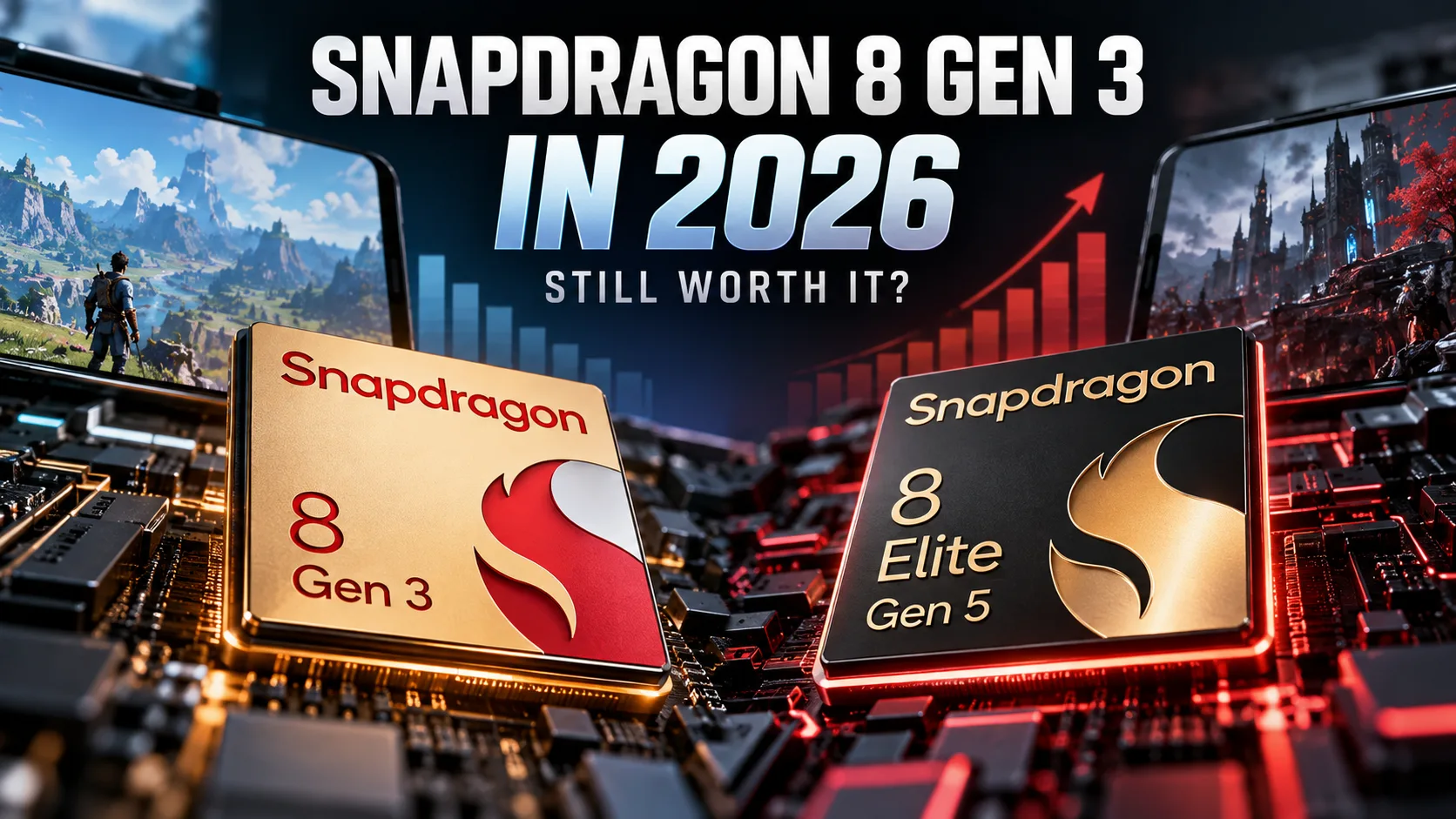
Qualcomm Snapdragon 8 Gen 3 in 2026: How Far Behind Newer Flagships Is It?
The Snapdragon 8 Gen 3 was released almost three years ago, but it still offers enough performance for modern mobile games. At the same time, the OnePlus 15 with a Snapdragon 8 Elite Gen 5 outperforms the OnePlus 12 by approximately 65% in Geekbench 6. What does this gap mean when choosing a smartphone in 2026, and why do devices with the Snapdragon 8 Gen 3 produce different results?
Architecture: Six Performance Cores Instead of Five
Qualcomm introduced the Snapdragon 8 Gen 3 in October 2023. The processor is manufactured by TSMC using a 4nm process and has eight cores:
- 1 × Cortex-X4 at up to 3.3 GHz - the main performance core.
- 3 × Cortex-A720 at up to 3.15 GHz - performance cores.
- 2 × Cortex-A720 at up to 2.96 GHz - an additional group of performance cores.
- 2 × Cortex-A520 at up to 2.27 GHz - efficiency cores.
The Snapdragon 8 Gen 2 had five performance cores, including the main core, while the Snapdragon 8 Gen 3 has six. The number of efficiency cores decreased from three to two. The process technology remained unchanged, so the performance gains came from the new architecture and higher clock speeds.
The Galaxy S24 Ultra is equipped with the Snapdragon 8 Gen 3 for Galaxy, with the Cortex-X4 clocked at up to 3.39 GHz. In single-threaded tests, this version is slightly faster than the standard model, but the higher clock speed does not guarantee an advantage under sustained workloads.
Performance: From Snapdragon 8 Gen 2 to 8 Elite Gen 5
The table presents results from six smartphones using four generations of Qualcomm flagship processors.
| Smartphone | Processor | Geekbench 6 Single | Geekbench 6 Multi | AnTuTu 11 |
|---|---|---|---|---|
| OnePlus 11 | Snapdragon 8 Gen 2 | 2 013 | 5 590 | 1 846 250 |
| OnePlus 12 | Snapdragon 8 Gen 3 | 2 182 | 6 465 | 2 401 788 |
| Xiaomi 14 | Snapdragon 8 Gen 3 | 2 206 | 6 701 | 2 363 726 |
| Galaxy S24 Ultra | Snapdragon 8 Gen 3 for Galaxy | 2 259 | 7 330 | 2 341 394 |
| OnePlus 13 | Snapdragon 8 Elite | 2 899 | 8 945 | 3 145 582 |
| OnePlus 15 | Snapdragon 8 Elite Gen 5 | 3 607 | 10 732 | 4 008 294 |
The move from the Snapdragon 8 Gen 2 to the 8 Gen 3 delivered a moderate CPU performance increase. The OnePlus 12 is 8% faster than the OnePlus 11 in Geekbench 6 Single-Core and 16% faster in Multi-Core. In AnTuTu 11, the difference reaches 30% because the test also accounts for graphics, memory, and other system components.
The move to the Snapdragon 8 Elite produced a more noticeable performance increase. The OnePlus 13 is 33% faster than the OnePlus 12 in Single-Core and 38% faster in Multi-Core. The OnePlus 15 with the Snapdragon 8 Elite Gen 5 increases the advantage to 65-66%.
However, differences in benchmarks do not translate into proportional application speedups. When browsing the web, using messengers, and navigating the system interface, the Snapdragon 8 Gen 3 does not encounter serious difficulties. The newer generations’ advantage is more pronounced in video processing and other resource-intensive tasks.
There are also differences within the same generation. The Galaxy S24 Ultra scores 13% higher than the OnePlus 12 in Geekbench 6 Multi-Core. In addition to clock speeds, results are affected by power settings, firmware, and the device’s thermal conditions.
Adreno 750: Graphics Improved More Than the CPU
The Snapdragon 8 Gen 3 received the Adreno 750 graphics accelerator instead of the Adreno 740. Qualcomm claimed a 25% increase in GPU performance along with improved power efficiency.
The Adreno 750 supports hardware ray tracing, Snapdragon Game Super Resolution, and Frame Motion Engine 2.0. The latter technology is designed to increase the displayed frame rate in compatible games.
| Smartphone | Processor | Wild Life Extreme | Solar Bay | Steel Nomad Light |
|---|---|---|---|---|
| OnePlus 11 | Snapdragon 8 Gen 2 | 3 671 | 5 312 | 1 091 |
| OnePlus 12 | Snapdragon 8 Gen 3 | 4 646 | 8 360 | 1 676 |
| Xiaomi 14 | Snapdragon 8 Gen 3 | 4 551 | 7 582 | 1 511 |
| Galaxy S24 Ultra | Snapdragon 8 Gen 3 for Galaxy | 4 531 | 7 748 | 1 527 |
| OnePlus 13 | Snapdragon 8 Elite | 6 241 | 11 360 | 2 455 |
In Wild Life Extreme, the OnePlus 12 outperforms the OnePlus 11 by 27%, while in Solar Bay the advantage is 57%. The second test uses ray tracing, so the larger gain reflects improvements in processing the corresponding graphics effects.
The three smartphones with the Snapdragon 8 Gen 3 score between 4 531 and 4 646 points in Wild Life Extreme. The difference between them is less than 3%, despite their different body sizes and cooling systems.
The OnePlus 13 with the Snapdragon 8 Elite outperforms the OnePlus 12 by 34% in Wild Life Extreme and by 46% in Steel Nomad Light. The OnePlus 15 widens the gap further: its results reach 12 540 points in Solar Bay and 2 699 in Steel Nomad Light, which is 50% and 61% higher than the OnePlus 12’s results, respectively.
Over three years, Qualcomm’s flagship graphics performance has increased substantially. But the Adreno 750’s results show that the Snapdragon 8 Gen 3 is still capable of handling demanding graphics workloads, even though it falls behind newer generations in maximum speed.
Gaming and Throttling: One Processor, Different Results
In short graphics tests, the Xiaomi 14, OnePlus 12, and Galaxy S24 Ultra deliver similar performance. Under sustained workloads, the differences can be much greater.
In the published 3DMark Wild Life Extreme Stress Test results, stability is distributed as follows:
| Smartphone | Stability |
|---|---|
| OnePlus 12 | 83% |
| Xiaomi 14 | 87% |
| Galaxy S24 Ultra | 59% |
Stability is the ratio of the minimum result to the maximum result across a series of stress-test cycles. The values refer to published tests of specific devices.
In the standard Wild Life Extreme test, the Xiaomi 14 and Galaxy S24 Ultra achieve almost identical scores of 4 551 and 4 531 points. But in the stress tests shown above, the Xiaomi retains 87% of its peak performance, while the Samsung retains 59%.
These results do not mean that the Xiaomi 14 is always faster than the Galaxy S24 Ultra in games. However, they show how much the performance consistency of smartphones using the same platform can vary.
The Snapdragon 8 Gen 3 handles Genshin Impact, Honkai: Star Rail, and other demanding games. But FPS stability depends on graphics settings, device temperature, and firmware limitations.
Therefore, for extended gaming sessions, an FPS chart covering 20-30 minutes is more informative than a single maximum 3DMark result.
Cameras, AI, and Connectivity
The Snapdragon 8 Gen 3 is equipped with a triple 18-bit Spectra image signal processor. The platform supports cameras of up to 200 MP, 8K HDR recording at 30 fps, and 4K recording at 120 fps. The availability of these modes depends on the smartphone manufacturer.
The Hexagon NPU can run compatible generative models directly on the device. Wireless connectivity is handled by the Snapdragon X75 5G modem and FastConnect 7800, with support for Wi-Fi 7 and Bluetooth 5.4. The platform also supports LPDDR5X memory and UFS 4.0 storage.
Is the Snapdragon 8 Gen 3 Worth Buying in 2026?
In September 2026, Qualcomm introduced the Snapdragon 8 Elite Gen 6 and 8 Elite Extreme Gen 6. Several generations now separate the Snapdragon 8 Gen 3 from the newest platforms, but CPU and GPU benchmark results are not the only factors that matter when choosing a smartphone.
The OnePlus 12 offers a large display and fast charging, the Xiaomi 14 provides comparable performance in a more compact body, while the Galaxy S24 Ultra stands out with cameras featuring optical zoom, an S Pen stylus, and long-term software support.
If a smartphone with the Snapdragon 8 Gen 3 costs roughly the same as a comparable model with the Snapdragon 8 Elite, the newer processor becomes a significant argument in its favor. This is especially true when buying a device for several years of gaming.
But with substantial savings, a 2024 flagship may be preferable to a new mid-range smartphone. In addition to the processor, it may offer better cameras, a better display, and extra features that are absent from a cheaper model with a newer chip.
Before buying a used flagship, it is also worth checking the battery’s condition and the remaining period of software support. For gaming, the results of extended stress tests for the specific model are particularly important.
Conclusion
The Snapdragon 8 Gen 3 falls significantly behind Qualcomm’s newer flagship processors, especially in graphics and multi-threaded workloads. But its performance is still sufficient for most mobile tasks.
In 2026, smartphones with this processor should primarily be considered when there is a substantial price difference compared with newer models. At the same time, the features and condition of a specific device may matter more than the difference in synthetic benchmark results.
SOC Comparison
Compare Snapdragon 8 Gen 3 with other SOCs
Basic
5x (3x3.2 GHz/2x3.0GHz) – Cortex-A720
2x 2.3 GHz – Cortex-A520
GPU Specifications
Connectivity
Memory Specifications
Miscellaneous
Benchmarks
Phones with Snapdragon 8 Gen 3














































Tablets with Snapdragon 8 Gen 3








Comparison of Devices with Snapdragon 8 Gen 3
Compared to Other SoC
Related SoC Comparisons


Share in social media
Or Link To Us
<a href="https://cputronic.com/index.php/soc/qualcomm-snapdragon-8-gen-3" target="_blank">Qualcomm Snapdragon 8 Gen 3</a>