Qualcomm Snapdragon 8 Gen 2

Snapdragon 8 Gen 2 in 2026: How Much Slower Is It Than Newer Processors?
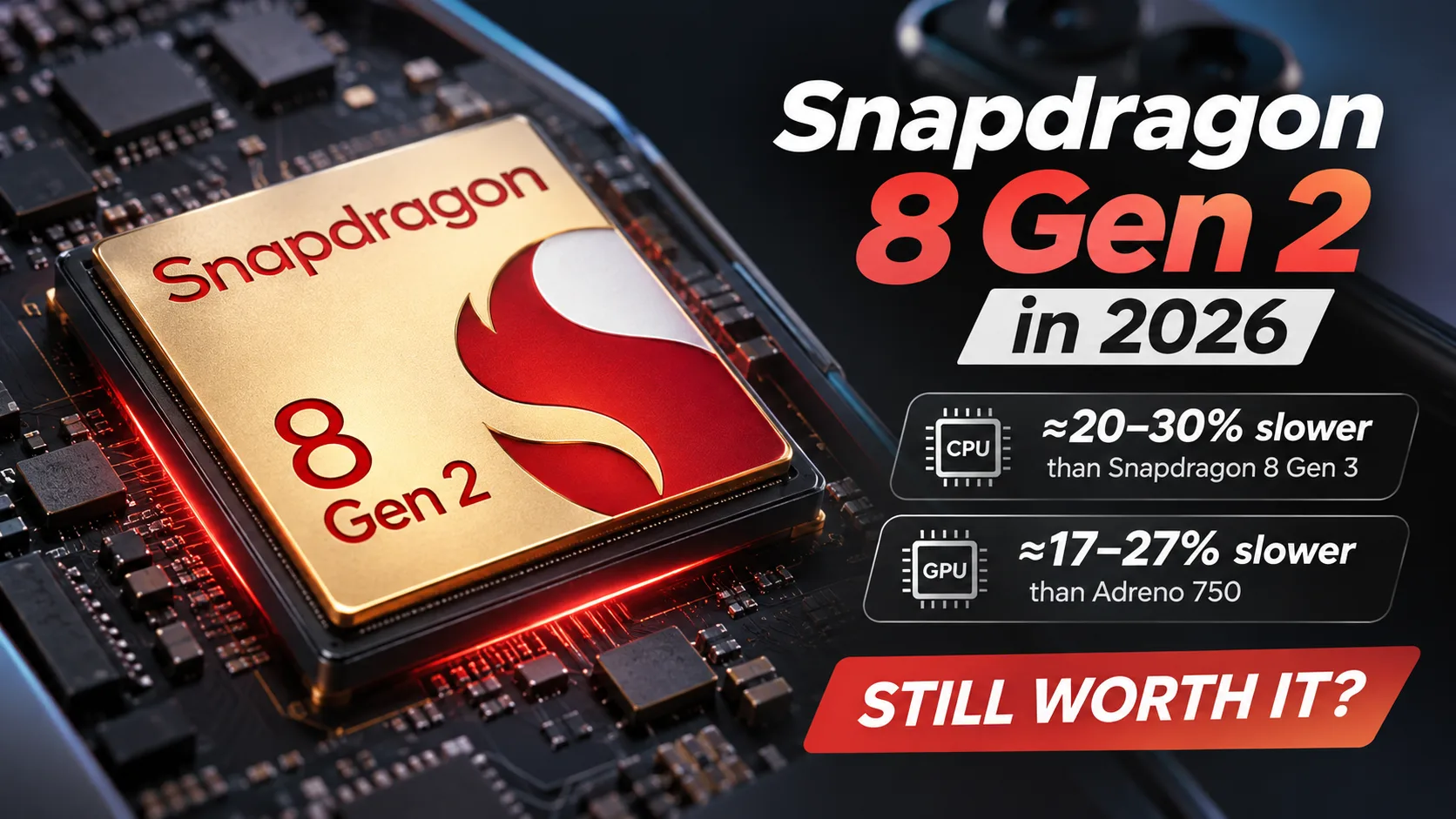
The Qualcomm Snapdragon 8 Gen 2 was released in November 2022, but its performance is still sufficient for most Android games. Smartphones with this chip score around 2,000 points in the single-core Geekbench 6 test and 5,300-5,500 points in the multithreaded test. The Snapdragon 8 Gen 3 is approximately 20-30% faster when all cores are loaded, but the difference is much smaller during everyday use.
In 2026, the main problem with the Snapdragon 8 Gen 2 is not performance but the age of the smartphones that use it. Many models have already received several major Android updates, while devices with faster processors are gradually becoming cheaper. When choosing a phone, price, cooling, and the remaining support period are the most important factors.
Architecture: What Changed After the Snapdragon 8+ Gen 1
The Snapdragon 8 Gen 2 is manufactured by TSMC using a 4 nm process and uses eight cores: one Cortex-X3 clocked at up to 3.2 GHz, two Cortex-A715 cores, two Cortex-A710 cores, and three Cortex-A510 cores.
It is more appropriate to compare it with the Snapdragon 8+ Gen 1. The Plus version was the first to switch from Samsung manufacturing to TSMC and significantly improved the previous generation’s power efficiency.
| Specification | Snapdragon 8+ Gen 1 | Snapdragon 8 Gen 2 |
|---|---|---|
| Prime core | Cortex-X2, 3.2 GHz | Cortex-X3, 3.2 GHz |
| Performance cores | 3 × Cortex-A710 | 2 × A715 + 2 × A710 |
| Efficiency cores | 4 × Cortex-A510 | 3 × Cortex-A510 |
| L3 cache | 6 MB | 8 MB |
| Graphics | Adreno 730 | Adreno 740 |
| Memory | LPDDR5 | LPDDR5X |
| Modem | Snapdragon X65 | Snapdragon X70 |
| Wi-Fi | Wi-Fi 6E | Wi-Fi 7 |
The newer cores and Adreno 740 increased performance without significantly increasing power consumption. Memory bandwidth rose to 67.2 GB/s. Since both processors are manufactured using TSMC’s 4 nm process, the Snapdragon 8 Gen 2’s main advantages are related to its updated architecture.
Geekbench 6 Performance
The comparison uses specific smartphones and their Geekbench 6.7 results.
| Smartphone | Processor | Single | Multi |
|---|---|---|---|
| Nothing Phone (2) | Snapdragon 8+ Gen 1 | 1719 | 4584 |
| OnePlus 12R | Snapdragon 8 Gen 2 | 2005 | 5344 |
| OnePlus 12 | Snapdragon 8 Gen 3 | 2148 | 6630 |
| Xiaomi 14 | Snapdragon 8 Gen 3 | 2144 | 6914 |
Compared with the Nothing Phone (2), the OnePlus 12R is 17% faster in both tests. The improvement over the Snapdragon 8+ Gen 1 is noticeable, but not large enough to justify replacing a functioning smartphone solely for its processor.
The difference between the OnePlus 12R and OnePlus 12 is 7% in single-core performance and 24% under a full CPU load. The Xiaomi 14 achieves an even higher multithreaded score, approximately 29% above that of the OnePlus 12R.
These are measurements from specific devices. Under sustained load, the difference may vary because of power and thermal limitations.
In AnTuTu 10, smartphones with the Snapdragon 8 Gen 2 typically score around 1.4-1.6 million points. Newer processors have a more noticeable advantage in video processing and other sustained workloads than in everyday application use.
Adreno 740 vs. Adreno 750: How Outdated Is the Graphics?
The Snapdragon 8 Gen 2 is equipped with an Adreno 740 GPU that supports Vulkan 1.3 and hardware-accelerated ray tracing. The Snapdragon 8 Gen 3 uses the more powerful Adreno 750.
The 3DMark Wild Life Extreme Unlimited results show the difference between them.
| Smartphone | GPU | 3DMark Wild Life Extreme Unlimited |
|---|---|---|
| OnePlus 12R | Adreno 740 | 3713 |
| OnePlus 12 | Adreno 750 | 4331 |
| POCO F7 Pro | Adreno 750 | 4448 |
| Xiaomi 14 | Adreno 750 | 4729 |
The OnePlus 12 with the Adreno 750 outperforms the OnePlus 12R by 17%. On the Xiaomi 14, the advantage reaches 27%. The variation in results between smartphones with the same GPU shows the impact of clock speeds, power settings, and cooling.
In games, the difference depends on the graphics settings. The Snapdragon 8 Gen 2 can deliver around 60 FPS in Genshin Impact at maximum settings, although dips are possible in demanding scenes. This result was obtained using game versions that were current at the time of testing. The Adreno 750 provides additional performance headroom, especially at high resolutions and graphics-quality settings.
The Same Processor, Different Gaming Performance
The impact of cooling is clearly visible in the 3DMark Wild Life Extreme Stress Test.
| Smartphone | GPU stability |
|---|---|
| Asus ROG Phone 7 Ultimate | 96.3% |
| OnePlus 12R | 75.7% |
| OnePlus 11 | 52.6% |
All three smartphones use the Snapdragon 8 Gen 2, but their results differ considerably. The ROG Phone 7 Ultimate retains almost all of its initial performance, while the OnePlus 11 significantly reduces its clock speeds as it heats up.
This does not mean that the OnePlus 11 will be almost twice as slow in every game. The stress test creates a sustained workload and shows how sharply GPU performance drops. In demanding games during extended sessions, good heat dissipation helps maintain a more stable frame rate.
Snapdragon 8 Gen 2 for Galaxy: How Samsung’s Version Differs
The Galaxy S23, S23+, and S23 Ultra are equipped with the Snapdragon 8 Gen 2 for Galaxy. In this version, the Cortex-X3 prime core’s clock speed is increased from 3.2 to 3.36 GHz. The Adreno 740 GPU also runs at a higher frequency.
The advantage over the standard Snapdragon 8 Gen 2 is small. An additional 160 MHz on the prime core does not change the smartphone’s performance class.
In terms of speed, the Galaxy S23 is still relevant, but its software support period is limited. Samsung promised four major Android updates, up to Android 17, and five years of security updates from its release in 2023. Security support is expected to continue until approximately February 2028.
Memory, Cameras, and Connectivity
The Snapdragon 8 Gen 2 supports LPDDR5X, UFS 4.0 storage, Wi-Fi 7, and the Snapdragon X70 modem. The processor also supports 8K video recording at 30 FPS and cameras with resolutions of up to 200 MP.
The chip’s capabilities are not always used to their full extent. For example, the OnePlus 12R has UFS 3.1 storage, even though the Snapdragon 8 Gen 2 supports the faster UFS 4.0 standard.
Is It Worth Buying a Snapdragon 8 Gen 2 in 2026?
In November 2026, Xiaomi’s German catalog lists the POCO F7 with a Snapdragon 8s Gen 4 at approximately €450, while the POCO F7 Pro with a Snapdragon 8 Gen 3 costs €480. These are reference prices from the official store, not the lowest prices on the market.
Given the prices of these competitors, buying a new smartphone with a Snapdragon 8 Gen 2 makes sense when there is a significant difference in price:
- Up to €320. An attractive option if the cameras and remaining support period are satisfactory. This is a price reference, not confirmation that such offers are available.
- €320-400. It is worth comparing the complete devices. The Galaxy S23 or Xiaomi 13 may be more appealing than some newer smartphones thanks to their cameras, build quality, and compact dimensions.
- From €400. Consider newer devices instead. With a small additional payment, you can get a Snapdragon 8 Gen 3 or 8s Gen 4, along with more performance headroom and longer support.
Conclusion: The Snapdragon 8 Gen 2 remains fast enough for most games and everyday tasks. In the tested smartphones, the Snapdragon 8 Gen 3 outperforms it by approximately 20-30% in the multithreaded Geekbench 6 test, while the Adreno 750’s advantage in 3DMark is 17-27%. Replacing a functioning smartphone for this kind of performance increase is not necessary. When buying a new device, the Snapdragon 8 Gen 2 should be chosen only if it offers substantial savings compared with newer models.
SOC Comparison
Compare Snapdragon 8 Gen 2 with other SOCs
Basic
2x 2.8 GHz – Cortex-A715
2x 2.8 GHz – Cortex-A710
3x 2 GHz – Cortex-A510
GPU Specifications
Connectivity
Memory Specifications
Miscellaneous
Benchmarks
Phones with Snapdragon 8 Gen 2


Tablets with Snapdragon 8 Gen 2

Comparison of Devices with Snapdragon 8 Gen 2
Compared to Other SoC
Related SoC Comparisons


Share in social media
Or Link To Us
<a href="https://cputronic.com/index.php/soc/qualcomm-snapdragon-8-gen-2" target="_blank">Qualcomm Snapdragon 8 Gen 2</a>