Qualcomm Snapdragon 8s Gen 3

Qualcomm Snapdragon 8s Gen 3: Performance, Graphics, and Benchmark Results
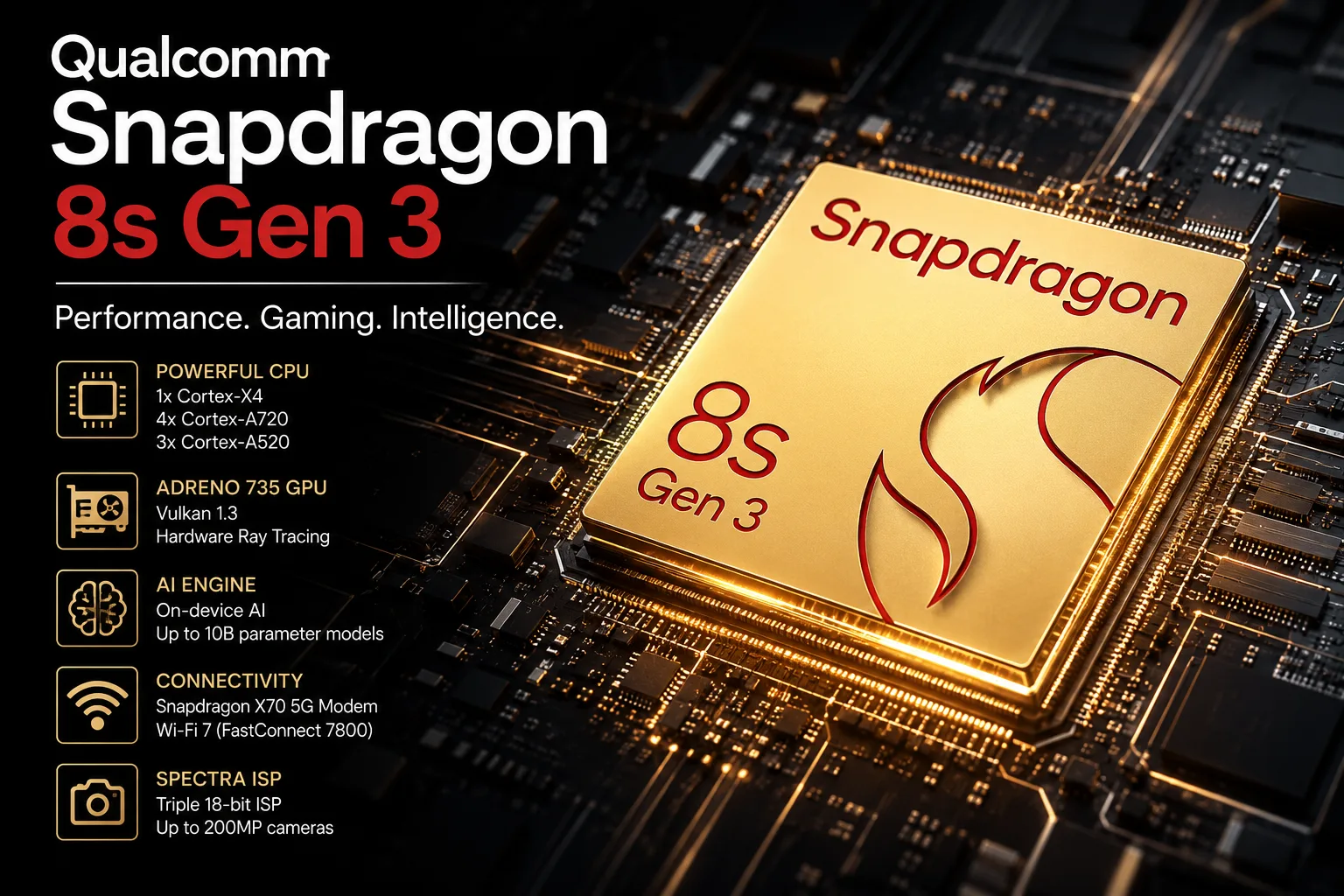
The Snapdragon 8s Gen 3 occupies a position below the Snapdragon 8 Gen 3: it lags behind in CPU performance more than in graphics. The SoC features Cortex-X4, Adreno 735 graphics, and NPU; it supports hardware ray tracing and Wi-Fi 7.
The CPU includes one Cortex-X4 clocked up to 3.0 GHz, four Cortex-A720 up to 2.8 GHz, and three Cortex-A520 up to 2.0 GHz. The SoC is manufactured using a 4nm process.
CPU Performance
The Snapdragon 8s Gen 3 is not a lower-clocked version of the Snapdragon 8 Gen 3. The Snapdragon 8 Gen 3 features a more powerful CPU and especially GPU.
The Snapdragon 8s Gen 3 is positioned above most mid-range chips but below the higher-end Snapdragon 8 models. It's better to assess the differences between specific smartphones through real tests, as results depend on cooling, firmware, and power consumption limits.
Snapdragon 8s Gen 3 in Specific Smartphones
| Smartphone | AnTuTu | Geekbench 6 Single-Core | Geekbench 6 Multi-Core |
|---|---|---|---|
| POCO F6 | 1,509,605 | 1,930 | 5,017 |
| Realme GT 6 | 1,501,830 | 1,852 | 4,761 |
| Motorola Edge 50 Ultra | 1,444,591 | 1,944 | 5,070 |
| Xiaomi 14 Civi | 1,443,011 | 1,913 | 5,087 |
In Geekbench 6 Single-Core, the results are close, while in Multi-Core and AnTuTu, the variation is greater. The difference between the POCO F6 and the Xiaomi 14 Civi is about 67,000 AnTuTu points, although both use the Snapdragon 8s Gen 3.
The POCO F6 leads this selection in AnTuTu, but short tests do not reflect performance stability under prolonged load. Under sustained stress, results are more dependent on the smartphone's cooling and thermal limits.
Adreno 735 and Gaming
Graphics are handled by the Adreno 735, which supports Vulkan 1.3 and hardware ray tracing. It includes Snapdragon Elite Gaming features, including Adreno Frame Motion Engine 2.0.
The Adreno 735 is slower than the GPU in the Snapdragon 8 Gen 3. However, most modern Android games run at high settings. In demanding titles, the outcome depends heavily on graphical settings, screen resolution, and cooling.
For example, the Realme GT 6 runs at about 60 FPS in BGMI's Smooth mode. In Ultra HDR mode, the frame rate is capped at around 40 FPS.
Performance Under Sustained Load
Short tests reflect peak performance but not frequency stability under prolonged load.
Two smartphones with the same SoC may yield similar results in Geekbench and AnTuTu but differ in FPS after 20-30 minutes of gameplay. This is due to differences in cooling systems, firmware thermal limits, and power consumption settings.
It's not possible to accurately assess a smartphone's gaming performance based solely on the SoC model.
AI, Camera, and Multimedia
The Snapdragon 8s Gen 3 utilizes the Hexagon NPU and Qualcomm AI Engine. The NPU allows running generative models directly on the device, including models sized up to 10 billion parameters.
The set of available AI features depends on the firmware and manufacturer applications.
Image processing is handled by an 18-bit triple Spectra ISP. It supports sensors with resolutions up to 200 MP, semantic segmentation, and image processing capabilities via the AI Engine.
The same SoC does not guarantee uniform photo quality: the outcome depends on sensors, optics, and the specific smartphone's algorithms.
Memory and Connectivity
The Snapdragon 8s Gen 3 supports LPDDR5X memory and UFS 4.0 storage.
Mobile connectivity is managed by the Snapdragon X70 modem, with a claimed download speed of up to 6.5 Gbps. FastConnect 7800 supports Wi-Fi 7 with speeds of up to 5.8 Gbps.
Conclusion
The main difference between the Snapdragon 8s Gen 3 and the Snapdragon 8 Gen 3 is weaker graphics performance; the CPU gap is smaller. In the reviewed smartphones, results are approximately in the range of 1.44-1.51 million AnTuTu points and 1850-1940 / 4760-5090 Geekbench 6 points.
Under prolonged load, the variation between smartphones increases due to different thermal and power limits.
The primary advantage of the Snapdragon 8s Gen 3 is seen in models that are significantly cheaper than smartphones with the Snapdragon 8 Gen 3. In everyday tasks, Its performance is comparable to the flagship platforms of the previous generation, while in heavy graphics, the gap from the Snapdragon 8 Gen 3 is more pronounced.
SOC Comparison
Compare Snapdragon 8s Gen 3 with other SOCs
Basic
4x 2.8 GHz – Cortex-A720
3x 2.0 GHz – Cortex-A520
GPU Specifications
Connectivity
Memory Specifications
Miscellaneous
Benchmarks
Phones with Snapdragon 8s Gen 3














Tablets with Snapdragon 8s Gen 3



Comparison of Devices with Snapdragon 8s Gen 3
Compared to Other SoC
Related SoC Comparisons


Share in social media
Or Link To Us
<a href="https://cputronic.com/index.php/soc/qualcomm-snapdragon-8s-gen-3" target="_blank">Qualcomm Snapdragon 8s Gen 3</a>