Qualcomm Snapdragon 8 Elite Gen 5

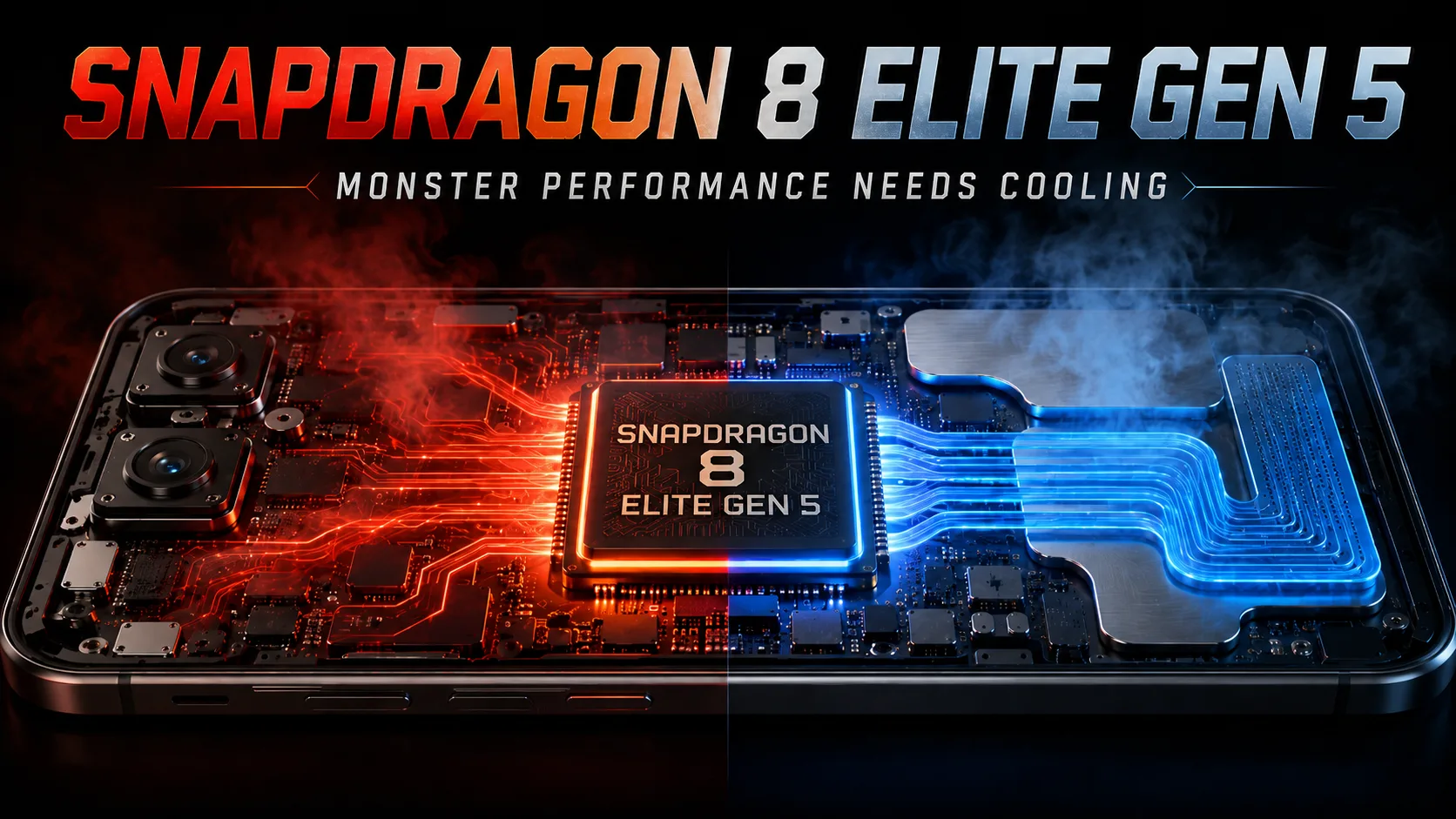
Snapdragon 8 Elite Gen 5: A Performance Monster That Feels Cramped in Smartphones
The Snapdragon 8 Elite Gen 5 features third-generation Oryon, Adreno 840, an accelerated Hexagon NPU, and a new modem. The CPU performance improvement over the Snapdragon 8 Elite reaches about 20%, but actual performance greatly depends on cooling: the difference between smartphones using the same SoC in graphics tests exceeds 30%.
CPU: Third Generation Oryon
The standard version of Snapdragon 8 Elite Gen 5 comes with eight cores: two Prime cores clocked up to 4.6 GHz and six Performance cores up to 3.62 GHz. There are no separate efficiency cores-Qualcomm retains the configuration used in Snapdragon 8 Elite.
Snapdragon 8 Elite Gen 5 utilizes third-generation Oryon and is manufactured using TSMC's 3nm process technology.
Qualcomm claims a CPU performance increase of approximately 20% compared to Snapdragon 8 Elite with enhanced energy efficiency.
Benchmarks in Real Smartphones
Performance results are influenced by power limits, firmware, and device design.
| Smartphone | Geekbench 6 Single | Geekbench 6 Multi | AnTuTu 10 |
|---|---|---|---|
| OnePlus 15 | 3,498 | 10,645 | 2,456,231 |
| Xiaomi 17 | 3,662 | 10,842 | 2,545,132 |
| Xiaomi 17 Pro Max | 3,640 | 10,620 | 2,390,211 |
| Nubia RedMagic 11 Pro | 3,741 | 11,634 | 3,269,237 |
Most models score between 3,500 and 3,700 points in Geekbench 6 Single-Core and over 10,000 in Multi-Core. The RedMagic 11 Pro scores higher than the others due to its high power limits and superior cooling.
The difference is even more pronounced in AnTuTu, which takes into account the CPU, GPU, memory, and storage. Therefore, AnTuTu is more dependent on the implementation of a specific smartphone than Geekbench.
Adreno 840: A Significant Headroom for Gaming
Adreno 840 features a new architecture and 18 MB of dedicated high-performance memory, Adreno HPM. Qualcomm reports a graphical performance increase of about 23%, a 20% boost in energy efficiency, and a 25% acceleration in ray tracing compared to the previous generation.
| Smartphone | GPU | 3DMark Wild Life Unlimited | 3DMark Wild Life Extreme Unlimited |
|---|---|---|---|
| Nubia RedMagic 11 Pro | Adreno 840 | 30,553 | 8,004 |
| Xiaomi 17 Ultra | Adreno 840 | 30,187 | 7,087 |
| Xiaomi 17 Pro Max | Adreno 840 | 23,088 | 6,168 |
| Samsung Galaxy S25 Ultra* | Adreno 830 | 26,614 | 6,907 |
- Galaxy S25 Ultra with Snapdragon 8 Elite for Galaxy is presented as a benchmark of the previous generation.
The difference between the RedMagic 11 Pro and Xiaomi 17 Pro Max is about 32% in Wild Life Unlimited and 30% in Wild Life Extreme Unlimited. The same GPU in different smartphones exhibits significantly different performance.
In some tests, the Xiaomi 17 Pro Max remains on par with the flagship of the previous generation, while the RedMagic 11 Pro is noticeably faster. Therefore, the mere label of Adreno 840 does not indicate the gaming performance a smartphone will deliver.
Adreno 840 supports hardware ray tracing, Mesh Shading, Lumen, and other Unreal Engine 5 technologies. The support for these technologies in mobile games is currently limited, so their practical value is minimal.
Performance is Limited by Cooling
The Snapdragon 8 Elite Gen 5 can maintain high clock speeds for an extended period only with effective heat dissipation.
In some smartphones, the body temperature exceeds 50 °C under prolonged load. In certain models, after a lengthy graphical test, performance drops by about 30%.
Thus, a short benchmark run does not reflect the sustained speed a smartphone can maintain after 20-30 minutes of gaming.
A powerful vapor chamber, large body, or active cooling allows for better power retention over time, which is why gaming models like RedMagic can perform better than slimmer flagships with the same SoC under prolonged loads.
AI: Hexagon is Faster
Qualcomm reports a performance increase of about 37% for the Hexagon NPU and improved energy efficiency.
It supports INT2 and FP8 computations, and some AI workloads can be distributed across the NPU, CPU, and GPU.
Primary scenarios include running generative models on-device, photo and video processing, voice functions, and AI agents. The capabilities of a specific smartphone depend not only on the NPU's performance but also on the manufacturer's software.
Camera and Video
The Spectra ISP uses three 20-bit image processing units.
The platform supports cameras with resolutions of up to 320 MP, simultaneous operation of three sensors up to 48 MP with Zero Shutter Lag, and recording 4K video at 120 FPS.
There is now hardware support for Advanced Professional Video-a format aimed at high-quality shooting and subsequent processing.
The ISP itself defines the platform's capabilities, but the final image quality largely depends on the sensors, optics, and algorithms of the specific smartphone.
Memory and Connectivity
Snapdragon 8 Elite Gen 5 supports LPDDR5X and UFS 4.1 storage.
Mobile connectivity is handled by the Snapdragon X85, with a theoretical download speed of up to 12.5 Gbps. It also features Wi-Fi 7, Bluetooth 6.0, and UWB.
Not every smartphone utilizes all the platform's capabilities: memory type and wireless interface sets depend on the model.
Hidden Context of the Series: Why Gen 5 Right Away
The name Snapdragon 8 Elite Gen 5 may seem odd: after Snapdragon 8 Elite, the company jumped directly to the Gen 5 index.
Qualcomm considers generations from the Snapdragon 8 Gen series. The first Snapdragon 8 Elite effectively took the position of the fourth generation, which is why its successor is designated Gen 5.
| Series | CPU | Year of Introduction | Position in the Lineup |
|---|---|---|---|
| Snapdragon 8 Gen 3 | Kryo | 2023 | last generation before flagship transition to Oryon |
| Snapdragon 8 Elite | Oryon 2nd generation | 2024 | effectively the fourth generation |
| Snapdragon 8 Elite Gen 5 | Oryon 3rd generation | 2025 | high-end platform of the fifth generation |
| Snapdragon 8 Gen 5 | Oryon 3rd generation | 2025 | version one tier below Elite |
Snapdragon 8 Elite became the first mobile Snapdragon with Oryon cores. Snapdragon 8 Elite Gen 5 uses the third generation of the architecture.
Snapdragon 8 Gen 5 belongs to the same generation but is positioned lower than Elite in the lineup and operates at lower clock speeds. Therefore, the same Gen 5 index does not imply the same level of performance.
The Snapdragon 8 Elite Gen 5 has versions with different configurations and maximum clock speeds, so a single commercial name is insufficient for precise comparisons.
Conclusion
The Snapdragon 8 Elite Gen 5 has increased CPU performance by about 20%, while the Adreno 840 has significantly improved graphical performance compared to the previous generation. In multi-threaded tasks and gaming, it is one of the fastest mobile platforms of its generation.
The variation in graphical test results between smartphones using Snapdragon 8 Elite Gen 5 exceeds 30%, meaning cooling and power limits have a direct impact on real-world performance.
After Snapdragon 8 Gen 3, the transition to the new generation offers substantial gains in CPU and GPU performance. For Snapdragon 8 Elite owners, switching smartphones solely for a new processor is less appealing: the cooling, autonomy, and camera capabilities of a specific model may provide more value than the difference between two generations of SoC.
SOC Comparison
Compare Snapdragon 8 Elite Gen 5 with other SOCs
Basic
GPU Specifications
Connectivity
Memory Specifications
Miscellaneous
Benchmarks
Phones with Snapdragon 8 Elite Gen 5
























Tablets with Snapdragon 8 Elite Gen 5









Comparison of Devices with Snapdragon 8 Elite Gen 5
Compared to Other SoC
Related SoC Comparisons





Share in social media
Or Link To Us
<a href="https://cputronic.com/index.php/soc/qualcomm-snapdragon-8-elite-gen-5" target="_blank">Qualcomm Snapdragon 8 Elite Gen 5</a>