Samsung Exynos 2600

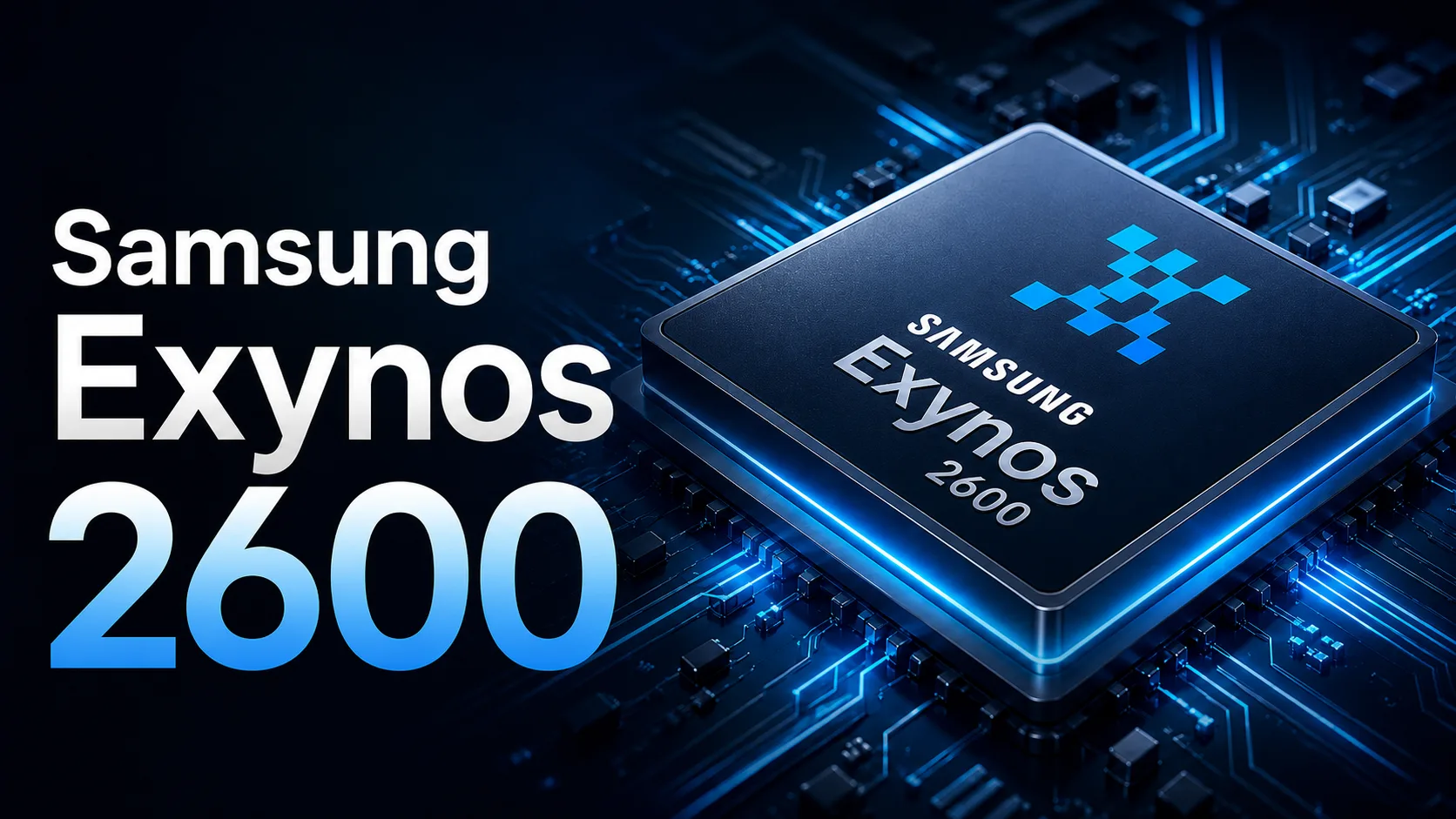
Samsung Exynos 2600 - specs, architecture, and real-world performance (2026)
Samsung Exynos 2600 is a flagship mobile SoC that serves as a showcase for Samsung Foundry's 2nm GAA (Gate-All-Around) process. The goal of this generation is straightforward: improve performance per watt and make behavior under sustained load more stable - in games, video capture, and on-device AI. These are exactly the scenarios where previous Exynos chips were most often criticized for heat and throttling.
Below is a clean, practical breakdown of Exynos 2600: what changed in the architecture, which features actually matter, and what early public device benchmarks suggest.
Architecture and process - what 2nm GAA means in practice
Moving to 2nm GAA is not a magic FPS boost. It is a foundation that gives engineers more flexibility in balancing frequency, voltage, leakage, and thermal density. In practice, this usually enables three improvements:
higher efficiency (similar performance at lower power)
better chances to hold higher clocks longer before hitting thermal limits
more headroom to strengthen large blocks (GPU/NPU/ISP) without destroying battery life
That is why Exynos 2600 is positioned as a generation meant to behave better in long, heavy workloads.
CPU - 10 cores without a "small core" cluster
Exynos 2600 uses a new Arm CPU core generation (the C1 family) and a 10-core 1+3+6 layout:
1x Arm C1-Ultra (prime) up to 3.8 GHz
3x Arm C1-Pro (performance middle) up to 3.25 GHz
6x Arm C1-Pro (efficiency middle) up to 2.75 GHz
The key idea is to drop the classic "little-core" cluster and instead use middle cores tuned for different power-performance targets. This can make sense in real life: many day-to-day workloads live in the middle, not at the peak. Strong middle cores can help keep the UI smooth, speed up background tasks, and maintain steadier multi-thread performance without sharp dips.
Armv9.3 and SME2 - why it matters
The platform is based on Armv9.3 and supports SME2 instructions. SME2 accelerates matrix operations on the CPU and can reduce latency in scenarios where part of ML compute runs on CPU cores (or when it is simply more efficient to execute certain pipeline stages on the CPU instead of pushing everything to the NPU). This is a practical feature for modern on-device workloads.
Performance - early public Geekbench 6 results
Since Galaxy S26 devices have been announced and early benchmark entries are already visible, we can look at first public Geekbench 6 numbers for Exynos 2600:
Single-core: roughly 3100-3200
Multi-core: roughly 10,400-11,000
Context matters: these are early runs and the results can vary significantly due to firmware, power settings, temperature, and the specific device sample.
Compared to top Snapdragon variants in flagship phones, the pattern is typical: Exynos 2600 often trails in single-core, while the multi-core gap is smaller and sometimes nearly closes. That is why final conclusions should rely on sustained tests and real scenarios (games, camera, long exports).
GPU and gaming - Xclipse 960, ray tracing, and ENSS
Exynos 2600 includes the Samsung Xclipse 960 GPU. This generation clearly emphasizes gaming features:
hardware ray tracing
a noticeable RT uplift versus the previous generation (per Samsung's claims)
ENSS (Exynos Neural Super Sampling): AI upscaling and frame generation to increase perceived smoothness within a limited power budget
What to know about ENSS
Even if a SoC supports upscaling and frame generation, the real benefit depends on:
whether the game engine supports it and how well it is integrated
target resolution and settings
the phone's thermal design (cooling and power limits)
drivers and game-specific optimizations
So ENSS is potentially strong, but its real value shows up only in specific games on specific devices.
On-device AI - NPU, model deployment, and security
Exynos 2600 pushes on-device AI in several directions:
a large claimed uplift in NPU performance for generative workloads versus the previous generation
optimizations for latency and power consumption in generative scenarios
support for ExecuTorch to simplify deploying PyTorch models on Exynos devices
Security is also a focus. Samsung mentions hardware-backed isolation (virtualization) and hybrid Post-Quantum Cryptography (PQC) approaches - essentially a "future-proof" security angle as cryptographic risks evolve.
Camera and ISP - VPS, DVNR, 320 MP, and APV
On the camera side, Exynos 2600 relies not only on raw ISP throughput but also on AI-assisted processing:
VPS (Visual Perception System): real-time scene and object understanding
DVNR (Deep learning Video Noise Reduction): DL-based video noise reduction, especially useful in low light
support for sensors up to 320 MP
APV (Advanced Professional Video) codec support, aimed at denser detail and color retention and smoother post-processing workflows
In practice, this should improve stability in difficult conditions (night scenes, motion, high noise) without an overly harsh hit to battery life.
Heat and sustained clocks - Heat Path Block and High-k EMC
One of the most practical changes is the thermal work:
Heat Path Block (HPB): optimizing the heat path away from the die
High-k EMC: packaging materials designed to reduce thermal resistance
This matters because users care less about short peak scores and more about stable clocks and reasonable surface temperatures in long gaming sessions and long video recording.
Connectivity - 5G Release 17 and an external modem
Exynos 2600 is often described alongside a separate Exynos Modem 5410. Claimed capabilities include 3GPP Release 17 support, modern aggregation modes, and very high peak speeds under ideal network conditions.
At the phone level, current wireless standards (for example Wi-Fi 7) are also part of the flagship story, while Bluetooth versions can vary by model and region.
Where you will see Exynos 2600
Exynos 2600 appears in the Galaxy S26 lineup, but SoC distribution depends on the market and specific model. This is a common Samsung strategy: some regions get Exynos for base models, others get Qualcomm.
Conclusion - what matters in Exynos 2600
Exynos 2600 looks like one of the most cohesive Exynos generations in years:
2nm GAA as a foundation for efficiency and sustained performance
a 10-core CPU without classic little cores (strong middle cores instead)
Xclipse 960 with hardware ray tracing and ENSS (AI upscaling plus frame generation)
a strong on-device AI focus (NPU) and modern security (including PQC-style approaches)
meaningful thermal and packaging improvements (HPB and related materials) to support stability
As always, real-world behavior will decide the verdict: battery life, surface temperatures, sustained clocks in long games, and camera quality in long video sessions. But architecturally, Exynos 2600 looks like a generation where Samsung tried to fix old weak points rather than just inflate paper specs.
SOC Comparison
Compare Exynos 2600 with other SOCs
Basic
GPU Specifications
Memory Specifications
Miscellaneous
Benchmarks
Phones with Exynos 2600


Comparison of Devices with Exynos 2600
Compared to Other SoC
Related SoC Comparisons



Share in social media
Or Link To Us
<a href="https://cputronic.com/index.php/soc/samsung-exynos-2600" target="_blank">Samsung Exynos 2600</a>