MediaTek Dimensity 7060
MediaTek Dimensity 7060: A Chip That MediaTek Has Already Sold Twice
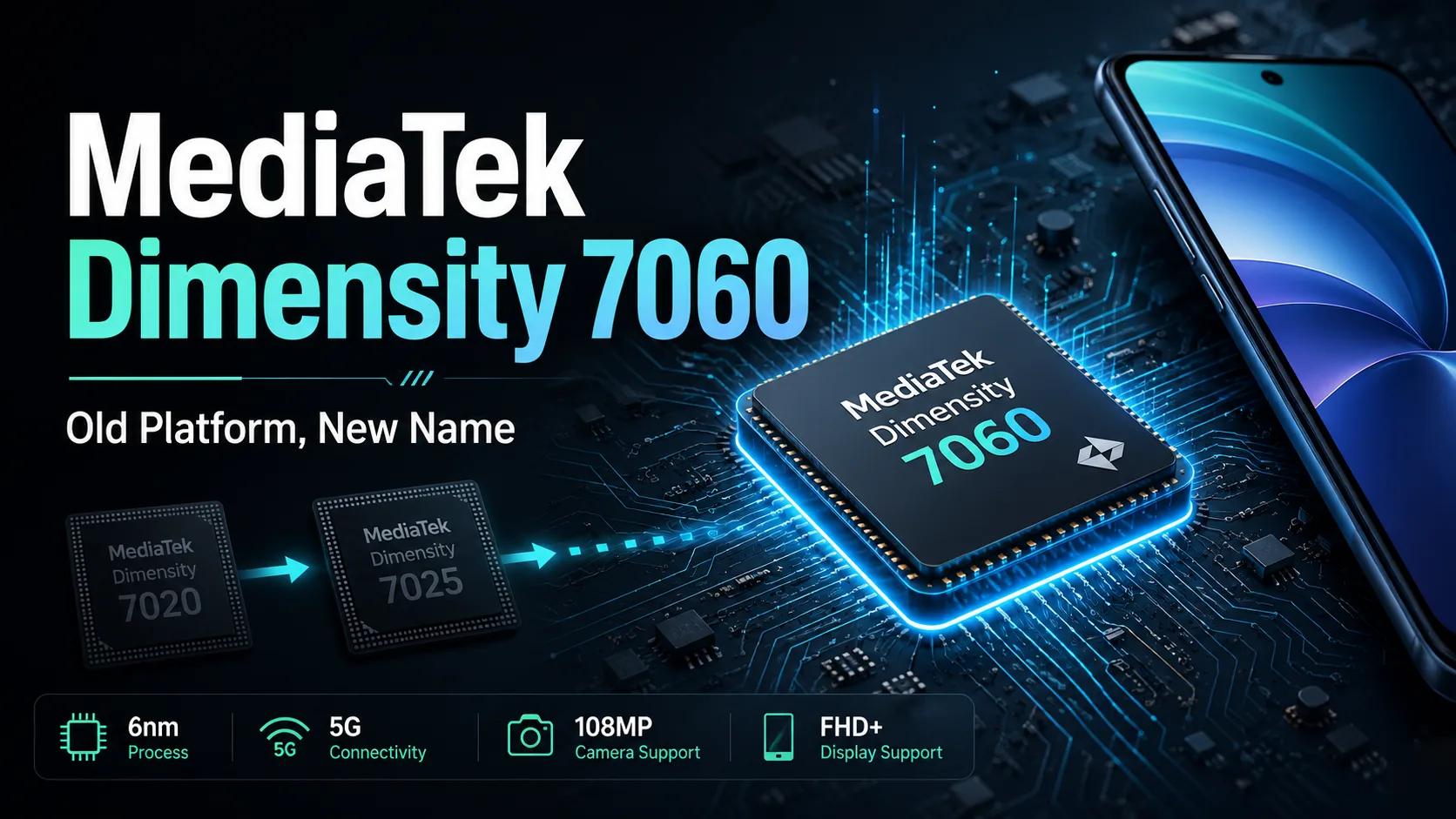
In May 2025, Motorola presented the Moto G56 5G featuring the Dimensity 7060 processor. The name seemed like another step in the lineup, but technically the upgrade was only by 100 MHz. In Geekbench, the platform is identified as Bogota, with two Cortex-A78 cores clocked at 2.6 GHz and six Cortex-A55 cores at 2.0 GHz. The Dimensity 7025 utilized the same configuration with the higher cores clocked at 2.5 GHz, while the Dimensity 7020 had them at 2.2 GHz.
The similarities extend even further. All three chips are manufactured using TSMC's 6nm process and utilize IMG BXM-8-256 graphics. Therefore, the Dimensity 7060 is not a new generation but rather another refresh of an older platform.
For a budget smartphone, its performance is sufficient for the interface, browsing, messaging, navigation, and typical multitasking. The problem arises when the new index is used as an argument to sell the device significantly above the budget level.
A Family Tree Without Surprises
The Dimensity 7020 had two Cortex-A78 cores clocked up to 2.2 GHz. In the Dimensity 7025, MediaTek increased it to 2.5 GHz, and in the Dimensity 7060, it has been raised to 2.6 GHz. The six Cortex-A55 cores in all three cases operate at 2.0 GHz.
There are even fewer changes in graphics. The IMG BXM-8-256 was already used in the Dimensity 930, introduced in 2022. Then this core transitioned to the Dimensity 7020 and 7025, and now remains in the 7060. This does not mean that the entirety of the Dimensity 7060 is merely a rebranded Dimensity 930, but MediaTek has been using the graphical core from this architecture in its chips since 2022.
The Dimensity 7050 should not be included in this chain. Its CPU configuration is similar - two Cortex-A78 at 2.6 GHz and six Cortex-A55 at 2.0 GHz - but it has different graphics, utilizing Mali-G68 MC4. The Dimensity 7050 essentially duplicates the older Dimensity 1080 and represents a separate branch.
The Dimensity 7060 supports LPDDR4x and LPDDR5, UFS 3.1 storage, and dual SIM 5G. The set of wireless interfaces depends on the specific smartphone. For example, the Moto G56 has Wi-Fi 5 and Bluetooth 5.3.
Performance: Four Smartphones Instead of One
Independent results are available for several smartphones equipped with the Dimensity 7060, allowing for assessment of the chip's behavior beyond just the Moto G56.
| Smartphone | AnTuTu 10 | Geekbench 6, Single Core | Geekbench 6, Multi-Core |
|---|---|---|---|
| Motorola Moto G56 5G | 470,448 | 1037 | 2386 |
| Lava Storm Play | 503,166 | 1056 | 2464 |
| Lava Blaze AMOLED 2 | 504,235 | 1062 | 2533 |
| Lava Blaze Duo 3 | - | 1061 | 2522 |
The results paint a consistent picture. In Geekbench 6, the single-core results of the four smartphones fall within the range of 1037 to 1062 points. The multi-core test yields scores around 2380-2530. This range confirms that the performance metrics of the Moto G56 were not a peculiarity of a specific firmware or batch of smartphones.
The differences in AnTuTu are more pronounced. The Moto G56 scores around 470,000 points in AnTuTu 10, while two Lava models surpass the 500,000 mark. Here, it is influenced not only by the processor. The devices vary in memory, storage, cooling, and firmware settings.
There are also reports of the Moto G56 achieving around 690-710 thousand points in AnTuTu 11. Direct comparison with AnTuTu 10 figures is impossible due to the new version changing the assessment methodology and scale.
For a budget smartphone, the performance of the CPU is currently sufficient. Approximately 1000-1060 points in Geekbench 6 in single-threaded tasks provide adequate responsiveness in everyday applications. The limitations become evident in multi-threaded tasks: two powerful Cortex-A78 cores are no longer competitive with platforms that feature four such cores.
The main point here is different. The transition from Dimensity 7025 to 7060 brings almost no change for the smartphone owner. An extra 100 MHz on two cores is too small an increase to justify choosing a new device.
Integrated Graphics: Old Core Makes Itself Known
The IMG BXM-8-256 remains the weakest part of the platform. This graphics core appeared in MediaTek chips as early as 2022 and has undergone several updates in the processor lineup without a significant architectural leap.
Real gaming tests clearly showcase its capabilities. The Lava Storm Play achieves around 29 frames per second on HD + High settings in BGMI. In Call of Duty: Mobile, the performance significantly improves to around 54 fps. The Lava Blaze AMOLED 2 shows approximately 30 and 58 fps respectively in the same tests.
Thus, the Dimensity 7060 cannot be deemed unsuitable for gaming. Popular mobile titles run adequately, and less demanding games can operate at a high frame rate. However, in demanding 3D games, the situation worsens: to achieve stable 60 fps, settings need to be lowered, as the maximum presets for this GPU are already too heavy.
The performance of the Lava Blaze Duo 3 is telling as well. Under short loads, the smartphone functions well, but during extended gaming sessions, reviewers noted performance drops and significant heating. This is influenced not only by the SoC itself but also by the cooling of the specific device.
For YouTube, social media, browsing, interfaces, and simple games, the power of the IMG BXM-8-256 is sufficient. Buying a smartphone with the Dimensity 7060 specifically for gaming performance is not advisable.
Devices, Prices, and Availability
The majority of smartphones featuring the Dimensity 7060 belong to the budget segment. Motorola primarily sells the platform in Europe, while Lava employs it in several models for the Indian market.
For comparison, all prices are given in dollars and rounded.
| Smartphone | Memory | Screen | Estimated Price | Primary Market |
|---|---|---|---|---|
| Lava Storm Play | 6/128 GB | IPS, 120 Hz | around $105 | India |
| Lava Blaze AMOLED 2 | 6/128 GB | AMOLED, 120 Hz | around $136 | India |
| Lava Blaze Duo 3 | 6/128 GB | AMOLED, 120 Hz + rear AMOLED | from $183 | India |
| Motorola Moto G56 5G | 8/256 GB | IPS, 120 Hz | around $190-205 | Europe |
The Lava Storm Play best illustrates where the Dimensity 7060 finds its place. For approximately $105, the buyer receives 5G, LPDDR5, UFS 3.1, and sufficient performance for everyday tasks. In such a smartphone, the old GPU does not appear as a problem - the price aligns with the capabilities.
The Blaze AMOLED 2 around $136 also seems reasonable. Here, the limited performance of the chip is offset by the AMOLED display and low price.
The situation with the Blaze Duo 3 is more complex. Prices start at approximately $183, and part of the cost goes to the design featuring two AMOLED displays. The buyer is paying not just for processing speed but for the smartphone's unique features.
The Moto G56 is priced around $190-205 depending on the market and retailer. It features a rugged body, a large battery, a decent camera for its class, and normal availability in Europe. However, the Dimensity 7060 at this price no longer looks like an advantage.
Competitors: Where the Old Platform Becomes Constrained
Qualcomm Snapdragon 6 Gen 1. This processor also uses Cortex-A78, but it features four high-performance cores instead of two. In Geekbench 6, Snapdragon typically trails Dimensity 7060 slightly in single-thread performance but achieves around 2700 points in multi-core testing. It is also built using a 4nm process and uses Adreno 710. At the same price point, the Snapdragon 6 Gen 1 is preferable due to its four high-performance cores and more modern manufacturing process.
MediaTek Dimensity 7300. The difference here is even more pronounced. Four Cortex-A78 cores, a 4nm process, and Mali-G615 MC2 yield around 2800 points in Geekbench 6 multi-core testing and approximately 880,000 points in AnTuTu 11. The disparity in graphics performance is especially significant. If a phone powered by Dimensity 7300 costs only slightly more, the performance difference justifies that additional expense.
MediaTek Dimensity 6300. This is a weaker budget platform. In terms of CPU, it significantly lags behind Dimensity 7060, ensuring the latter retains a solid position among the cheapest 5G smartphones. Again, it boils down to the device's price: at $100-140, Dimensity 7060 looks significantly more convincing than at $200.
Conclusion
The Dimensity 7060 is neither a failure nor a pointless processor. Its power is enough for most everyday tasks, with the four tested smartphones showing stable scores around 1000-1060 points in Geekbench 6 for single-threaded performance, and the affordable Lava models demonstrate that a successful budget phone can be made on this platform.
However, there is no new generation here. MediaTek took the foundation of the Dimensity 7020, overclocked the high cores first to 2.5 GHz in the Dimensity 7025, then to 2.6 GHz in the Dimensity 7060, while retaining the IMG BXM-8-256 that it has been using in its chips since 2022.
Thus, the Dimensity 7060 should be assessed not by its name but by the price of the smartphone. The Lava Storm Play at around $105 fits into the right category: a cheap 5G phone with adequate performance. The Blaze AMOLED 2 at approximately $136 also appears convincing due to its AMOLED display.
At a price of around $180-200, expectations rise. In this range, smartphones with four high-performance cores, more modern graphics, and 4nm platforms start to appear. The Moto G56 does not become a bad phone due to the Dimensity 7060, but paying extra for the novelty of the processor is unwarranted. Essentially, the buyer receives yet another version of a platform that MediaTek has been selling since 2022, changing frequencies and names faster than architectures.
SOC Comparison
Compare Dimensity 7060 with other SOCs
Basic
GPU Specifications
Connectivity
Memory Specifications
Miscellaneous
- AIFF
- CAF
- MP3
- MP4
- WAV
- H.265
- VP9
Benchmarks
Phones with Dimensity 7060


Comparison of Devices with Dimensity 7060
Compared to Other SoC
Related SoC Comparisons



Share in social media
Or Link To Us
<a href="https://cputronic.com/index.php/soc/mediatek-dimensity-7060" target="_blank">MediaTek Dimensity 7060</a>