MediaTek Helio G91
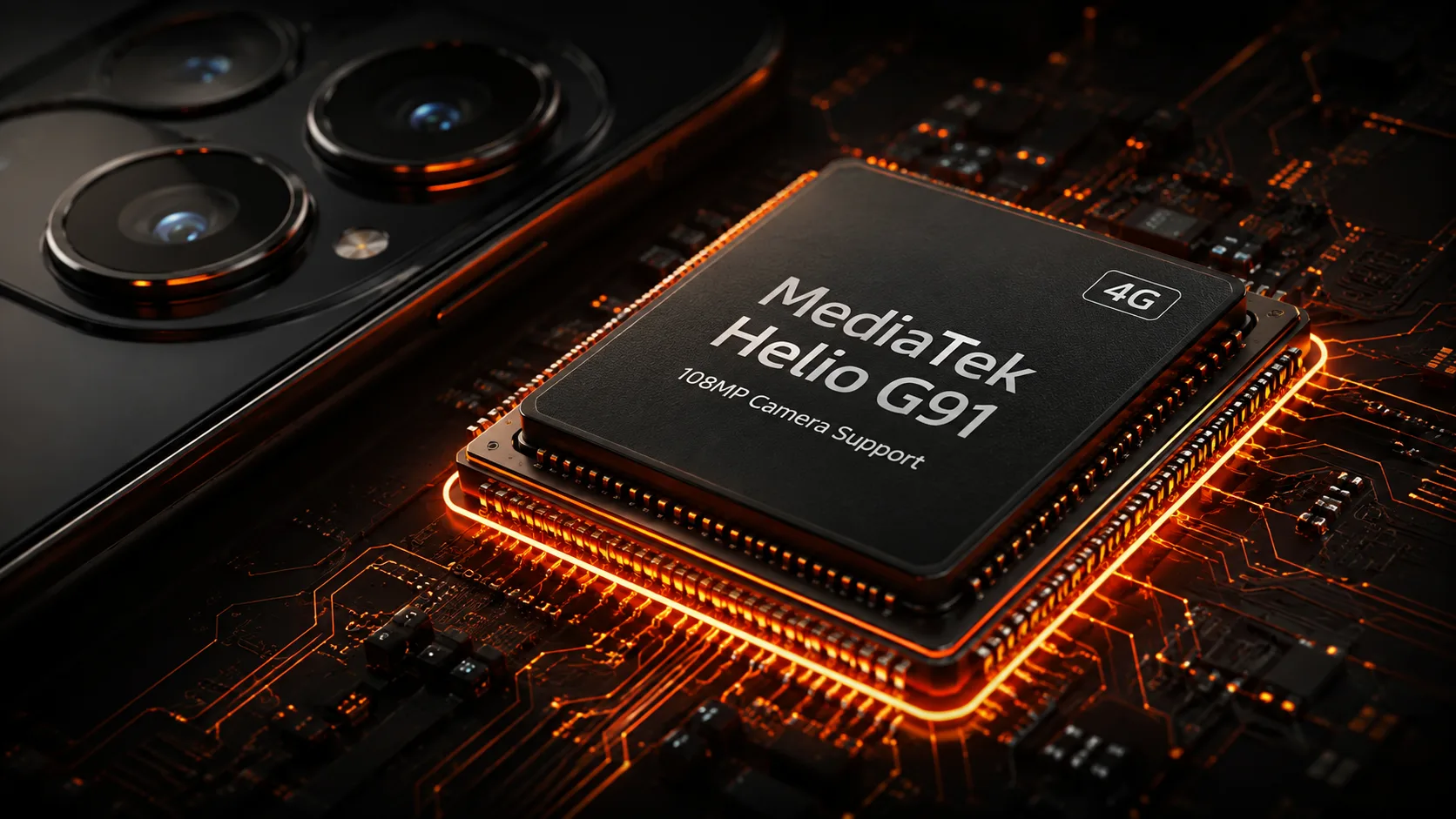
MediaTek Helio G91: 108 MP Instead of Performance Gains
MediaTek Helio G91 appeared in 2024, but in terms of performance, it is not a new generation. It retained two Cortex-A75 cores at 2 GHz, six Cortex-A55 cores, and Mali-G52 MC2 - a configuration that has long been used in budget Helio processors. The main change is related to the camera: G91 is designed for smartphones with 108 MP sensors. In 2026, this is a budget 4G chip, and its appeal directly depends on the smartphone's price.
What Has Changed in Helio G91
In terms of CPU and GPU, Helio G91 almost replicates Helio G88. Both are manufactured using a 12nm process, use two powerful Cortex-A75 cores, six Cortex-A55 cores, and the Mali-G52 MC2 graphics with a frequency of up to 1 GHz.
Therefore, the transition from G88 to G91 does not significantly change application and game speeds. The main change is support for 108 MP cameras instead of the 64 MP sensors found in G88. This allowed manufacturers to release affordable models with a 108 MP main camera without switching to a more expensive SoC.
Xiaomi uses the designation Helio G91-Ultra in the Redmi 13 and POCO M6. In terms of CPU and GPU specs, G91-Ultra does not differ from the regular G91: the same Cortex-A75 and Cortex-A55 cores, frequency up to 2 GHz, and Mali-G52 MC2.
Benchmarks of Helio G91 in Smartphones
Redmi 13, POCO M6, and Tecno Spark 30 show very similar results.
| Smartphone | Geekbench 6 Single | Geekbench 6 Multi | AnTuTu 11 | 3DMark Steel Nomad Light |
|---|---|---|---|---|
| Xiaomi Redmi 13 4G | 430 | 1369 | 376 039 | 79 |
| POCO M6 4G | 405 | 1407 | 361 872 | 81 |
| Tecno Spark 30 | 420 | 1442 | 354 158 | about 84 |
In Geekbench 6, the G91 usually scores between 400-430 points in the single-core test and 1350-1450 points in the multi-core test. This is sufficient for basic tasks, but in heavier applications, the performance is already lacking.
In AnTuTu 11, smartphones with G91 score around 350-380 thousand points. The final score is more influenced by the memory, storage, and firmware of the specific model.
The results of AnTuTu 10 and AnTuTu 11 cannot be directly compared, as the test versions use different scoring systems.
Games and Graphics
Mali-G52 MC2 is the weak part of Helio G91 by modern standards. Mobile Legends, Free Fire, and other undemanding games run fine on medium or lower settings.
In Genshin Impact, Honkai: Star Rail, and other demanding projects, it will be necessary to lower the graphics quality. Expecting stable 60 fps in such games is unrealistic.
Around 80 points in 3DMark Steel Nomad Light is a low result even for a budget smartphone in 2026.
Where the Age of the Platform Is Most Apparent
Helio G91 is manufactured using a 12nm process. Modern 6nm SoCs are typically faster and more energy-efficient.
Another weak aspect of the platform is the lack of support for UFS and the focus on eMMC 5.1. This type of memory is used, for example, in the Redmi 13 and POCO M6. The difference compared to UFS is especially noticeable during app installation, updates, file copying, and downloading heavy games.
For a new smartphone in 2026, eMMC 5.1 already looks like an outdated solution.
Which Smartphones Use Helio G91
The most notable models are Xiaomi Redmi 13 4G, POCO M6 4G, and Tecno Spark 30. The first two use the designation G91-Ultra, while Tecno installs the regular Helio G91.
As of late August 2026, the Redmi 13 6/128 GB can still be found for around €115-135. The Tecno Spark 30 8/256 GB is available from about €119 depending on the country. The POCO M6 is gradually disappearing from the shelves of major stores, although remnants can still be found for sale.
At a price around €110-125, smartphones with G91 are still justified as simple models for everyday tasks. At prices closer to €150, it is worth looking for models with more modern 6nm SoCs and UFS storage.
Conclusion
The Helio G91 should only be considered in the most affordable smartphones. Prices around €110-125 are still in line with the capabilities of this platform.
Paying €150 or more for a device with G91 in 2026 is no longer worthwhile. In this price range, smartphones with more modern 6nm platforms, faster GPUs, and UFS storage can be found. The main distinguishing feature of Helio G91 is support for 108 MP cameras rather than an increase in performance.
SOC Comparison
Compare Helio G91 with other SOCs
Basic
6x 1.8 GHz – Cortex-A55
GPU Specifications
Connectivity
Memory Specifications
Miscellaneous
Benchmarks
Phones with Helio G91
Comparison of Devices with Helio G91
Compared to Other SoC
Related SoC Comparisons



Share in social media
Or Link To Us
<a href="https://cputronic.com/index.php/soc/mediatek-helio-g91" target="_blank">MediaTek Helio G91</a>