Unisoc Tiger T615

Unisoc Tiger T615 - Review of a Budget 4G Processor
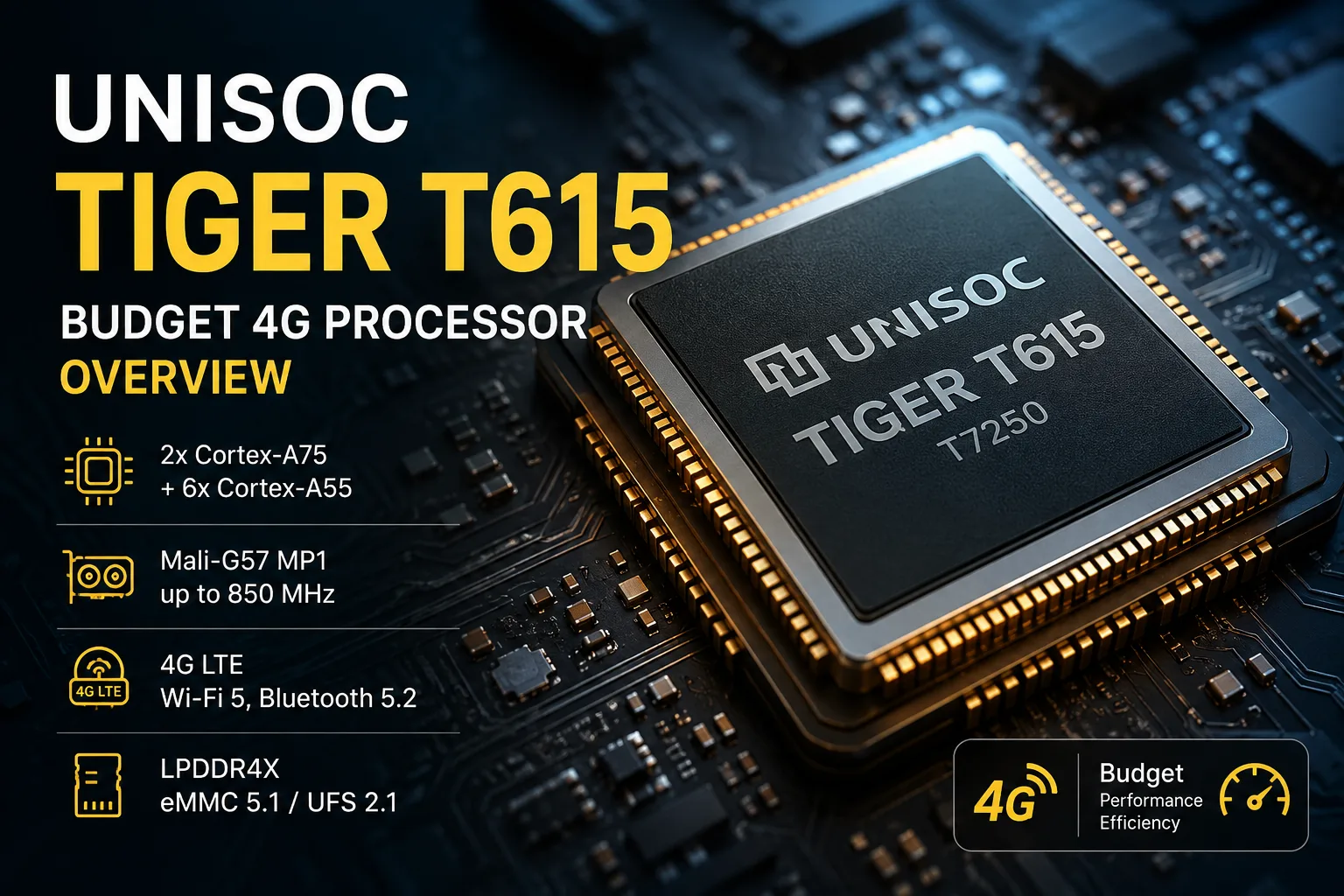
Unisoc Tiger T615, also known as Unisoc T7250, is a budget-class 4G chip. It is sufficient for communication, browsing, YouTube, maps, banking applications, and light multitasking. However, for gaming and prolonged performance reserves, the T615 is somewhat lacking.
In smartphones using the T615, it is more important to look at the memory, storage, display, and price rather than the chip name. A smartphone with 4/128 GB and UFS will perform more stably than a version with 3/64 GB and eMMC, even with the same processor.
What Is This Chip and What Are Its Specifications
Unisoc Tiger T615 is found in the specifications of smartphones also as Unisoc T7250. It is a platform for simple 4G smartphones, closely related to Unisoc T606 and T616.
The processor section is built on the scheme of 2 Cortex-A75 cores up to 1.8 GHz + 6 Cortex-A55 cores up to 1.6 GHz. Graphics are handled by the Mali-G57 MP1 with a frequency of up to 850 MHz. It supports LPDDR4X, eMMC 5.1, and UFS 2.1/2.2, but the specific type of storage depends on the smartphone manufacturer.
The manufacturing process is 12 nm. For basic tasks, this is acceptable, but under prolonged load, the T615 lags behind 6-nm and 7-nm chips in energy efficiency. The difference is noticeable in gaming, navigation, and long video calls.
Connectivity is limited to 4G. It has LTE, Wi-Fi 5, and Bluetooth 5.2, but there is no 5G. For a simple smartphone, this is sufficient, but one should not expect extra network capabilities.
Performance in Everyday Tasks
In everyday use, the Unisoc Tiger T615 handles basic tasks: messaging apps, calls, browsing, YouTube, maps, email, banking applications, and light multitasking. The T615 itself does not make a smartphone slow unless the manufacturer has cut costs on memory and storage.
In benchmarks, the T615 is positioned in the entry-level class. It scores approximately 350-360k points in AnTuTu 11, about 440 points in Geekbench 6 Single-Core, and around 1350-1400 points in Geekbench 6 Multi-Core. This is above that of older budget chips, but below modern mid-range platforms.
The main risk is the weak memory configuration. A version with 3 GB RAM and 64 GB eMMC can experience noticeable pauses when launching applications, updating, and switching between programs. The minimum is 4/128 GB. Preferably, 6/128 GB with UFS.
Thus, two smartphones using the T615 can differ significantly in speed. A fast storage and adequate memory capacity are more critical here than any slight difference between adjacent Unisoc chips.
Gaming, Graphics, Display, and Multimedia
The primary limitation of the T615 remains the graphics. The Mali-G57 MP1 is a single graphics unit for the interface, simple games, and basic 3D graphics.
Light projects, casual games, and simple online games will run adequately. Heavy 3D games like Genshin Impact are not recommended: you’ll have to lower the settings and deal with FPS drops. In simple online games, performance depends on cooling, memory size, and graphics settings.
Support for HD+ 120 Hz does not make the T615 a gaming chip. This feature provides a smoother interface on a smartphone with low resolution. At FHD+, the platform is limited to 60 Hz, but the picture will be sharper.
Camera performance is similar. The T615 supports sensors up to 108 MP, but this does not guarantee good photography. In budget smartphones, photo quality is often limited by the camera module, optics, autofocus, stabilization, and processing. A high megapixel count is more marketing than a guarantee of quality pictures.
Video capture is limited to 1080p 60 fps. This is sufficient for a simple smartphone, but advanced video shooting should not be expected.
Comparison with Unisoc T606, T616, and Snapdragon 680
It makes sense to compare the Unisoc Tiger T615 with neighboring budget platforms rather than modern mid-range ones.
| Comparison | Conclusion |
|---|---|
| Unisoc T615 vs T606 | T615 is slightly faster and newer, but remains in the same class |
| Unisoc T615 vs T616 | T616 may be stronger in CPU performance; T615 is closer in level and slightly more interesting in GPU frequency |
| Unisoc T615 vs Snapdragon 680 | Snapdragon 680 is a better platform: 6 nm, higher energy efficiency, and overall higher performance |
Compared to the T606, the Tiger T615 is generally faster, but it does not cross into a different class. In AnTuTu, the difference is a few tens of thousands of points: it is noticeable in tests, but it does not change the device class.
With the T616, the difference is less pronounced. The T616 has higher CPU frequencies, while the T615 has higher GPU frequencies. In practice, this difference is often offset by memory, storage, cooling, and the UI of the specific device.
Snapdragon 680 appears stronger as a platform. It is built on a 6-nm process, generally better in energy efficiency, and scores about 420k points in AnTuTu 11 compared to 350-360k for the T615. A smartphone with the T615 only makes sense if it is significantly cheaper and has a reasonable memory configuration.
In Which Smartphones It Can Be Found and What to Look for When Buying
Unisoc T615/T7250 can be found in models such as Redmi A5 4G, Infinix Smart 10, Tecno Spark Go, and similar 4G smartphones. These are mass-market entry-level devices, not high-performance mid-range models.
When choosing, not only the SoC matters but also memory, storage, display, and price:
- It's better to go for 4/128 GB or 6/128 GB;
- UFS is preferable to eMMC;
- HD+ 120 Hz is not always better than FHD+ 60 Hz;
- A 50 or 108 MP camera does not guarantee anything on its own;
- A heavy interface may lead to slowdowns;
- The price should be lower than models with Snapdragon 680, Helio G99, and other more powerful platforms.
The T615 is usually placed where the manufacturer saves on almost everything. A good option arises if the manufacturer does not cut corners on memory, display, and battery: having 4/128 GB or 6/128 GB, a decent display, and a price lower than models with stronger chips.
Should You Get a Smartphone with Unisoc Tiger T615?
A smartphone with Unisoc Tiger T615 is suitable for communication, messaging apps, YouTube, browsing, maps, simple applications, or as a secondary phone.
Do not opt for T615 if you need heavy gaming, 5G, a fast camera, or heavy multitasking.
Conclusion: The Unisoc Tiger T615 is suitable for a simple 4G smartphone, but it is not a standalone advantage. It is worth considering such a model only at a low price, with 4/128 GB or 6/128 GB of memory, and preferably with a UFS storage.
SOC Comparison
Compare Tiger T615 with other SOCs
Basic
GPU Specifications
Connectivity
Memory Specifications
Miscellaneous
Benchmarks
Phones with Tiger T615

Tablets with Tiger T615
Comparison of Devices with Tiger T615
Compared to Other SoC
Related SoC Comparisons


Share in social media
Or Link To Us
<a href="https://cputronic.com/index.php/soc/unisoc-tiger-t615" target="_blank">Unisoc Tiger T615</a>