MediaTek MT6750
MediaTek MT6750: Eight Cores That No Longer Save an Old Smartphone
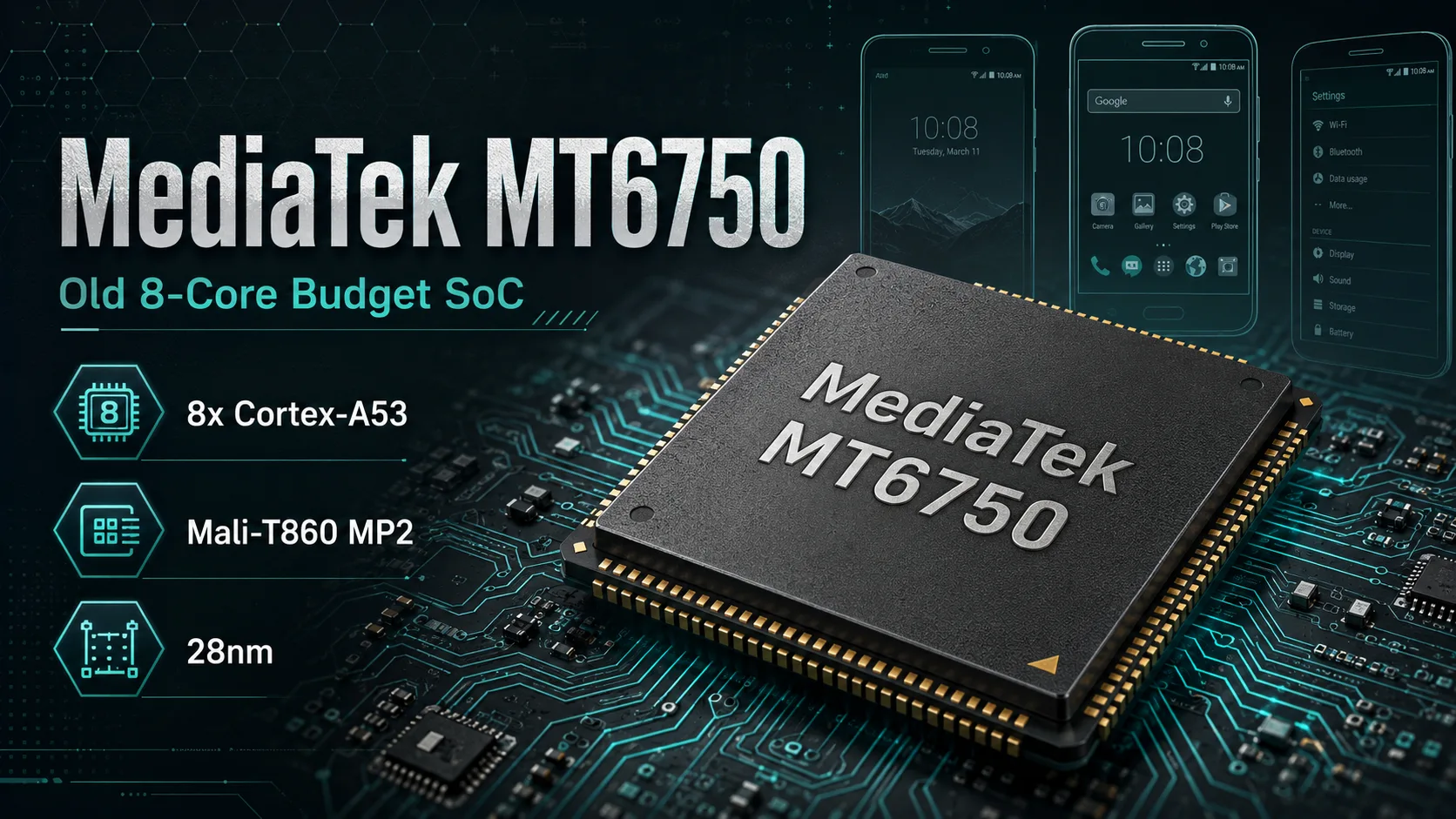
MediaTek MT6750 emerged in 2016, when the phrase "eight cores" itself helped sell budget smartphones. There are indeed eight cores here, but they all belong to the Cortex-A53 architecture: four operate at frequencies of up to 1.5 GHz, while the other four reach up to 1.0 GHz. There is no high-performance cluster, so the number of cores appears more impressive than the actual speed.
The platform includes a Mali-T860 MP2 GPU, LPDDR3 memory, an LTE Cat. 6 modem, and support for cameras up to 16 MP. In the mid-2010s, such specifications were sufficient for cheap smartphones. Today, the capabilities of the MT6750 are limited by its weak single-threaded performance, slow eMMC storage, and outdated Android versions.
Results of Smartphones with MediaTek MT6750
For this platform, it makes more sense to use benchmarks from the time it was relevant. AnTuTu v6 results cannot be directly compared with AnTuTu 10 or 11: the workload set, methodology, and evaluation scale have changed over time.
| Smartphone | RAM | AnTuTu v6 | PCMark Work 2.0 |
|---|---|---|---|
| LG X power2 | 2 GB | 38,547 | 3,191 |
| LG K10 (2017) | 2 GB | 39,063 | 3,167 |
| Honor 6C Pro | 3 GB | 41,203 | 3,009 |
| Gigaset GS370 Plus | 4 GB | 42,909 | 3,394 |
| Doogee BL5000 | 4 GB | 43,679 | 3,254 |
The differences between smartphones are small. Increasing RAM from 2 to 4 GB reduces the number of app reloads, but it does not speed up the processor itself. Results are also influenced by firmware, storage speed, background processes, and manufacturer settings.
Some devices were released with a faster MT6750T variant, so the performance metrics of different models cannot be considered entirely comparable. In individual Geekbench 4 results, smartphones of the MT6750 family scored about 550-700 points in single-core tests and 1800-2700 points in multi-core tests.
Where MT6750 Starts to Struggle
The second four-core cluster helps distribute tasks among threads but does not increase the speed of a single core. It is this weak single-threaded performance that is most felt when launching applications, loading web pages, installing updates, and using the interface.
Calls, music, maps, messaging apps, and simple websites still work well on a functioning smartphone. However, heavy pages and active app switching quickly lead to delays. Variants with 2 GB of RAM are particularly constrained: the system occupies a significant portion of the available memory, and apps are frequently unloaded from the background.
Mali-T860 MP2 Graphics and Gaming
The Mali-T860 MP2 was designed for HD displays and mobile games from the mid-2010s. Casual games and older titles can still function, especially at a resolution of 1280 × 720.
Modern 3D games lack both graphical and processing power. Even at minimal settings, achieving acceptable frame rates is rare. Additionally, outdated drivers and Android versions limit compatibility: some new games do not run on such smartphones.
Manufacturing Process and Battery Life
The MT6750 is manufactured using a 28-nm process technology. This relatively large manufacturing process for today's standards limits the platform's efficiency, particularly under prolonged loads and active mobile network usage.
Among smartphones powered by the MT6750, there were several heavy models with batteries ranging from 5000 to 6000 mAh. A larger battery could provide good runtime but increased the size and weight of the device.
Older reviews showcase the original battery life of these smartphones but say little about the condition of specific used units today. After several years of use, the performance is heavily influenced by battery wear, screen condition, firmware, and background applications.
Age also affects storage. Flash memory degradation, lack of free space, and an overloaded system can make the smartphone even slower than what the processor specifications suggest.
Cameras, Video, and Connectivity
The camera controller is designed for sensors with resolutions up to 16 MP. It supports HDR, electronic stabilization, and various autofocus systems. The actual quality of photos depends on the sensor, optics, and algorithms of the specific manufacturer.
The platform is capable of playing H.265 video at Full HD resolution. Recording in H.264 is limited to 1080p at up to 24 frames per second. For a budget smartphone from 2016, this was sufficient, but today these capabilities seem modest.
The built-in modem supports LTE Cat. 6 with download speeds of up to 300 Mbps and upload speeds of up to 50 Mbps. Features like carrier aggregation, VoLTE, video calls over LTE, and Wi-Fi calling are also claimed. The availability of these functions depends on the firmware, signal bands, and operator support.
Smartphones on MediaTek MT6750
Among the notable models on this platform are the OPPO F3 and A71, vivo V5s, Honor 6C Pro, LG K10 (2017), LG X power2, Doogee BL5000, and Oukitel K6000 Plus.
Manufacturers chose the MT6750 due to its low cost, built-in LTE modem, and attractive eight-core configuration for buyers. The platform was marketed based on core count and feature set rather than high speed.
Is it Worth Using a Smartphone with MT6750 Today?
A functioning device with 3 or 4 GB of RAM can still suffice for calls, navigation, music, and basic messaging. However, for banking apps and regular everyday use, such smartphones are already undesirable.
Most models came out with Android 6 or Android 7 and have long stopped receiving system updates. Some applications are discontinuing support for older system versions, and the lack of fresh security patches becomes more significant than benchmark results.
The low price also does not make such a smartphone an automatically worthwhile purchase. The cost of the device may add expenses for battery replacement, instability of storage, and software compatibility issues.
Conclusion
In 2016, the MediaTek MT6750 was an ordinary mass-market platform with LTE, eight Cortex-A53 cores, and sufficient multimedia capabilities for its class. It lacked a significant reserve of performance even back then, and today the number of cores has completely lost its practical significance.
A smartphone running on the MT6750 can still serve as a calling device, music player, navigator, or backup phone. However, it is no longer advisable to purchase it as a primary phone: slow performance, weak graphics, aging hardware, and outdated Android outweigh any savings.
SOC Comparison
Compare MT6750 with other SOCs
Basic
4x 1 GHz – Cortex-A53
GPU Specifications
Connectivity
Memory Specifications
Miscellaneous
Benchmarks
Compared to Other SoC
Related SoC Comparisons



Share in social media
Or Link To Us
<a href="https://cputronic.com/index.php/soc/mediatek-mt6750" target="_blank">MediaTek MT6750</a>