Unisoc Tiger T610

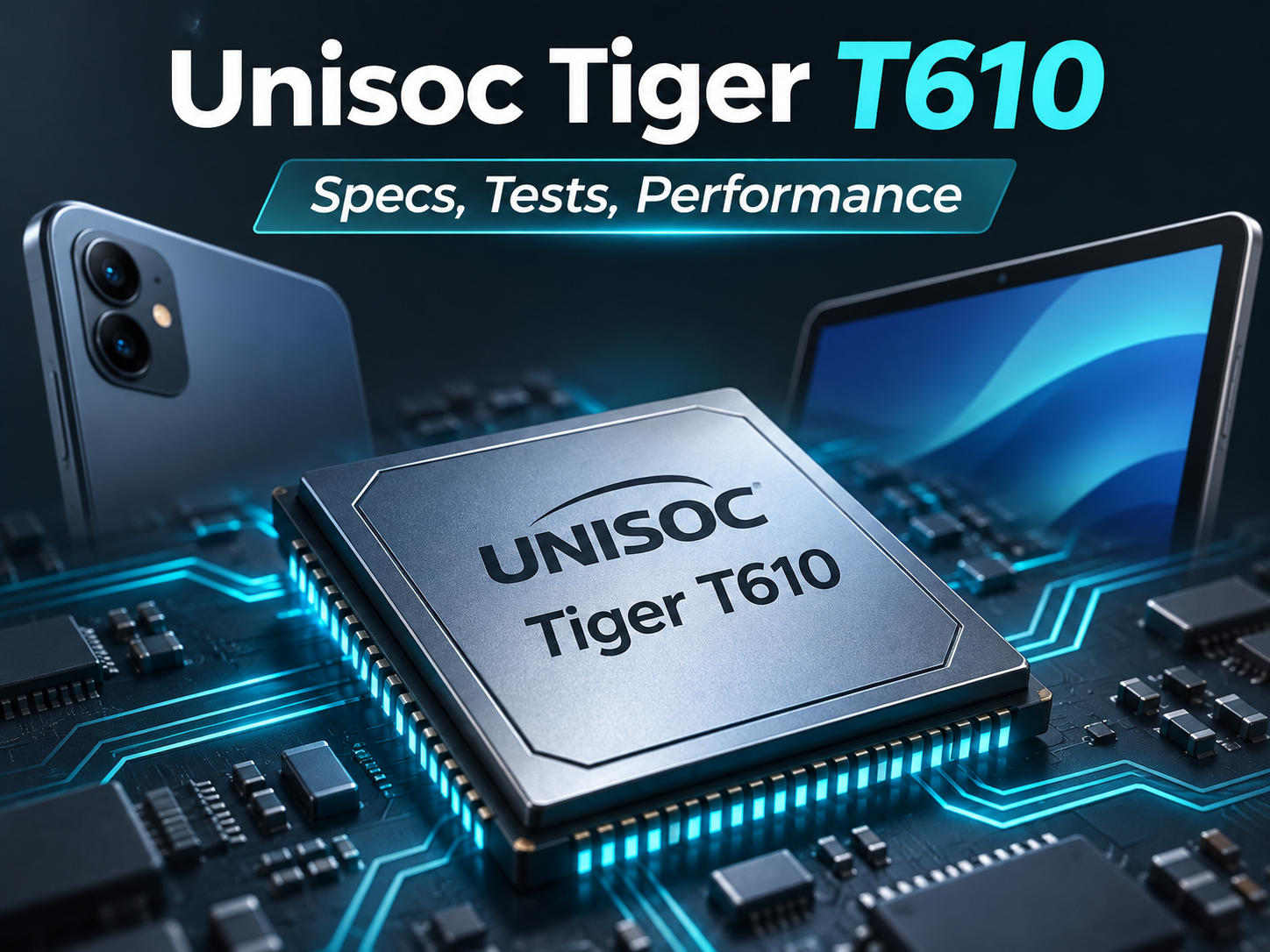
Unisoc Tiger T610: Specifications, Tests, and Performance in 2026
The Unisoc Tiger T610 is an entry-level octa-core mobile processor introduced in 2019. It is manufactured using TSMC’s 12 nm process and combines two performance Cortex-A75 cores with six energy-efficient Cortex-A55 cores. Graphics are handled by the Mali-G52 MP2, with a frequency of up to 614.4 MHz. The chip was used in affordable smartphones and tablets, including the realme C21Y, Nokia T20, and third-generation Lenovo Tab M10.
The processor is designed for everyday Android tasks, while its graphics capabilities limit its use in demanding games.
Benchmarks: Comparing Real Devices
The table includes three devices powered by the Tiger T610 and the Xiaomi Redmi 9 with its MediaTek Helio G80 processor. The tests used were Geekbench 6.4.0, 3DMark Wild Life (Vulkan), and Sling Shot Extreme (OpenGL ES 3.1).
| Device | Processor | Geekbench 6 Single | Geekbench 6 Multi | 3DMark Wild Life | Sling Shot Extreme |
|---|---|---|---|---|---|
| realme C21Y, 4 GB | Tiger T610 | - | - | 526 | 1124 |
| Nokia T20, 4 GB | Tiger T610 | 426 | 1441 | 526 | 1113 |
| Lenovo Tab M10 (3rd Gen), 4 GB | Tiger T610 | 429 | 1458 | 537 | 1117 |
| Xiaomi Redmi 9, 4 GB | Helio G80 | 423 | 1388 | 665 | 1332 |
Geekbench 6.4.0 results are individual published device measurements, not median model scores. The 3DMark results are median values from the UL Benchmarks database. The missing realme C21Y result was not replaced with a measurement from another Geekbench version.
In CPU tests, the Tiger T610 is on par with the Helio G80. For example, the Lenovo Tab M10 scores 429/1458 points, while the Redmi 9 scores 423/1388. The difference is small and does not allow for a confident claim that one processor is faster than the other in every device.
The G80’s advantage is more noticeable in graphics tests. The Redmi 9 scores 665 points in Wild Life, compared with 526-537 for the devices using the Tiger T610. This represents an advantage of approximately 24-26%. In Sling Shot Extreme, the difference is within the 19-20% range.
The results apply to specific devices, so they are also affected by cooling, firmware, and memory configuration. Nevertheless, the Helio G80’s graphics subsystem consistently delivers higher performance in the selected tests.
CPU Architecture and Performance
The Tiger T610 contains eight CPU cores:
- 2 × Cortex-A75 cores clocked at up to 1.8 GHz-for computationally demanding operations.
- 6 × Cortex-A55 cores clocked at up to 1.8 GHz-for less demanding tasks.
In terms of CPU configuration, the processor is similar to the Helio G80, whose two Cortex-A75 cores operate at up to 2.0 GHz. The difference in maximum clock speeds is approximately 11%.
The T610 is generally sufficient for browsing, messaging, streaming video, and standard applications. Difficulties arise when working with heavy web pages, processing photos, and running several resource-intensive programs simultaneously.
Under a high parallel workload, computations are distributed between two Cortex-A75 cores and six less powerful Cortex-A55 cores. This limits multithreaded performance compared with processors equipped with a larger number of fast cores.
Mali-G52 MP2 Graphics and Gaming
The Tiger T610 is equipped with a Mali-G52 MP2 GPU based on the Bifrost architecture. Its maximum frequency is 614.4 MHz.
The Helio G80 uses a dual-block Mali-G52 configuration with a frequency of up to 950 MHz. The GPU’s higher frequency helps explain the G80’s advantage in 3DMark, although performance also depends on other system components.
In Wild Life, devices based on the T610 score around 530 points, which corresponds to modest performance for modern 3D games. Simpler 2D titles usually pose fewer problems, while demanding games require low graphics quality settings.
Display resolution also affects the workload. The realme C21Y has a 1600 × 720 display, whereas the Nokia T20 has a 2000 × 1200 display. At the same internal rendering resolution, the difference may be small, but processing the image at the tablet’s full resolution requires more resources.
3DMark results should not be directly converted into in-game FPS: the actual frame rate depends on the specific game and its settings.
RAM and Storage
The Tiger T610 supports LPDDR3 and LPDDR4/LPDDR4X. LPDDR4X is specified to operate at up to 1600 MHz. The supported standard for internal storage is eMMC 5.1.
Most devices using this processor were released with 3-4 GB of RAM. Configurations with 4 GB are preferable for multitasking, since Android unloads apps from memory more often when less RAM is available.
eMMC 5.1 also limits file-operation speeds compared with faster modern storage. This is especially noticeable when installing apps, copying data, and updating the system.
Cameras and Multimedia
The Tiger T610 includes a three-core ISP. According to Unisoc’s official specifications, the platform supports cameras of up to 32 MP at 24 FPS and displays with resolutions of up to 2400 × 1080.
The hardware video block supports decoding H.264, H.265, H.263, VP8, VP9, and MPEG-4 at up to 1080p and 60 FPS. Encoding support includes H.264, H.265, and H.263 at up to 1080p and 60 FPS.
These capabilities apply to the processor itself. The recording resolution, available codecs, and image quality of a specific device depend on its camera, firmware, and manufacturer settings.
Connectivity and Wireless Interfaces
The Tiger T610 is equipped with an LTE Cat. 7 modem and does not support 5G networks. At the platform level, it supports Wi-Fi 5 (802.11ac), Bluetooth 5.0, and the GPS, GLONASS, BeiDou, and Galileo satellite systems.
However, device manufacturers may not implement all available interfaces. For example, the realme C21Y supports only Wi-Fi 4 (802.11 b/g/n), and its official navigation specifications list GPS, GLONASS, and BeiDou but not Galileo.
Therefore, the wireless capabilities of a specific smartphone or tablet should be checked separately.
Tiger T610 vs. T606 and T612
The later Unisoc T606 and T612 use the same basic combination of two Cortex-A75 cores and six Cortex-A55 cores.
The T606’s CPU frequencies reach 1.6 GHz, while the T612 and T610 operate at around 1.8 GHz. At the same time, the T612 features Mali-G57 MP1 graphics, which differs from the Mali-G52 MP2 in the T610.
The single Mali-G57 MP1 graphics block in the T612 does not automatically mean an advantage over the dual-block Mali-G52 MP2 in the T610.
Is the Tiger T610 Worth Choosing in 2026?
Devices based on the Tiger T610 are suitable for calls, messaging, watching videos, reading, and simple applications. Older tablets using this platform may still be useful for browsing, e-books, and multimedia.
When buying a device, benchmark results are not the only important factors. The amount of RAM, battery condition, and availability of security updates also matter. Software support should be checked particularly carefully for models released in 2021-2022.
Bottom line: The Unisoc Tiger T610 is close to the Helio G80 in CPU performance, but in the graphics tests considered here, devices with the G80 score 19-26% higher. The T610 is still capable enough for everyday tasks. When buying a device for gaming or intensive multitasking, it is worth looking for models with higher CPU and GPU performance confirmed by benchmarks.
SOC Comparison
Compare Tiger T610 with other SOCs
Basic
6x 1.82 GHz – Cortex-A55
GPU Specifications
Connectivity
Memory Specifications
Miscellaneous
Benchmarks
Compared to Other SoC
Related SoC Comparisons


Share in social media
Or Link To Us
<a href="https://cputronic.com/index.php/soc/unisoc-tiger-t610" target="_blank">Unisoc Tiger T610</a>