HiSilicon Kirin 8020
HiSilicon Kirin 8020: Benchmarks, CPU Performance, and Maleoon 920 Capabilities
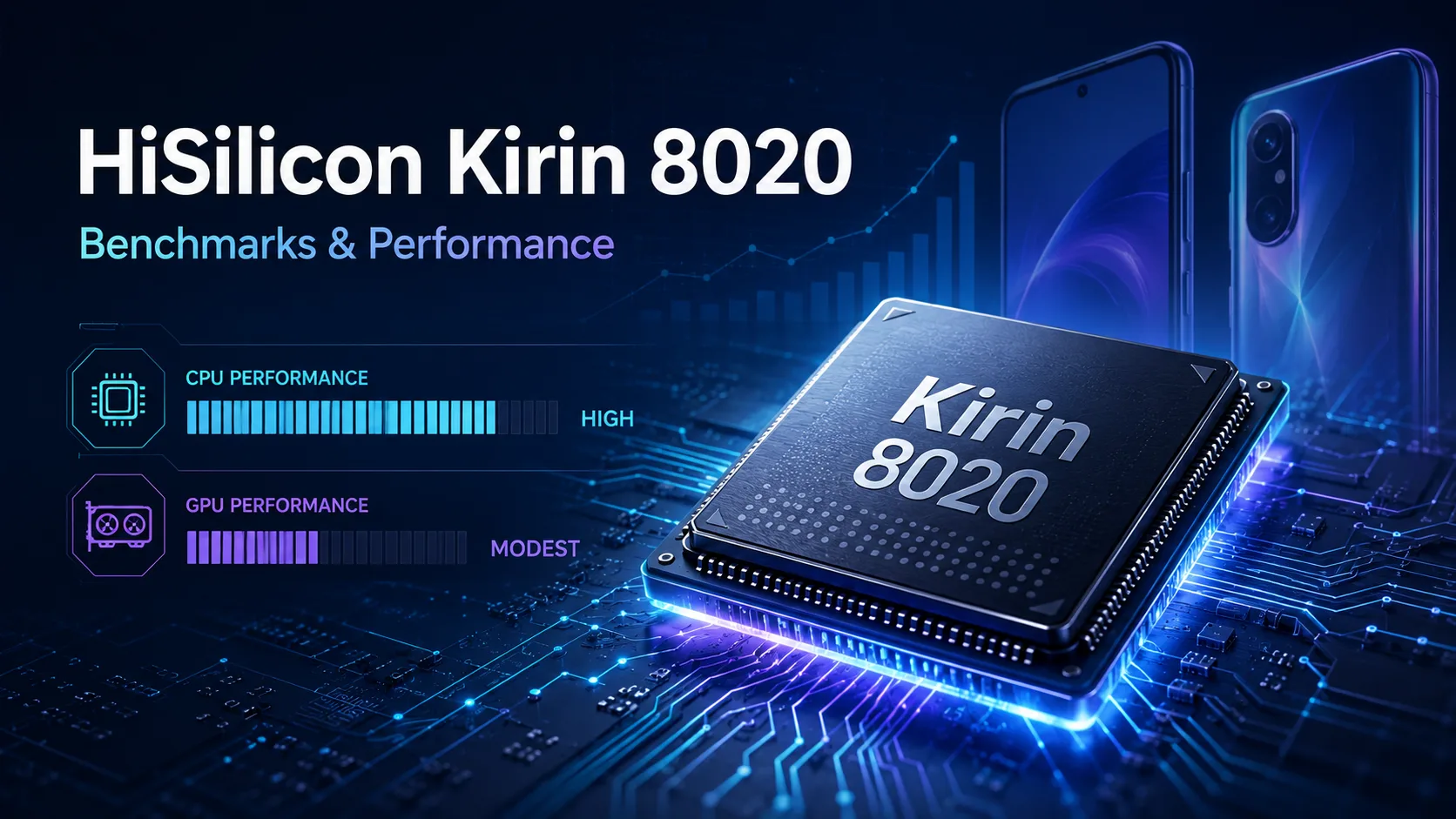
Huawei specifies that the Kirin 8020 has eight CPU cores; however, diagnostic tools can detect up to 12 computational threads. In the Huawei nova 14 Ultra, the processor scores about 1.16 million points on AnTuTu 11 and over 4100 points on Geekbench 6 Multi-Core. The Maleoon 920 graphics are noticeably weaker than the CPU part, particularly evident in demanding games.
Kirin 8020 in Specific Smartphones
The Kirin 8020 is used in several smartphones from the Huawei nova series. This allows for comparisons of its performance in mass-produced devices with different cooling solutions and power limits.
| Smartphone | AnTuTu 11 |
|---|---|
| Huawei nova 14 Ultra | ~1,156,650 |
| Huawei nova 16z | ~1,146,140 |
| Huawei nova 15 | ~1,033,120 |
| Huawei nova 14 Pro | ~1,021,890 |
The difference between the maximum and minimum scores is about 13%. This does not mean that the smartphones use different versions of the Kirin 8020; the results depend on cooling solutions, power limits, firmware, and the device's temperature.
The typical range for the Kirin 8020 is around 1.02-1.16 million points on AnTuTu 11. Results from AnTuTu 10 and AnTuTu 11 cannot be directly compared, as the test versions use different loads and evaluation scales.
CPU: About 4100 Points on Geekbench 6 Multi-Core
In Geekbench 6, the Kirin 8020 scores approximately 1300-1400 points in Single-Core and 4000-4200 points in Multi-Core. For example, the Huawei nova 14 Ultra achieves around 1389 and 4125 points, respectively.
The Kirin 8020 performs best in multi-threaded tests. Its maximum frequency is around 2.29 GHz; however, the high number of concurrently running threads helps with multi-threaded tasks.
Huawei officially calls the Kirin 8020 an octa-core processor. Some diagnostic programs detect up to 12 computational threads. Huawei does not disclose the details of the architecture of these CPU cores, making it incorrect to regard the Kirin 8020 as a typical 12-core processor.
Maleoon 920 - The Main Limitation in Gaming
The graphics are handled by the Huawei-developed GPU Maleoon 920, which operates at a frequency of around 840 MHz.
In 3DMark Steel Nomad Light, the Kirin 8020 scores about 500 points. This is quite modest compared to the CPU results. A high Geekbench 6 Multi-Core score does not imply similarly high gaming performance.
In demanding games, performance primarily hits the limitations of the Maleoon 920. Smartphones with the Kirin 8020 often require lowering graphics quality or rendering resolution more frequently than devices with more powerful GPUs of the same class.
Why the nova 14 Ultra is Faster than the nova 14 Pro
The Huawei nova 14 Ultra can score about 1.16 million points on AnTuTu 11, while the nova 14 Pro is around the 1.02 million mark.
The difference of about 130,000 points demonstrates how much the result depends on the specific smartphone. More efficient cooling helps maintain high frequencies for longer. Energy consumption limits and firmware version also influence the outcome.
When comparing smartphones with the Kirin 8020, not only the characteristics of the SoC but also the cooling and power settings of the specific model are crucial.
How the Kirin 8020 Compares to Snapdragon and Dimensity
With a score of around 4100 points on Geekbench 6 Multi-Core, the Kirin 8020 stands alongside the Snapdragon 7+ Gen 2 and Dimensity 8300.
| SoC | Geekbench 6 Single | Geekbench 6 Multi |
|---|---|---|
| Kirin 8020 | ~1,300-1,400 | ~4,000-4,200 |
| Snapdragon 7+ Gen 2 | ~1,700 | ~4,400 |
| Dimensity 8300 | ~1,400 | ~4,300 |
The advantages are distributed differently: the Kirin 8020 is especially strong in Multi-Core, while competitors are faster in Single-Core and graphics tests.
The main gap with competitors is in graphics performance. The Maleoon 920 significantly lags behind the Adreno and Mali/Immortalis GPUs found in modern Snapdragon and Dimensity processors of this class.
Conclusion
In terms of CPU performance, the Kirin 8020 is on par with strong mid-range solutions: about 4100 points on Geekbench 6 Multi-Core and 1.02-1.16 million points on AnTuTu 11 in mass-produced smartphones.
The main compromise is the graphics of the Maleoon 920. In CPU tests, the Kirin 8020 is close to the Snapdragon 7+ Gen 2 and Dimensity 8300, but its GPU is notably weaker.
For regular applications and multitasking, such a balance does not create serious problems, but when choosing a smartphone primarily for gaming, the weak graphics of the Kirin 8020 become its main disadvantage.
SOC Comparison
Compare Kirin 8020 with other SOCs
Basic
GPU Specifications
Connectivity
Memory Specifications
Miscellaneous
- AIFF
- CAF
- MP3
- MP4
- WAV
- H.265
- VP9
Benchmarks
Compared to Other SoC
Related SoC Comparisons



Share in social media
Or Link To Us
<a href="https://cputronic.com/index.php/soc/hisilicon-kirin-8020" target="_blank">HiSilicon Kirin 8020</a>