HiSilicon Kirin 9010

HiSilicon Kirin 9010: Performance, Benchmarks, and Architectural Features
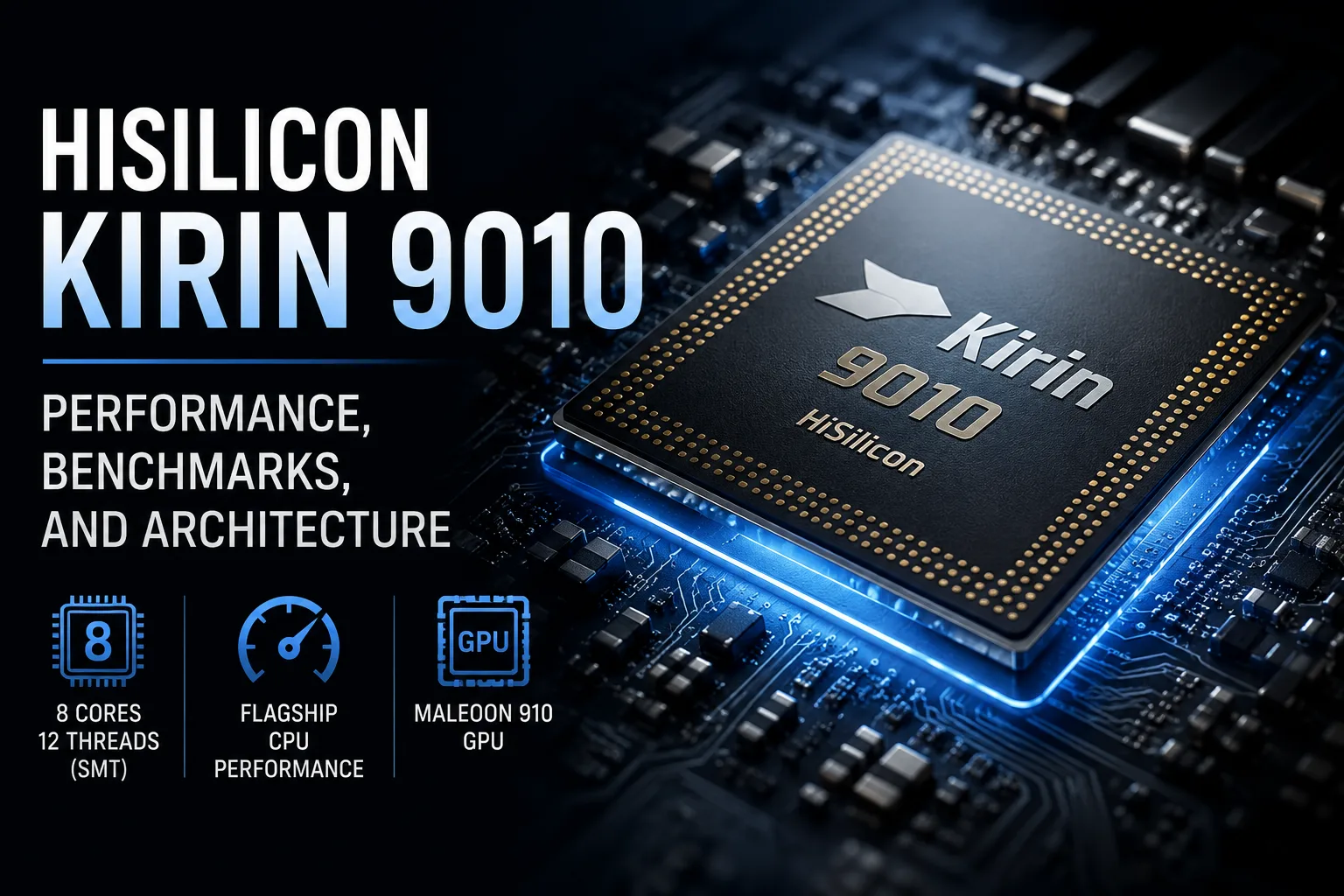
The HiSilicon Kirin 9010 is Huawei's flagship SoC, used in the higher-end models Pura 70 and the foldable Mate XT. Its main feature is 8 physical CPU cores and 12 threads thanks to SMT on the TaiShan cores. The processing part of the Kirin 9010 appears stronger than the graphics, but overall, the chip falls short compared to flagship Snapdragon and Dimensity chips from the same period.
8 Cores and 12 Threads: How the CPU is Structured
The CPU part of the Kirin 9010 consists of three groups of cores:
- 1 × TaiShan V121 with a frequency of up to 2.3 GHz;
- 3 × TaiShan V121 up to 2.18 GHz;
- 4 × Cortex-A510 up to 1.55 GHz.
Physically, this is an octa-core processor. The four TaiShan cores support simultaneous multi-threading, allowing the system to identify 12 logical threads. This is why the Kirin 9010 is sometimes mistakenly referred to as a 12-core processor.
The chip is manufactured by SMIC using the 7nm N+2 process. In some directories, there is mention of 5nm, but a chip analysis confirms the use of SMIC's 7nm technology.
Compared to the Kirin 9000S, clock speeds have increased, but the Kirin 9010 has not received a fundamentally new CPU architecture.
CPU Performance
In Geekbench 6, smartphones powered by the Kirin 9010 typically score around 1350-1450 points in single-thread mode and 3700-4500 points in multi-thread.
Single-thread performance lags behind contemporary flagship Snapdragon and Dimensity chips. However, the situation is better in multi-threaded scenarios: SMT support helps the Kirin 9010 utilize the four TaiShan cores more efficiently.
For the interface, browser, and most applications, the CPU performance is sufficient without noticeable delays. The gap from newer flagship SoCs becomes more apparent in heavy computing tasks and during prolonged loads across all cores.
Kirin 9010 Benchmarks in Specific Smartphones
The performance of the same SoC can vary depending on cooling, power settings, and firmware, so it is more useful to compare the results of specific devices.
| Device | Geekbench 6 Single | Geekbench 6 Multi | AnTuTu |
|---|---|---|---|
| Huawei Pura 70 Pro | 1420 | 4264 | 1,136,063 (v11) |
| Huawei Pura 70 Ultra | 1421 | 4323 | 1,155,792 (v11) |
| Huawei Mate XT Ultimate | 1354 | 3719 | 865,285 (v10) |
The difference between the Pura 70 Pro and Pura 70 Ultra is minimal: both smartphones use the same configuration of the Kirin 9010.
The Mate XT shows a lower multi-threaded result. This may be due to cooling and power consumption limitations in its thin foldable design.
The AnTuTu result for the Mate XT is provided only as a reference: AnTuTu 10 and AnTuTu 11 cannot be directly compared by score.
Maleoon 910 - The Weak Spot of Kirin 9010
The graphics are handled by the proprietary GPU Maleoon 910. It is primarily the graphical component that separates the Kirin 9010 from competing flagship platforms.
The Huawei Pura 70 Ultra scores around 1500-1600 points in 3DMark Wild Life Extreme Unlimited. This is significantly lower than the performance of Snapdragon 8 Gen 2 and Snapdragon 8 Gen 3, and in some tests, the result is even lower than that of some less expensive Qualcomm platforms.
In regular applications, the difference is hardly noticeable. However, in heavy games at high settings, it becomes much more apparent: Maleoon 910 significantly lags behind flagship Adreno GPUs in performance.
Heating and Performance under Sustained Load
The 7nm SMIC process lags behind modern 4nm and 3nm platforms in energy efficiency. Therefore, under continued load, the performance of the Kirin 9010 is more reliant on the smartphone's body and power limits.
The Pura 70 Pro and Ultra show higher results than the Mate XT, but the difference cannot be attributed solely to cooling. Performance is also influenced by firmware, thermal constraints, and power consumption settings of the specific device.
Smartphones with Kirin 9010
The Kirin 9010 is used in several high-end Huawei smartphones:
- Huawei Pura 70 Pro;
- Huawei Pura 70 Pro+;
- Huawei Pura 70 Ultra;
- Huawei Mate XT Ultimate Design.
However, the base Huawei Pura 70 uses the Kirin 9000S1, so it is incorrect to categorize the entire Pura 70 lineup under the Kirin 9010.
Conclusion
The Kirin 9010 stands out with its unusual 8 physical cores and 12 threads for smartphones. SMT particularly helps in multi-threaded tasks, while single-thread performance remains relatively low.
The main performance gap with competitors lies in graphics: the Maleoon 910 significantly lags behind the GPUs of flagship Snapdragon chips from its generation.
The Pura 70 Pro and Pura 70 Ultra stay competitive as flagships due to their cameras, displays, and construction, but not because of the SoC performance. For heavy gaming, the Kirin 9010 is weaker than leading Snapdragon and Dimensity chips of its time.
SOC Comparison
Compare Kirin 9010 with other SOCs
Basic
4x 1.55 GHz – TaiShan V121
6x 2.18 GHz – Cortex-A510
GPU Specifications
Memory Specifications
Benchmarks
Compared to Other SoC
Related SoC Comparisons



Share in social media
Or Link To Us
<a href="https://cputronic.com/index.php/soc/hisilicon-kirin-9010" target="_blank">HiSilicon Kirin 9010</a>